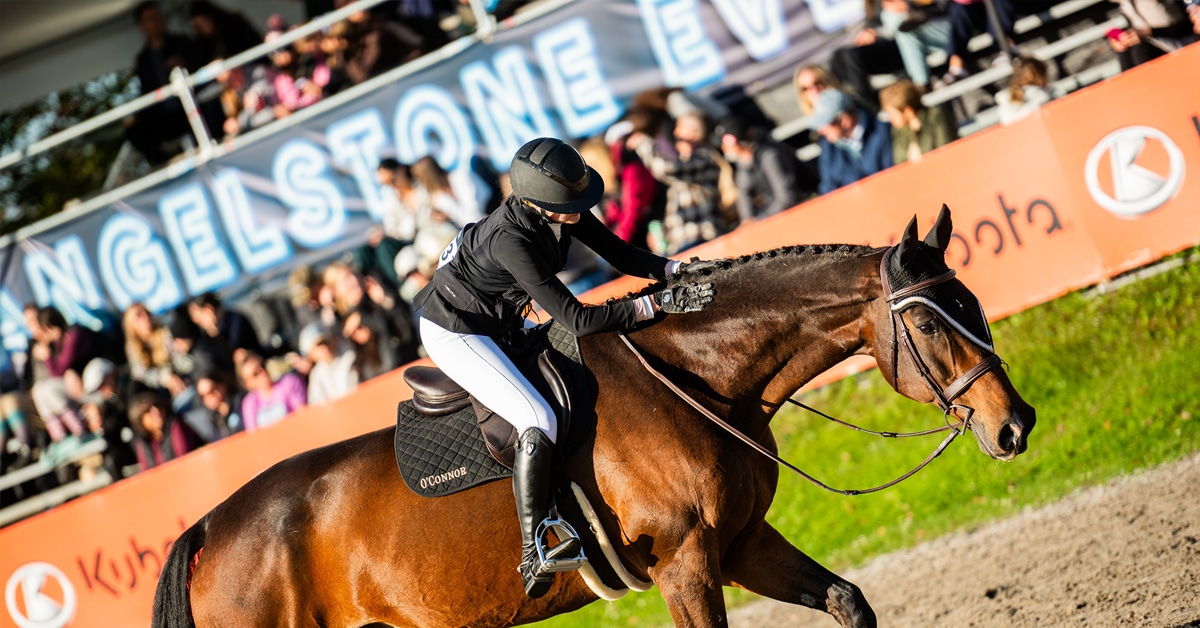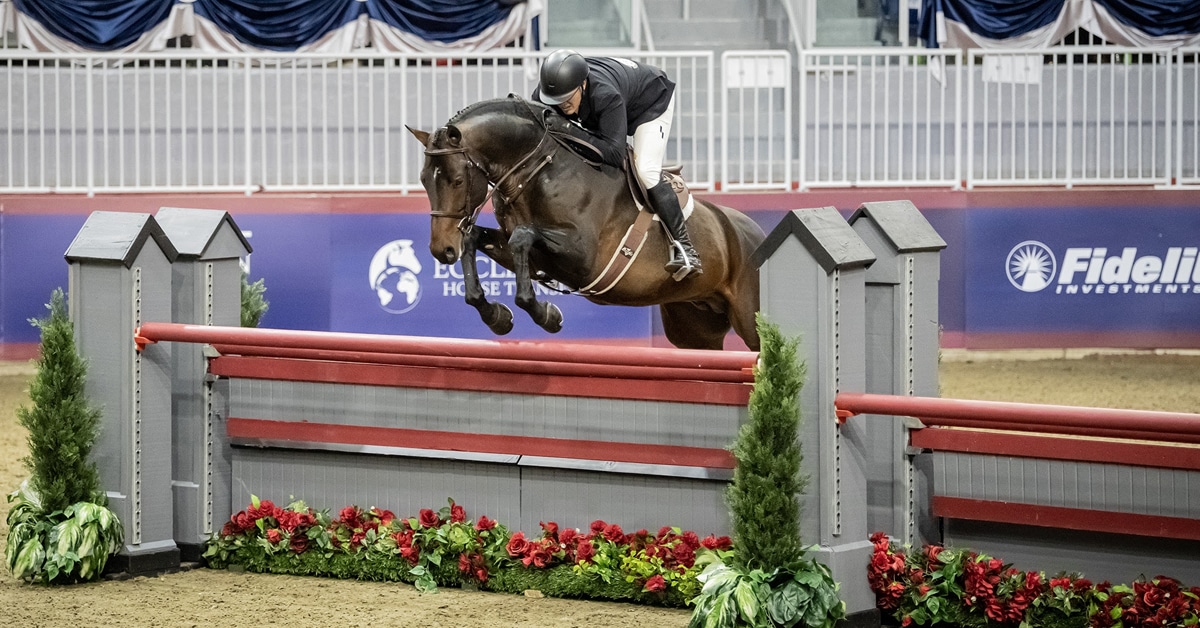
Kristjan Good has earned a reputation as a Canadian ‘derby whisperer’ and a king of the hunter ring. His talents were on full display at the 2025 Royal Horse Show in Toronto in November, where he won the Braeburn Farms Hunter Derby and Knightwood Hunter Derby with Levi VDL, owned by John Kimmel, and claimed the Canadian National Championship (Combined Hunters) with Louis DelSignore’s Case Closed. He also piloted Ulla Brooks’ Ascot Noir to the win in the Lieutenant Governor’s Cup.
Currently, Good is busy training future hunters and derby horses at his Kristjan Good Show Stables in Campbellville, ON, teaching his own students and giving riding clinics at other barns. We asked him to share advice he gives on preparing to ride derby courses, and exercises he uses and teaches at clinics.
Successful derby riding is all about making the quality of jump the top priority, Kristjan says. The next priorities are straightness and rhythm, as those two elements are key to setting up turns. At clinics, he introduces one element at a time, such as a jump to a turn, building progressively until the end when riders tackle a whole course.
What Makes a Derby Horse?
“You need a really good hunter to begin with,” says Good. “For Canadian hunter derbies, you can take an equitation-type horse and do well. It should be a brave one with good style. For the American derbies, you need a true hunter, through and through. It needs good rhythm across lines and must jump impressively. In a way, you’re looking for a fancy failed jumper.”
Derby horses should be careful as well as brave, but not so careful that they’ll get scared if they knock a jump. They also need to be careful enough to read the difference in heights of jumps. “And you want a big canter, a big, big step.”
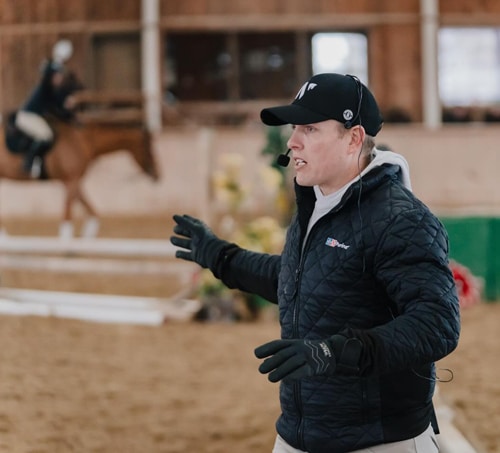
Kristjan teaching at a recent derby clinic at Rougemont Equestrian Park. (Kristjan Good Show Stables Facebook)
More Pace
“The most common thing I see is riders going too slowly, without enough pace. At a clinic, I start by asking riders to warm up on the flat at the trot and canter,” Kristjan says.
“You’ve got to go forward, and typically, I always ask for more pace at the beginning than most riders are comfortable with. Most people usually worry about finding a distance first, when they should be more concerned about the pace.”
Leg, Not Hand
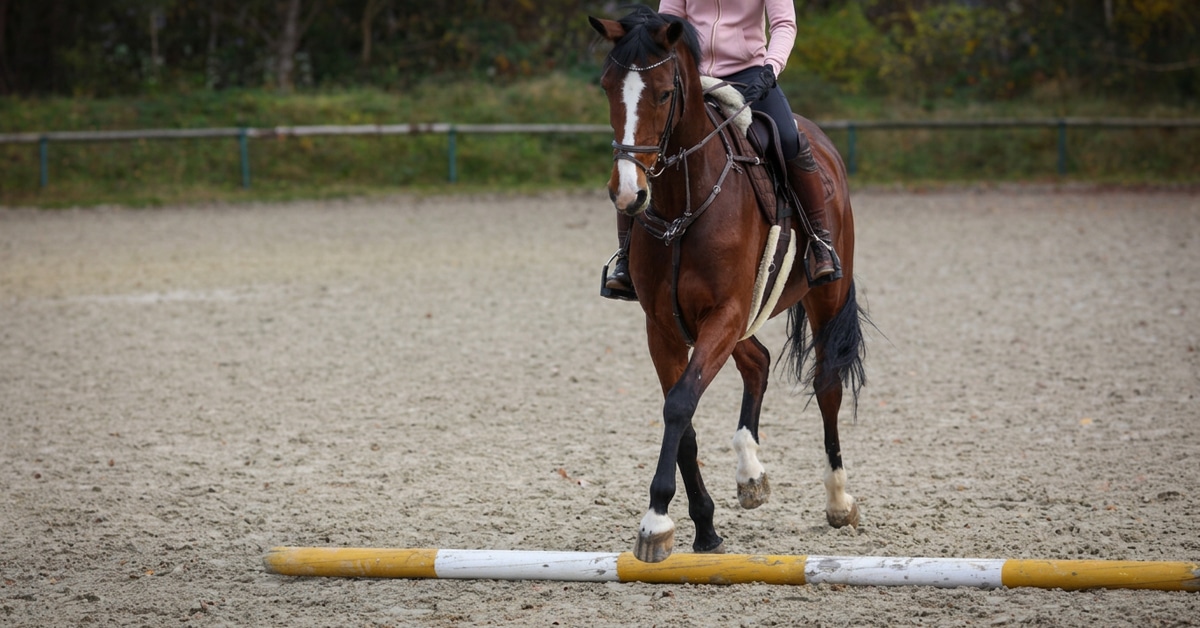
It’s human nature to try to control a horse with hand rather than leg, but that tends to interfere with pace and a horse moving forward, he notes. An exercise Kristjan often uses requires two cavalettis, with a quiet five-stride line in between. This exercise will also help with pace.
“Do the quiet five, then a four-stride, then a six, and play with stride,” he suggests. Try to ride the exercise using little hand and more leg.
“I’m a fan of leaving out and adding strides on a line. Most of it is a feel that you can’t teach. You either have it, or you don’t. You can practice it, but you have to feel it.”
Kristjan incorporates a lot of gymnastics into his own training program and that has a double benefit: it helps to develop a horse’s jump technique and confidence over fences, and requires a rider to rely more on leg than hand. A typical grid for a green horse might be a trot approach to an X, followed by a small vertical, and an oxer as the out. Or it could be a bounce, bounce, one-stride, two-stride, or trot in to a one-stride, two-stride, two-stride line.
Common distances would be nine to 10 feet from a trot pole to an X; nine to 10 feet between bounces; 18 to 21 feet for a one-stride between verticals and 19 to 22 feet from vertical to oxer; 33 to 36 feet in a two-stride distance. These are based on a typical 12-foot stride and may vary slightly based on the horse’s stride and the fence height.
Keep jumps low and sessions relaxed, says Kristjan, as the objective is to build, not shake a horse’s confidence.
Turn Signals
“Riders tend to worry too much about turns,” he says. Good likes to set a single jump, or a couple of jumps, in the middle of the ring perpendicular to the long sides of the arena, as an exercise to teach the horse to follow the rider’s cues to turn. After coming up the middle of the ring, jumping and landing, the rider can ask the horse to turn left or right.
“You shouldn’t take the jump at too much of an angle. Wait for a stride or two after the jump to make the turn. It’s more fluid if you wait for two strides to turn. If you have a good hunter score, a judge will give handy points if it looks smooth.”
The same advice applies when it comes to inside turns. Riders may want to do them to get a good handy score, but don’t attempt such turns unless you have them mastered. “If you do an inside turn and it’s perfect, it’s great, but if it’s not, they [the judges] will kill you in the score.”
Bending Lines
Many hunter riders are used to riding straight or diagonal lines, and may be unfamiliar with broken lines they’ll encounter on a derby course.
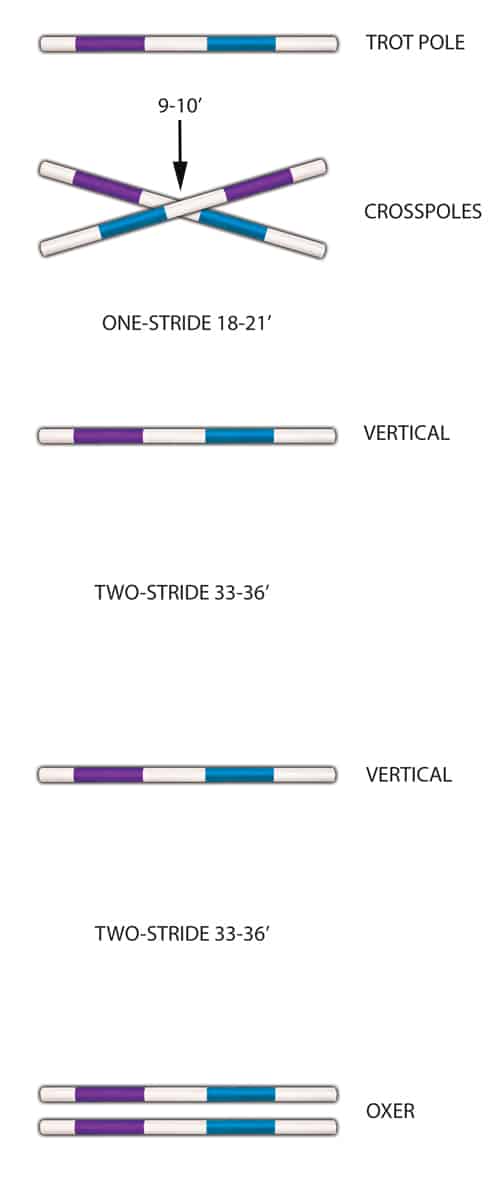
A simple trot-in exercise to a one-stride, two-stride, two-stride line.
“It’s almost like a jumper round,” Kristjan advises. “You may have a six-stride broken line, with three strides off a turn. It’s a mentality thing – you have to focus on one jump at a time. A lot of people try to mash it all together, rather than taking it one jump at time.”
In clinics, he sets an exercise such as the six-stride broken line. “I want to see how smooth the riders can make it. They tend to be long at first, as they or the horse are not looking through the bending line. You have to get the horse moving off your leg and going forward to make the shape.
“I often will do a lot of weird bending lines to teach the horse to think about the jump that’s coming.”
Rollbacks are another element in derby courses, and Good initially teaches riders to ride them at the walk, and walk with them. He will put a pole on the quarter line perpendicular to the long arena wall, about mid-way. He’ll ask the horse and rider to ride up the quarter line, go over the pole, execute a teardrop-shaped turn, then ride the opposite direction over the pole. This is another exercise that requires the rider to keep the horse going forward once they are cantering the rollback.
The Course Walk
When walking the course, be mindful of your horse’s strengths and weaknesses, and to know where the jumps are. Make a plan.
“A rider should never be afraid to resort to Plan B if the initial plan doesn’t work out. For instance, if a horse jumps farther out than expected so can’t turn where you planned, you have to turn farther out,” says Kristjan.
“Some people get stuck on sticking to their plan, but you have to adopt on the fly.” Kristjan says relaxed, confident riders tend to do the best. He says it’s a mental game, and if a rider makes an error, such as a bad distance, ride on and don’t be rattled, as mistakes do happen.
Good luck and good riding this derby season!
The Latest