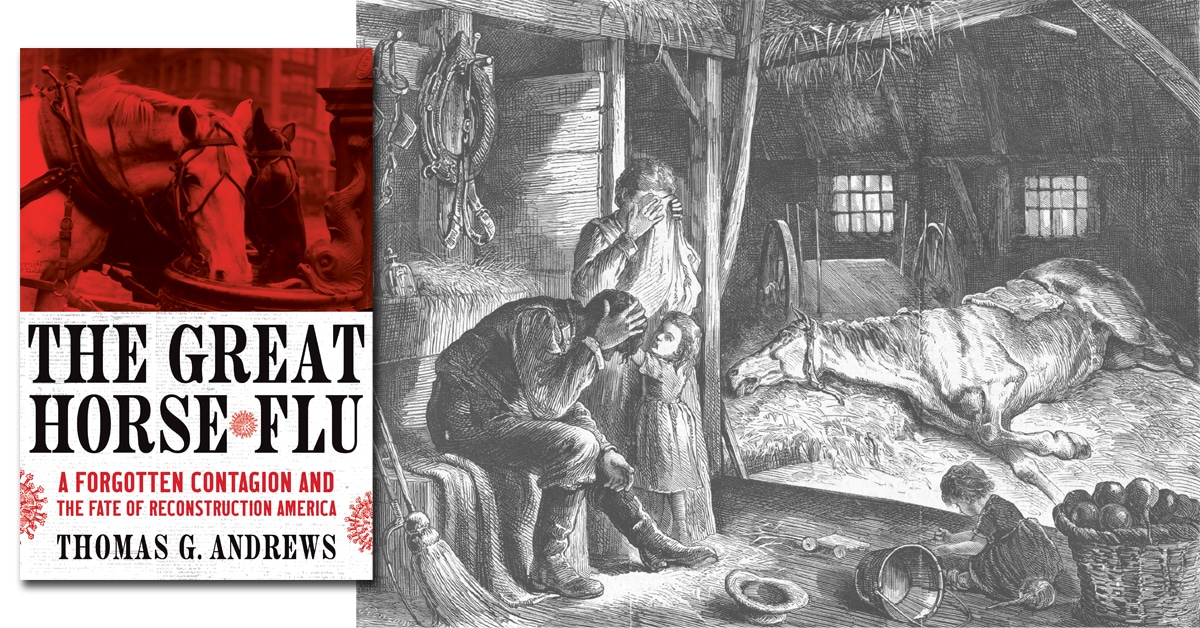
An exclusive excerpt from Thomas G. Andrews’ upcoming book, ‘The Great Horse Flu: A Forgotten Contagion and the Fate of Reconstruction America’
***
This book tells the story of one of the strangest contagions ever recorded. More than a century and a half ago, what I call the Great Horse Flu began to ravage North America. In an outbreak that raged from fall 1872 to late 1873, a powerful new viral variant beset millions of horses, donkeys, and mules (collectively known as equines) throughout most of the present-day United States as well as large swaths of Canada, Mexico, Cuba, and Central America before dissipating into British Columbian forests and Nicaraguan jungles. Because people in all these places depended on equines to drive their lives and economies, the Great Horse Flu caused profound disruptions.
The ensuing chaos casts a more illuminating light on the societies this plague preyed upon. By depriving North American communities of motive power for weeks at a time, the outbreak exposed just how fully humans across the continent had grown to depend on the labors of illness-prone animals.
It also prompted searching discussions regarding the nature of infectious diseases as well as what, if anything, people might owe to the equines they called their own.
As folks struggled to make do and get by without the work that ailing or recuperating equines could no longer do, they unwittingly sparked other problems. If history teaches us anything, it is that one crisis soon begets others. As those of us who lived through the COVID pandemic know all too well, contagions, whether among humans or the animals we call our own, have the capacity to cause troubles that can go on to activate other calamities. In the early 1870s no less than in the present day, viruses and other scourges possessed the power to shunt individual and collective lives onto unexpected and often unwanted trajectories. The story of the Great Horse Flu thus offers an illustrative chapter in the ancient yet also all-too-present dynamics by which humans, the creatures we hold closest, and the pathogens that circulate between us and them continually make and remake what we call history.
 This continent-conquering malady first entered human awareness in the countryside north of Toronto, Ontario, where farm horses pastured on late summer grasses started falling ill in September 1872 with fever and respiratory complaints. In the first widely disseminated account of the outbreak, Andrew Smith, a graduate of the world-famous Edinburgh veterinary college in his native Scotland and Ontario’s leading authority on equine health, observed in the Toronto Globe that these horses’ woes began with “a watery discharge from the nose, speedily followed by a severe hacking cough; the pulse is quickened, the mouth hot, the nasal membranes” reddened to a crimson hue, “and the ears and legs are unnaturally cold; the discharge from the nose increases, and becomes of a greenish-yellowish color; the breathing is increased and in some cases becomes labored and severe.” Hundreds of other accounts penned in the ensuing year detailed similar or identical symptoms. In the worst cases, patients could muster neither the will nor the energy to do anything but stand in their stalls “as if benumbed or paralyzed.” Days after farmers first noticed the illness running amok among horses outside Toronto, the Great Horse Flu began racing through Canada. Before long, Montreal’s horse-powered street railways suspended operations, “farmers in the country” found themselves “unable to bring grain to market,” and nearly every horse in Ottawa seemed to be ailing. “The progress of the disease since first heard of in Toronto,” a newspaper in the Canadian capital declared, “has been so astonishingly rapid that from every town and village in Ontario, as well as many places in Quebec, the same cry is sent forth.”
In mid-October, the equine plague began pouring over the international border, invading New England and Upstate New York despite a US Treasury Department ban on importing Canadian horses who showed clear signs of illness. Just days later, with nearly all of Buffalo’s equines on the sick list, a journalist observed that “the extent of mankind’s dependence upon equine assistance is being vividly brought to view.” In Rochester, two coroners “called upon to extricate the body of a drowned man” from the Erie Canal realized that with their horses ill, they had no way to cart off the deceased until “a bright idea struck one of them, and fastening a rope to the corpse they towed it, with the aid of a fishpole, a distance of several blocks.” They then plucked the body from the water and carried it to “the dead house” under their own steam.
A few weeks later, with the outbreak extending its reach throughout the Northeast, the New York Herald marveled at “the singular spectacle of a great city almost at a standstill,” with “thousands of persons, male and female, young and old,” now “unable to reach their homes after a day of toil except on foot.” In Lower Manhattan, “an ominous quiet” descended. Even Broadway, one of world’s busiest thoroughfares, suddenly fell “motionless, dumb, paralyzed.” On New York’s piers and wharves, “goods of all descriptions” accumulated “promiscuously” in piles “reaching to the height of ten or fifteen feet, completely hiding the river from view.” Hundreds of longshoremen, who could neither load nor empty ships without equine assistance, soon found themselves jobless and “penniless.” Up the Hudson in Newburgh, masons, carpenters, and other tradesmen who relied on horses “to draw sand, brick, and other building material” also faced slowdowns and layoffs, while New York’s “theatre and amusement managers” complained “of a perfect dearth of customers; and the playhouses, concert and lecture halls” all “reveal[ed] a disagreeable paucity of attendance.”
The pestilence ripped across vast stretches of North America with disquieting haste and thoroughness. “No sooner does one horse become affected,” an agricultural magazine pronounced, “than within twenty-four hours three-fourths of all the horses in the place are down with it.” The disease, another journalist marveled, “seemed to act by some malignant spell, prostrating equine victims by the thousand almost on the very instant of its appearance.” The Great Horse Flu “apparently required no time for development,” but instead was “born full-grown” with the capacity to sicken “the whole fam-ily” of equine creation all at once. In the face of this “pitiless malady,” “the submissive, patient, hard-worked carthorse, the magnificent, sleek-coated, high mettled charger, and the blooded racer” had all “gone down together.” With the outbreak expanding across a seven-hundred-mile front stretching from Maine to Ohio, traffic on Northeastern canals ground to a halt; loggers in the “lumbering districts north of Saginaw” all but stopped their preparations for Michigan’s upcoming logging season; and the Hartford Courant claimed that “a horse in the streets” had become “a rare sight.” Farmers, meanwhile, complained that the flu was “greatly hindering the work of . . . harvesting” crops and throwing “a serious obstacle in the way of all kinds of business.” Intent on isolating their equines from the fast-spreading plague, many countryfolk made the hard decision to put off their regular shopping trips to town until the malady relented.
By early November, the Great Horse Flu had spread to Halifax; Quebec City; Concord, New Hampshire; Philadelphia; Baltimore; Washington, DC; Norfolk, Virginia; Pittsburgh; Cincinnati; and Chicago. “All the horses in the city are sick,” complained the Chicago Evening Post, and had “disappeared from the streets.” The disorder, the same article continued, “comes upon them with the suddenness of a flash of lightning. No sooner do they trot from the barn than they commence running at the nose.” The only silver lining, the Evening Post concluded on November 2, was that “the poor beasts don’t die.” Subsequent events, though, disproved this hopeful prognosis. On November 6, the outbreak claimed the lives of ten Chicago horses. The next day, thirty more succumbed. By the time the plague finally moved on in early December, an estimated 561 of the city’s roughly 24,000 equines had breathed their last. Although one paper reasoned that this was “a remarkably low death rate when it is borne in mind that nearly all the horses and mules in the city were affected,” hundreds more horses would go on to die from the lingering effects of the malady and its complications.
By hobbling equine-powered production and exchange throughout the continent, the outbreak augured deeper ills. Chicago’s real estate market grew “dull.” Realtors in Indianapolis griped that “suburban property” there was “selling slowly” because the flu outbreak made it harder to bring potential buyers to inspect empty lots on the city’s outskirts. Railroads confronted “a general depression” as investors steered clear of their “securities, owing to the reduced business on account of the epizootic [a sweeping eruption of illness among other-than-human animals].” As the outbreak extended its reach to rural areas where farming, logging, mining, and stockraising predominated, some commentators even started to worry that flu-fueled disruptions might prompt additional contractions in the nation’s already stringent money supply, with potentially disastrous consequences for the American economy.
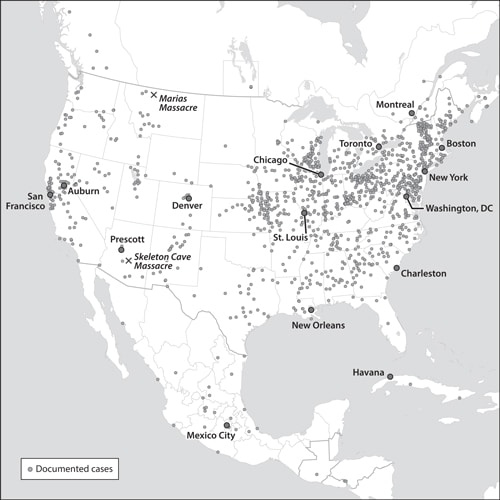
Fast forward to fall 1873, and the Great Horse Flu had permeated most of North America. It penetrated virtually every settled region in Canada, which had just confederated five years earlier (Prince Edward Island, which had joined that nation in July 1873, somehow eluded its ravages). It also attacked virtually all of the United States, from the nation’s largest metropolitan regions to its least populated rural reaches. It hit the North as well as the recently defeated Confederacy, then struck the West’s embattled Indigenous Nations as well as the US-Mexico borderlands.
While the Great Horse Flu moved across the United States and Canada like a wave, its movements proved more finicky in Latin America. The scourge reached most large towns and cities in Mexico but steered clear of the Yucatán, Baja California, and several other areas. In Cuba, where a coalition of planters, enslaved peoples, and others had been waging a desperate rebellion against Spanish colonial rule since 1868, the pestilence reserved its worst for Havana and scattered other locales. Few documents detail the outbreak’s closing throes after it pushed from Mexico to Guatemala and Nicaragua, but the Great Horse Flu clearly had difficulty tracking down new hosts in Central America—probably because the region’s rugged topography, tortuous transportation routes, and disjointed economies kept equine populations there more isolated than integrated.
In all these domains, the outbreak sometimes jumped to nonequine hosts. Newspapers from many parts of North America alleged that poultry, hogs, and other barnyard and household animals had contracted it. They also published hundreds of reports of humans falling ill with flu-like symptoms not long after the equine plague reached their communities, sparking localized infection hot spots and even occasional fatalities.
***
From The Great Horse Flu: A Forgotten Contagion and the Fate of Reconstruction America. Copyright © 2026 by Thomas G. Andrews. Published by the University of North Carolina Press. Used by permission of the publisher.
Pre-order your copy of the book, to be published in October 206, HERE.
Include this code for 30% off from UNCPress.org: 01UNCP30
The Latest