
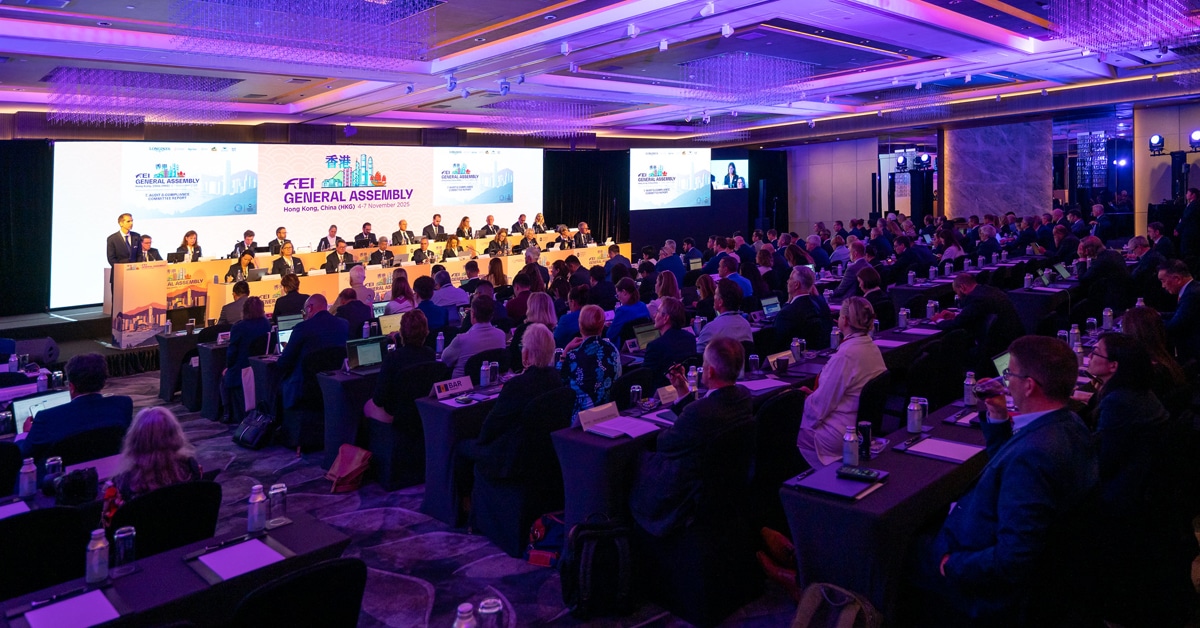
Whenever there is a controversial decision at an FEI General Assembly (GA), there’s a tendency to blame scores of smaller countries for swinging the vote the “wrong” way.
The GA is the annual session where new rules are approved, and 135 member national federations have one vote each. This means that Haiti and Ethiopia – and many others who’ve been inactive internationally despite decades of FEI membership – have equal influence over FEI rule-making to Canada, the USA, Germany, Great Britain and all other major players.
This alleged imbalance is being discussed again following last month’s GA in Hong Kong, particularly because of two decisions. One was the election of the relatively unknown Russian-Palestinian Diana Al Shaer to chair the powerful FEI dressage committee at such a critical time; she trounced Klaus Roeser, a huge name in dressage governance by 46 votes to 28 – to Roeser’s own astonishment and that of many others. (Neither candidate, by the way, has said much about their hopes for welfare and social licence.)
The other was approval of new Jumping Rule Art 259 (the “blood rule”) that drew saturation media coverage, passed by 56 votes to 20.
Elizabeth Max-Theurer, former Olympic dressage champion, international judge, president of the Austrian federation and board member of the European Equestrian Federation (EEF), weighed in on voting rights over Art 259, in interviews in the Austrian and German press.
The entire EEF has 59,096 FEI registered horses (of which France alone accounts for 11,255), 28,136 athletes and 42 votes. The rest of the world has 18,541 horses, 13,785 athletes, but 92 votes. “This is absurd. Countries without significant equestrian activity decide on regulations that affect the core of our sport,” said Max-Theurer. “I’m not questioning the vote itself – but the structure behind it. This has nothing to do with real democracy.
“We urgently need a reform of the voting system. The international ski federation FIS has shown the way: there, the votes are weighted according to the size and importance of the associations.” She articulated what many probably think, but dared not utter, in the GA debating chamber: “Animal welfare is a very important factor in Europe, thank God. But in many [FEI] voting countries, human rights are not a high priority – and animal welfare is probably not at all, or even less so.”
According to FEI statutes, voting at the GA should be a “show of hands.” But during the Covid-19 pandemic, the GAs were held online so electronic and hence confidential voting was employed. This practice has stuck, because some NFs still join in online.
How each NF votes is confidential, and the FEI won’t give me a full list of Hong Kong attendees until publication of GA minutes next month.
Is it fair to blame solely the “minor” NFs for “skewing” the vote in Hong Kong? After all, some major nations revealed they had supported Art 259, while tiny Chinese Taipei announced it would vote against. But as for the rest, we may never know. (Fifty of the 135 member NFs didn’t bother to attend even online or appoint a proxy – participation is dropping year by year since the pandemic and if this trend continues, FEI will struggle to reach quorum.)
We can identify some participants from already published minutes of FEI regional meetings in Hong Kong. Eighty-four NFs were represented either in person or by weblink, and this appears to include at least 22 with mostly zero or, at best, two or three FEI-registered horses, from Africa, the Caribbean and territories of the former USSR. So a minimum of 26% of voting power in Hong Kong will have been held by the near-inactive nations. I expect that percentage to increase when we eventually see who was there from the Middle East, Far East, and Oceana.
Does this matter? Surely it means that important decisions, especially on horse welfare, are moderated by the good sense of countries with no vested interests? It’s a noble thought. But in reality, the smaller countries will either be persuaded by robust, in-person lobbying, or simply go along with the recommendation of the FEI board.
The first stand-out decision “swung” by smaller NFs that apparently did not understand the bigger picture came in 2009 with a vote to reintroduce a tolerance of the controversial anti-inflammatory ‘bute’. This was bounced onto the agenda at the Copenhagen GA, one of the stranger initiatives of the then FEI president, HH Princess Haya. Her vice-president, Sven Homberg, resigned in protest. After immense push-back the vote was reversed by the FEI board through its rarely used special powers.
The more recent decision that was allegedly swayed by minor NFs was the three-to-a-team, no-dropscore format for the Olympic Games, approved at the 2017 GA in Montevideo. The improved chance of Olympic participation was over-sold to smaller NFs because while regional quotas were adjusted to help more countries “qualify”, the Minimum Eligibility Requirement (a competence certification) remains hopelessly out of reach if a rider’s experience is largely around two-star level.
The no-dropscore format has not increased the number of “flags” as much as hoped, while exposing some sub-standard horses and riders to risk of injury over Olympic jumping and cross-country tracks, and putting others in a dilemma when they must strive to complete “for the team.”
In 2022, former Equestrian Canada CEO Akaash Maharaj claimed that as chair of the FEI’s constitutional working group in 2011, he was dissuaded from looking at voting share.
Even if it wanted to change it, FEI is seemingly stuck with this voting system; changes to statute must be passed by a two-thirds majority vote, and who will vote for their own disenfranchisement? All that’s been achieved from recent interventions is an “associate” tier with no immediate voting rights on sport rules until the country has reached “development goals”; it was not enforced retroactively and so applies only to Nepal which joined in 2021 and still has no horses.
In our 2022 interview with Akaash Maharaj, HorseSport listed FEI member countries by year of joining. Countries with a handful or no horses at all are mostly from the 33 joining in the past 35 years. Here is an update: the first figure shows horses registered at the end of 2021 (by which time many NFs were back to pre-pandemic numbers) and the second figure is horses registered in 2025. There is a net increase in countries with no horses, up to 32 from 30.


