A growing body of scientific evidence by prominent international veterinarians and researchers suggests that bits used by top-level competitors, and especially double bridle bits, can cause discomfort and pain in competition horses.
Behavioral indicators of pain caused by bits, such as tension and resistance, and indicators of physical harm, including blue tongues, the compression of facial and oral tissues, and restricted airways, is being more commonly recognized by equestrians everywhere.
Amid the increased awareness of ridden horse welfare and the rise of alternative horsemanship and training practices, bitless riding has become an appealing avenue for equestrians looking to ensure the comfort of their horses while also increasing the bond of trust and communication between horse and rider.
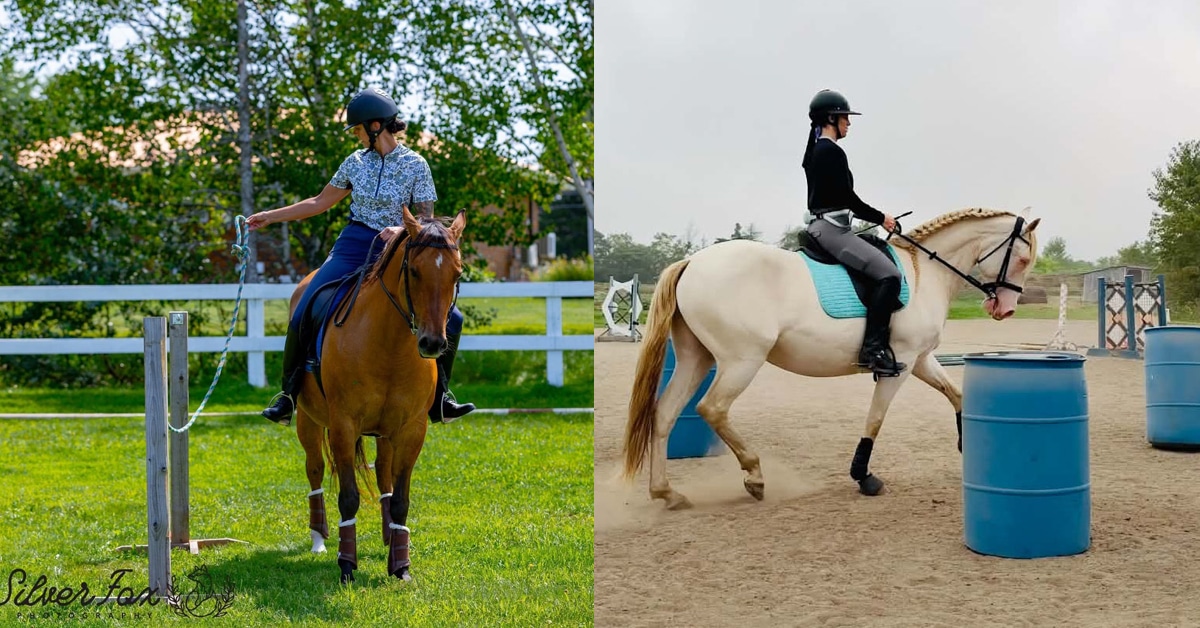
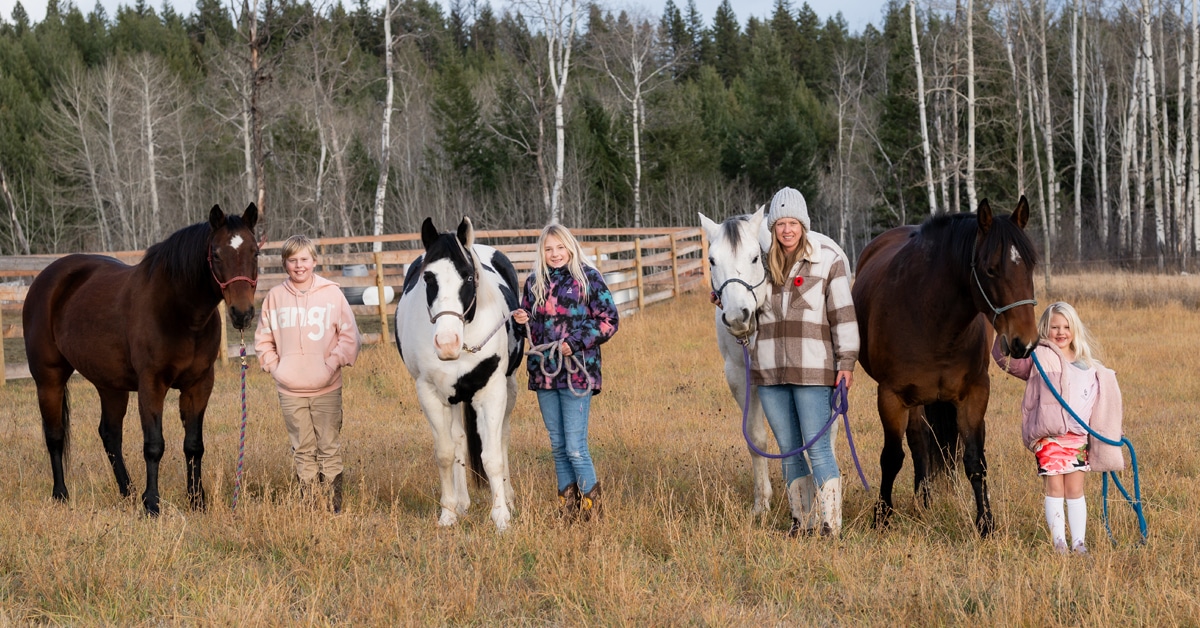
Pam Allen-LeBlanc, owner and proprietor of the alternative horsemanship hub Hidden Brook Farm, has been training, riding, and coaching bitless for almost 20 years. In addition to running what might be one of the only bitless riding schools in the country, she has also coached her farm’s team of riding school students to compete bitless at local and provincial 4H shows.
“I really believe getting the bit out of the way…allows us to move deeper into our connection [with horses],” Allen-LeBlanc told HorseSport.com from her 80-acre farm in the Nashwaak Valley of Durham Bridge, New Brunswick. “It’s not the only thing, but it’s the beginning. When the bit’s not there, the horse isn’t distracted, and appreciates the consideration.”
She spoke with HorseSport.com about how she got started in the world of alternative horsemanship, her training methods, and the hurdles she overcame to ensure her students could compete bitless.
Showing with a Bitless Riding School
When Allen LeBlanc began her journey into alternative horsemanship, she had already had decades of experience in traditional horsemanship under her belt. Her 40 years working with horses includes certification as a Pony Club coach and CANTRA therapeutic riding coach. She also has a Bachelor of Science in agriculture from McGill, and a Master of Business from the University of New Brunswick. Before opening up her lesson barn, she had successful career in business and government.
She had already been considering bitless training when she discovered the work of Dr. Robert Cook. Cook, who passed away in 2025, was a veterinarian and Professor of Surgery Emeritus at Tufts University. His extensive research and writings about how traditional bits and bridles can be physically and mentally harmful resulted in his creation of the popular Bitless Bridle™, which Allen-LeBlanc sometimes uses with her own horses.
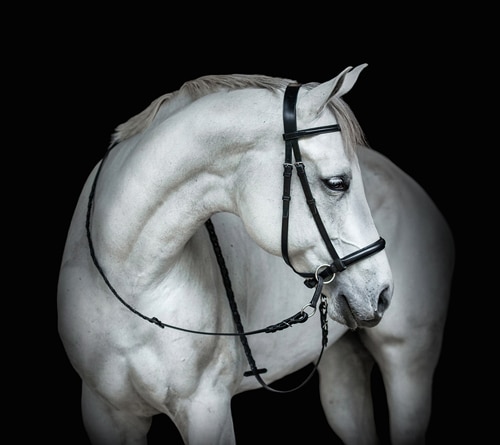
A Dr. Cook English bitless bridle. (bitlessbridle.com)
Cook’s work appealed to Allen-LeBlanc’s scientific, analytical mindset by providing research-based evidence on how traditional bridles affect the sensitive nerve structures in the face, heads, and mouths of horses.
“I couldn’t unlearn that,” Allen-LeBlanc said. “I thought, ‘I’m training horses using a rope halter, and they’re listening when they don’t know anything, so why do I have to teach them to put a bit in their mouths later on?’ It didn’t make any sense.”
When Allen LeBlanc acquired two untrained horses she intended to train with her young daughters, she took it as an opportunity to start them bitless.
“I was already working to adapt my training methods to ensure that they worked with the physiology and instincts and behaviours of horses, so it was a natural step to say ‘let’s keep going like this.’ Why do we need to cause them pain?’” said Allen-LeBlanc.
After becoming more comfortable with bitless training, Allen-LeBlanc took one of her daughters in a 4H Club leadline class with a horse that had been trained bitless. The judge told her that her daughter would have placed high in the class, but she was unable to award her higher marks because her horse had been bitless.
When Allen-LeBlanc approached her 4H Club to ask if the rules could be amended to allow bitless showing, she was surprised to encounter pushback from both other members and the club’s leadership.
“Usually one or two people would get very vocal about how it just wasn’t done, and just wasn’t acceptable, that it was dangerous, and I was being irresponsible,” said Allen-LeBlanc.
She spent several years providing the club with information about the science of bitless riding, and the safety of the training, but still the club wouldn’t budge, voicing safety concerns. It wasn’t until another member involved in cattle showing intervened at a meeting and said that she had recently ended up in the hospital after a ride with her own horse, who’d had a bit in his mouth at the time.
“People listened to her,” Allen-LeBlanc said. “It went to a vote, and it passed.”
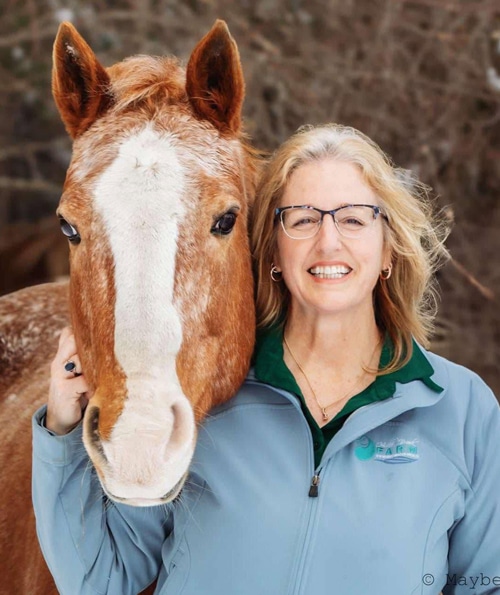
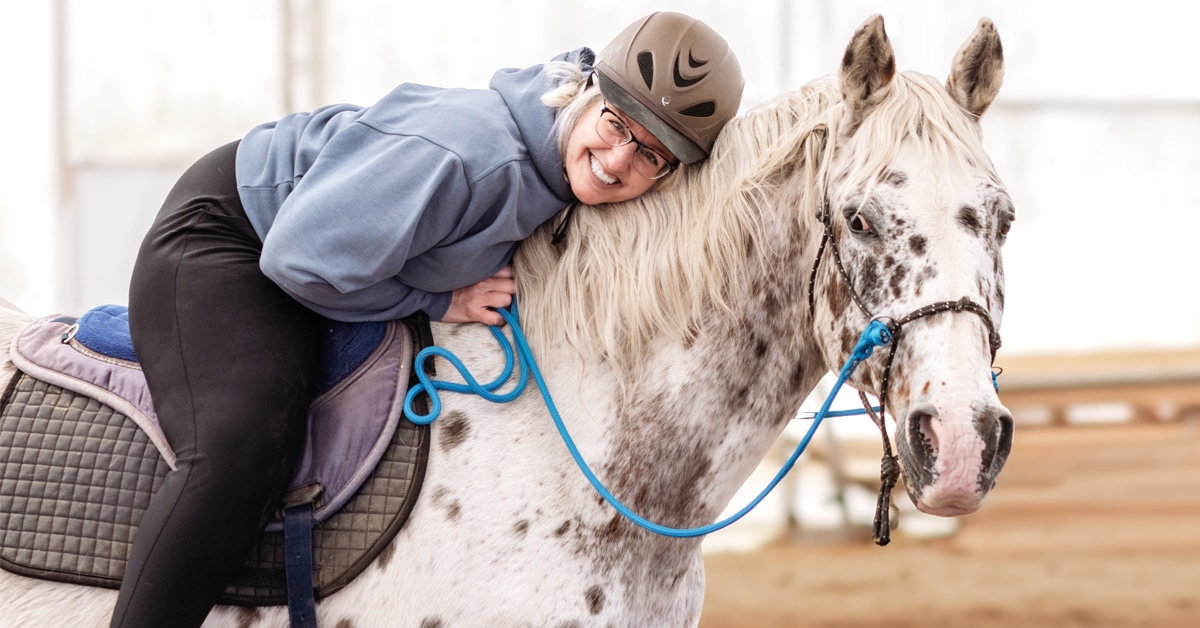
Pam Allen-LeBlanc.
Allen-LeBlanc’s riders were allowed to show in a separate equitation class for bitless riding with bitless bridles. In the first year, three or four other competitors from other clubs joined the dozen-or-so riders from Allen-LeBlanc’s barn. In subsequent years, the class continued to grow, and other clubs began offering bitless classes as well.
“We’ve created a community and a culture here,” said Allen-LeBlanc. “I would love to see it spread.”
(Ed. note: FEI regulations regarding bitless bridles vary significantly depending on the discipline. Bitless bridles and hackamores are allowed in show jumping and endurance, but currently prohibited in international dressage competitions, although some countries are beginning to allow bitless bridles at the lower levels. In eventing, bitless bridles may be allowed in certain phases, but are prohibited during cross-country, and in driving, they are prohibited when a horse is harnessed to a carriage. In 2023, the World Bitless Association made a formal request to the FEI to allow bit-free bridles in FEI competition, particularly dressage. And taking it one step further, in the UK they are now holding bridleless dressage and jumping competitions!
Training Bitless
Allen-LeBlanc’s bitless training depends on a unique blend of alternative horsemanship techniques she has cultivated by combining bitless riding, human and animal Reiki, animal communication, and Centered Riding.
She was initially drawn alternative horsemanship training methods when she tried Monty Robert’s join-up techniques with a problem horse. Join-up involves free-lungeing in a round-pen and practicing subtle cues to establish communication horses understand instinctively.
“It worked really well, and it improved our relationship, so I thought ‘there’s something here,’” Allen-LeBlanc said. “It led me to meeting Monty Roberts, Pat Parelli, John Lyons, Guy McLean, and my personal favourite, Mark Rashid. I read everything they wrote, and I went to their clinics. I really started paying attention to what was available and I would bring it home and try it.”
When Allen-LeBlanc expanded her lesson barn to meet demand in 2009, lessons became less about equitation, and more about learning how horses could teach students to listen, and the ways this could help students in everyday life.
In 2010, she began learning animal communication, a path that caused her to focus even more on training methods from the horse’s perspective. Animal communication involves the intuitive or psychic understanding of the thoughts, emotions, and past experiences of horses.
After beginning work with Reiki, or energy healing, in 2011, she later became the first International Center for Reiki Training licensed Reiki Master in Canada. She now uses Reiki as a vital part of her work with humans and horses, incorporating it into her training techniques. In 2022, she authored The Reiki Business Book, and she is one of the co-authors of the ICRT Animal Reiki Training book.
In 2013, she became a certified Centered Riding Instructor. Centered Riding, developed by the late ground-breaking trainer Sally Swift, teaches classical principles of riding through body awareness. Allen-LeBlanc found Swift’s techniques demonstrated how it was just as important to train riders to listen and communicate as it was to train horses.
“When I train my riders with body awareness, soft eyes, and breath principles we use in Centered Riding, it encourages the connection,” said Allen-LeBlanc. “I typically work with students on their own body awareness and mind awareness and having an awareness of their instincts. When you do that…you can do a lot with energy.”
Slowly, she began blending her horsemanship techniques. She found Centered Riding went hand-in-hand with Reiki energy work.
“You can do a lot with thoughts and clear intentions,” she said. “It’s incredible, when you’re breathing, when you’re eyes are soft, when your body is in a neutral position, how that energy can translate. I would get students into a neutral position that would not impact the horse, and we would experiment with moving energies through the reins with clear thoughts.”
During this time, Allen-LeBlanc was also experimenting with alternative saddlery.
“We worked to find saddles that worked for the horses. They liked synthetic saddles that were lightweight and less stiff,” she said.
Lessons often involved bareback riding, or riding with a supportive, stirrup-less bareback pad, or treeless endurance saddles. On distance rides and at shows, she found horses were more comfortable with treeless endurance saddles or lightweight Wintec saddles.
After receiving interest from others who wanted training for their horses, Allen-LeBlanc began to combine what she had learned in week-long bitless training camps where between 8-14 owners would work with their own horses. The training camps ran for about 14 years, pausing only when Covid happened.
The training camps involved join-up, animal communication, Reiki, and work with essential oils. Training began with basic groundwork for all horses, whether they were being introduced to saddles and riders for the first time, or going bitless for the first time. As horses and riders progressed, desensitization training with an obstacle course was introduced. The horses also had daily practice with trailer loading.
“By the end of the week, the relationship had shifted so much. It was all so gentle and easy and beautiful,” said Allen-LeBlanc. “I think that following the methods we did, including bitless…led to a closer relationship with [the horses]. And with that relationship they became our teachers. They taught us and showed us so much.”
Tips for Trying Bitless Riding
Allen LeBlanc said the transition to bitless riding might be easier than riders with traditional training might assume. She cautions it’s important to be confident and comfortable in a trusting relationship with your horse before trying bitless riding.
Before she introduces her horses and riders to bitless riding, she always makes sure the pair has very solid groundwork cue basics. She also always teaches the one-rein stop, first on the ground and then while riding. The one-rein stop involves pulling a single rein towards the hip to bend the horse’s head close to the stirrup.
“It moves them into a muscle memory so if you ever do need to stop, it pulls them out of the reactive fight-or-flight mode and pulls them back into the thinking mode and you can regain control,” said Allen-LeBlanc.
She also advises riders understand the action of the bitless bridle they’ve chosen, including where the pressure points lie and how the bridle creates leverage.
Lastly, for safety reasons, she recommends trying bitless riding for the first time in a smaller enclosed paddock or arena.
Allen-LeBlanc says riders who experiment with bitless riding might gain more than just a practice of alternative horsemanship. Learning to listen to horses and to themselves often helped her riders notice changes in other aspects of their lives, like leadership and confidence.
“Horses have shown us a different way of being, of living our lives, that’s more in harmony with the world around us and the creatures around us,” said Allen-LeBlanc.
“I think bitless riding, among other things, is a way of approaching horses from their perspective, and I think that’s one of the reasons it’s so successful. When we consider their perspective instead of our own, it’s so much easier to create that symbiotic relationship.”
The Latest