Horse owners are often taught to watch for obvious signs of discomfort such as pinned ears, tail swishing, bucking, or resistance under saddle but what if we could pick up on much more subtle clues, before the escalation into displays of discomfort?
A University of Guelph study of riding lesson horses suggests that tiny changes in facial expressions may provide valuable insights into how horses experience their work and interactions with riders. Equine Exercise Physiology PhD student, Aveil Oberhammer used EquiFACS (Equine Facial Action Coding System) to examine lesson horses before, during, and after riding lessons. EquiFACS is a standardized system that records specific facial muscle movements. Rather than assigning emotions, it simply documents what facial muscles are doing and allows researchers to investigate what those movements might mean.
‘Chewing’ is often assumed to indicate relaxation, but current evidence suggests it may function as a self-soothing behaviour that helps horses regulate their emotional state.
This approach differs from the Horse Grimace Scale, which was developed specifically to identify signs of pain. The Horse Grimace Scale scores features such as ear position, tension around the eyes, nostril shape, and muzzle tension to create an overall pain score. EquiFACS, by contrast, captures a much broader range of facial movements and can be applied in many different situations, including communication, attention, learning, and welfare research.
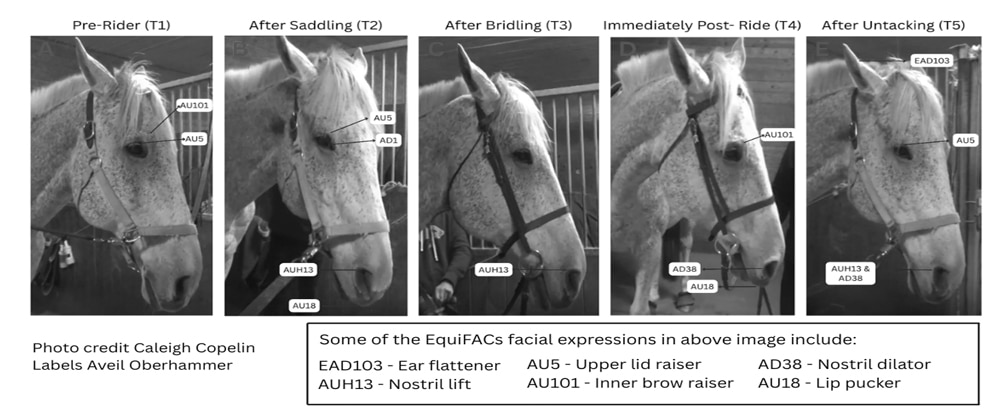
Some of the facial expressions observed included raised eyelids, tension above the eyes, ear movements, nostril dilation, and oral behaviours such as chewing or lip movements. Interpreting these expressions is not always straightforward. For example, chewing is often assumed to indicate relaxation, but current evidence suggests it may function as a self-soothing behaviour that helps horses regulate their emotional state. Nostril dilation may reflect physical exertion, heightened attention, or anticipation, depending on the context.
“You need to be very observant,” said Oberhammer when asked about the learning curve to use the EquiFACS facial action coding system. “I think doing it live versus recorded is a very different experience. It’s a lot harder to do live, especially for facial actions where it’s just like a lip twitch. You also have to know is the lip twitching backwards or upwards because that’s a different score and it’s hard to see in the moment.”
Oberhammer had the benefit of being able to hit rewind as the video footage for her study was captured in another University of Guelph study in Dr. Caleigh Copelin’s research on lesson horses in Canada.
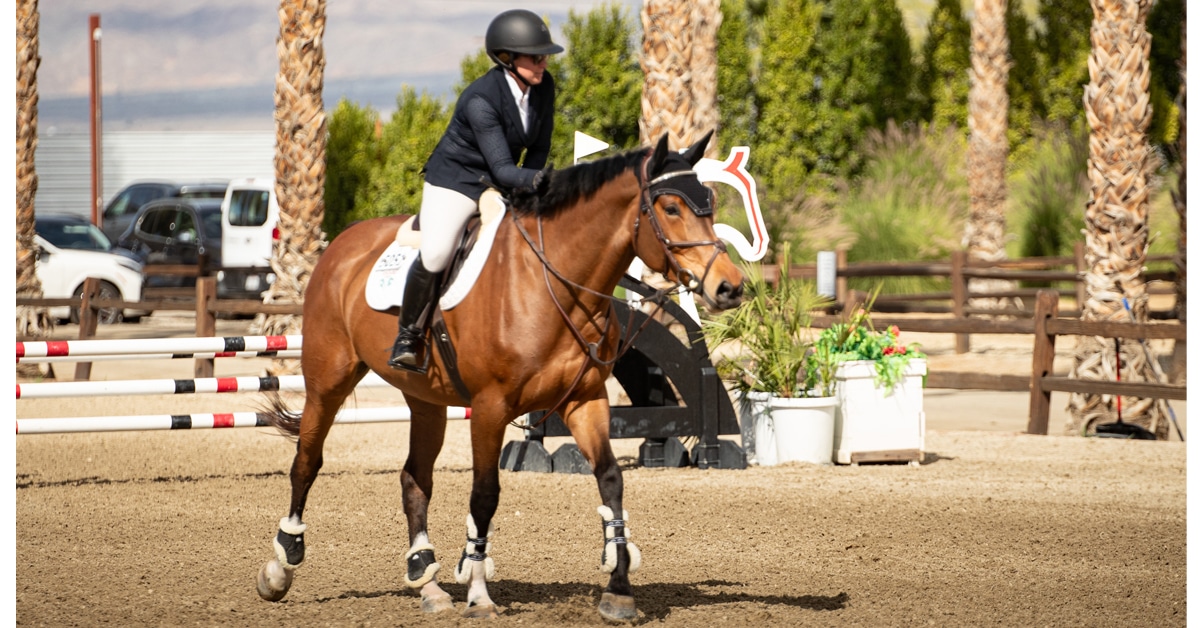
The findings challenge some common assumptions about lesson horses. While many people view beginner lessons as less demanding than advanced riding, the horses’ facial expressions did not differ significantly between rider skill levels. This suggests that riding with novice students may not necessarily be easier for horses than working with advanced riders.
Horses are constantly trying to understand what a rider is asking, and unclear timing or conflicting signals can create additional cognitive demands.
Oberhammer explained one of the questions the research was seeking to investigate, “We wanted to know if horses are actually coping better with beginner riders and if beginner lessons were less physically or psychologically demanding on them, or if that’s really just a misconception.”
One factor identified was the mental effort required to interpret inconsistent rider cues. Horses are constantly trying to understand what a rider is asking, and unclear timing or conflicting signals can create additional cognitive demands.
One particularly intriguing finding involved horse experience. Less-experienced lesson horses appeared more responsive to beginner riders, showing facial movements associated with heightened attention and vigilance. These horses may be actively trying different responses in an effort to please the rider, even when the rider’s cues are unclear. More experienced horses, however, seem to learn that poorly delivered cues have little meaning. Rather than repeatedly guessing what is being asked, they may simply wait until a rider provides a clearer signal.
“We know that horses learn from trial and error,” says Oberhammer “If they don’t associate a certain cue with a positive outcome, they might just do nothing.”
One takeaway is that good horsemanship is not just about giving cues. It is about giving clear, timely cues that make sense to the horse. In learning theory, releasing the pressure of a cue in a timely fashion is very important.
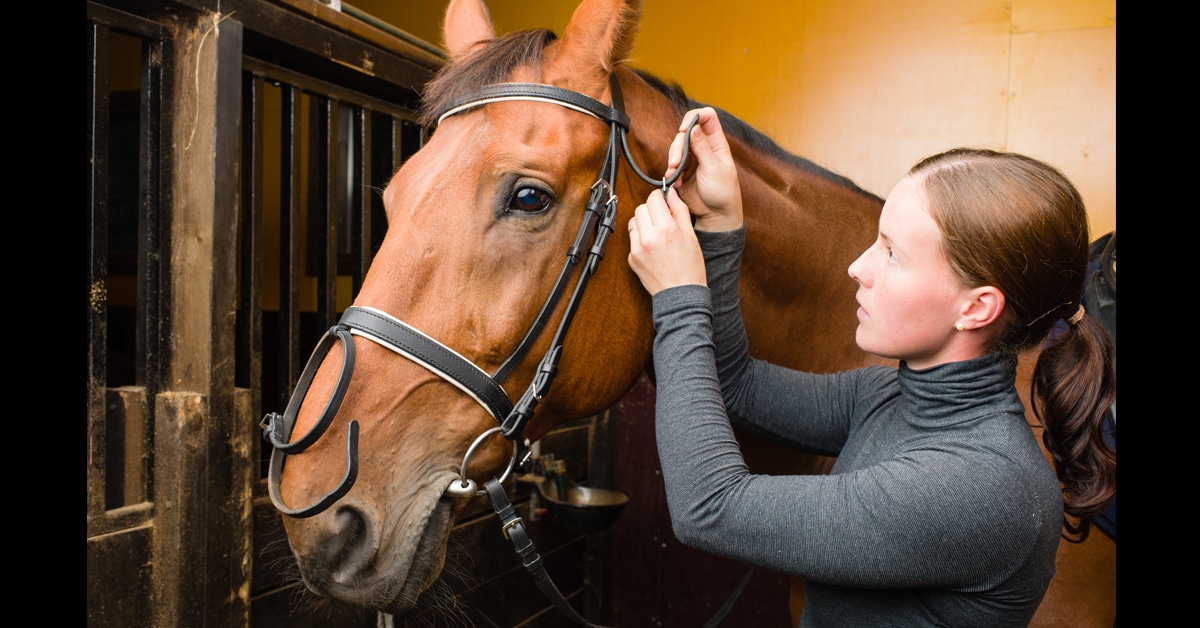
The study also revealed surprising changes in facial expressions throughout the lesson process. Horses exhibited a wide range of facial activity before tacking up, including movements around the eyes, nostrils, and mouth. As saddles and bridles were fitted, many of those expressions became less common and the horses appeared more stoic. After riding, oral behaviours re-emerged, suggesting that horses may communicate important information once tack and riding pressures are removed.
As research continues to uncover new insights into equine behaviour and welfare, subtle facial expressions are emerging as another valuable tool for understanding how horses communicate. These quieter signals may help riders and instructors refine communication, make informed training decisions, and gain a deeper appreciation of how horses experience the world around them in order to build stronger partnerships with them.
It is an exciting time for horse owners and professionals as advances in Equitation Science continue to reshape our understanding of horse behaviour, learning, and welfare. Around the world, evidence-based approaches grounded in learning theory are increasingly being incorporated into rider education, coaching programs, veterinary training, and welfare initiatives. The focus is shifting from tradition and assumption toward a deeper understanding of the horse’s perspective, creating opportunities for safer, more effective, and more horse-centred training practices.
Read the research paper here.
Watch the video here:
The Latest