Warming up is not a courtesy to the horse – it is a physiological obligation. Anyone who trains without warming up is training a different horse from the one they believe they are training.
The cardiovascular mechanism comes first
The first and decisive mechanism of warming up is cardiovascular, not muscular. At rest, the horse’s heart rate is around 28–40 beats per minute, and at this level the working musculature receives only enough blood to supply basal metabolism. Only when cardiac output – the product of heart rate and stroke volume – rises is the musculature properly perfused, and this improved blood flow is followed by an increase in muscle temperature.
Walk alone does not fulfil this task. During walk the heart rate barely rises above resting level and plateaus at around 40–55 beats per minute, so perfusion remains suboptimal and muscle temperature stagnates.
What actually works are dynamic transitions: repeated changes between walk and trot, plus deliberate canter strides. In trot the heart rate reaches 80–150 beats per minute, in canter 120–200, and the transitions themselves produce the most rapid changes in heart rate and thus the strongest cardiovascular stimulus. This mechanism is physiologically plausible, although it has not been directly demonstrated for warming up the horse.
Why a cold horse moves differently
Muscle. Skeletal muscle is a viscoelastic material whose mechanical properties depend directly on temperature. A cold muscle (below 37 °C) is stiff: its fibres are less extensible, contraction velocity is reduced and the force–length relationship is shifted unfavourably. A warm muscle at 38–39 °C shows optimal viscoelasticity and full excursion. What the rider perceives as “stiffness” – and may interpret as a flaw of character – is the predictable behaviour of cold musculature.
Order of activation. The postural stabilising muscles rich in type I fibres, such as M. multifidus, M. longissimus and the abdominal musculature, have a lower recruitment threshold than the fast type II fibres, but they take longer to reach full activity. A correct warm-up therefore activates them first and builds up abdominal tone before demanding work begins. If this step is skipped, the hindquarters transmit their forces onto a spine that is not yet stabilised.
Joints. Synovial fluid becomes less viscous as it warms, and this rise in joint temperature comes from the increased blood flow of cardiovascular activation. In addition, cartilage is nourished by a pumping mechanism in which compression and decompression during dynamic loading move fluid through the cartilage matrix. This requires sufficient ground reaction forces – trot or canter, not walk. The basic principles are well supported from human medicine and tribology; specific equine studies on walk and synovial fluid are lacking.
Tendons. The superficial digital flexor tendon (SDFT) is the horse’s primary elastic energy store. In the cold state its collagen fibres are less extensible, energy-storage efficiency is reduced and the risk of microtraumatic fibre damage increases. Warming up increases collagen compliance and activates the gliding mechanism of the tendon within its sheath.
Proprioception. At rest, the horse’s balance and position-sense system – muscle spindles, Golgi tendon organs and joint receptors – is present but not optimally tuned. Warming up calibrates it, so that postural reflexes are sharpened and reaction to disturbances of balance improves. This matters for assessment as well: a horse evaluated before warming up shows the compensation patterns of a not-yet-stable proprioception, not its trained movement.
The correct warm-up structure
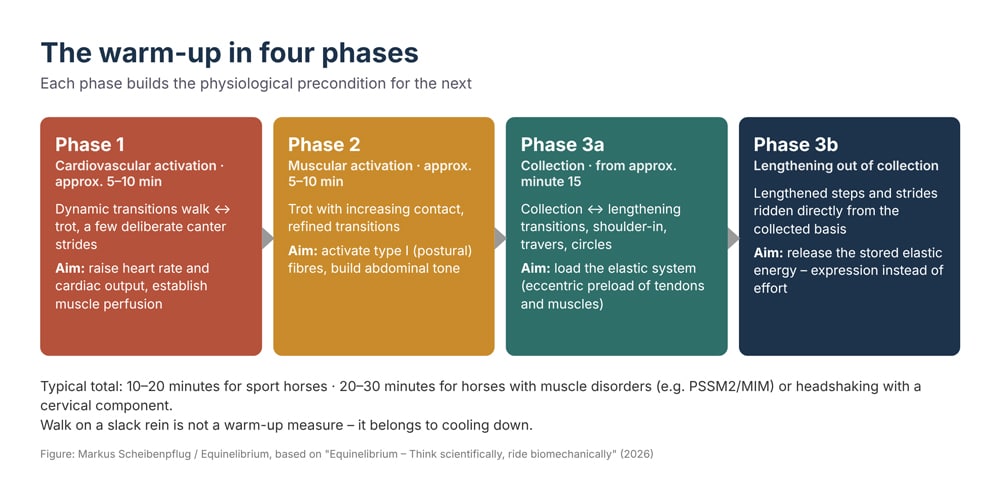
The warm-up follows a sequence that builds the physiological preconditions one after the other.
Phase 1 – cardiovascular activation (about 5–10 minutes). Dynamic transitions between walk and trot, plus a few deliberate canter strides. The aim is to raise heart rate and cardiac output and establish muscle perfusion. Long periods of walking on a slack rein do not achieve this.
Phase 2 – muscular activation (about 5–10 minutes). Trot with increasing contact and refined transitions. The aim is to activate the type I fibres, build up abdominal tone and establish the coupling of breathing and locomotion.
Phase 3a – collection (from about the 15th minute). Collecting work such as transitions between collection and lengthening, shoulder-in, travers and work on the circle. The aim is to build abdominal tone and to load the elastic system.
Phase 3b – lengthening out of collection. Only once Phase 3a has succeeded are lengthened steps and strides ridden directly out of the collected basis. The hindquarters are then already under the centre of mass and elastic energy is stored, which allows maximal expressiveness.
There is no uniform specification for duration, but 10–20 minutes is common practice for sport horses. Horses with muscular disorders such as PSSM2 or MIM, or with headshaking that has a cervical component, often need 20–30 minutes before they are truly able to move freely.
Collection before lengthening: loading the elastic system
The principle behind Phase 3 is the stretch–shortening cycle known from sports physiology. Collecting movements produce an eccentric preload of the hind limb musculature and tendons, especially the SDFT and the suspensory ligament, while abdominal tone increases trunk stiffness. Elastic energy is now stored in tendons and myofascial structures, like a drawn bow.
Lengthening is then the controlled release of this stored energy, not the result of more muscle force. Lengthenings shown without preceding collection are produced purely muscularly: they are energetically expensive, biomechanically less efficient and often look flat – horizontal rather than directed upwards with impulsion. This is the difference between a true medium trot and a trot that has simply “fallen forwards”. The evidence for this mechanism is strong, from comparative biomechanics and in vivo tendon measurements in horses.
Horses with muscle disorders
In horses with PSSM2 or MIM, warming up is critical. PSSM2 is a histopathological category (abnormal glycogen storage without amylase-resistant polysaccharide) for which no uniform pathomechanism has been established; affected horses often show stiffness and exercise intolerance, so a slow, aerobic start is advisable. MIM (Muscle Integrity Myopathy) refers to the variants of a commercial genetic test formerly marketed as the PSSM2 test.
These horses often compensate with altered movement mechanics, which increases the load on tendons and ligaments, and in the first 15–20 minutes they frequently show compensatory movement patterns that are easily misread as lameness or bad character. For them, a gradual warm-up is both therapeutically and diagnostically indispensable.
Walk is not a warm-up
Walk is too lacking in dynamism to work as a means of warming up: it produces no sufficient heart rate stimulus and no adequate muscle perfusion. Its place is cooling down after training and mobilisation – not warming up.
***
 Markus Scheibenpflug is a veterinarian (Vetmeduni Vienna, 2001) and has run his own equine practice in Switzerland since 2011, specialising in headshaking (TMHS), ECVM, PSSM2/MIM and muscle-related lameness. This article is a shortened excerpt from his book “Equinelibrium – Think scientifically, ride biomechanically” (e-book, ISBN 978-3-9526768-2-0), available HERE.
The Latest