Most riders have a “good side” and a “difficult side,” but could some of those tendencies be linked to whether we are right- or left-handed?
University of Guelph, MSc student, Alessia Masini, collaborated on a study which examined whether rider laterality, including hand dominance, leg dominance and leg length, is associated with differences in riding position. The researchers found several consistent posture differences between left- and right-side dominant riders, suggesting that our asymmetries may influence how we sit in the saddle and ultimately affect how a horse compensates for our laterality in their own muscle use.
One of the clearest findings was that left-handed riders generally rode in positions that were closer to symmetrical than right-handed riders.
Masini comments, “I believe this study is important because, to our knowledge, it is the first to directly examine how rider laterality influences their position in the saddle. Previous work has focused on how handedness affects rein tension or how experience and athletic ability shapes posture, but it has remained unclear what specifically drives asymmetry in rider position.”
Left-Handed Riders Showed More Symmetrical Positions
One of the clearest findings was that left-handed riders generally rode in positions that were closer to symmetrical than right-handed riders.
The study found that right-handed riders tended to lean their torso farther forward when viewed from the left side. They also showed a greater tendency to carry the right leg forward and tilt their head to the right when viewed from behind.
By comparison, left-handed riders showed fewer of these side-to-side differences. However, they were not perfectly symmetrical. Left-handed riders tended to ride with the left heel lower than the right, hypothesised because the left leg was positioned slightly longer or because the heel was pushed farther down.
The researchers noted that previous studies have found left-handed people often display greater functional symmetry between the two sides of the body. While this study did not directly measure whole-body laterality, the riding position results were consistent with that idea.
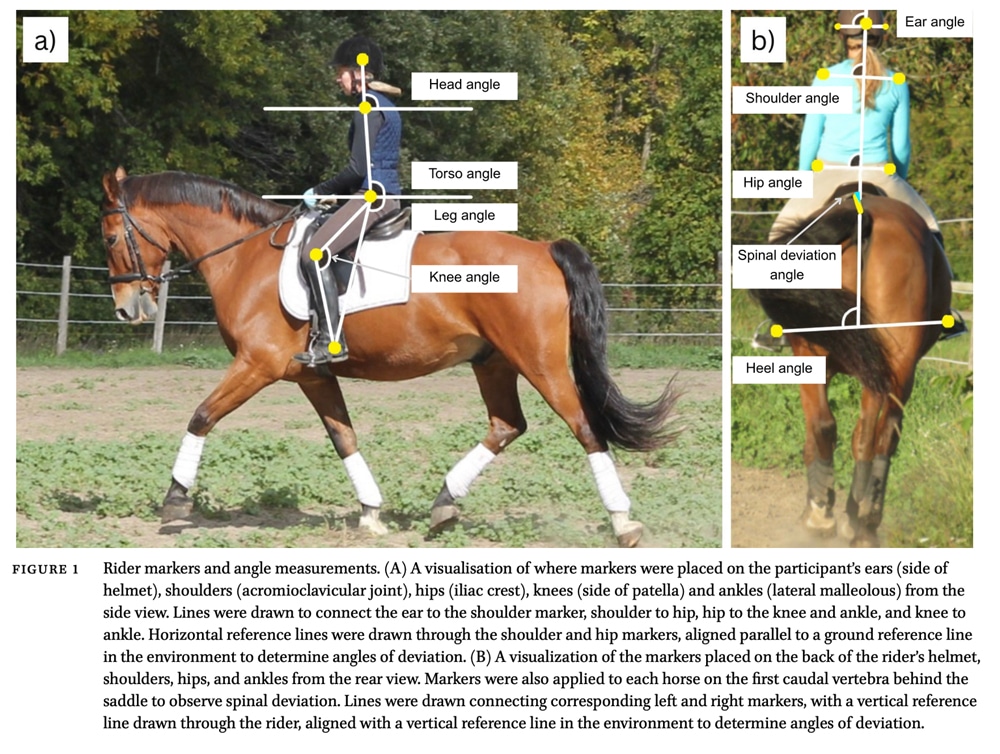
(from the research paper, The impact of horseback rider laterality on riding position. (Masini, A., Faouen, A., MacGregor, H., Beaudoin, V., & Merkies, K. 2025.)
Hand and Leg Dominance Usually Matched
The study also found a strong relationship between hand and leg dominance. Riders who were right-handed were usually right-leg dominant, while left-handed riders were typically left-leg dominant.
Right-leg dominant riders tended to lean their torso farther forward and, from the rear view, carried their shoulders farther to the left. They also rode with the left leg positioned farther forward.
In contrast, left-leg dominant riders maintained a more upright torso, kept their legs positioned more underneath their body, and rode with a lower left heel.
Longer-legged riders were more likely to tilt their head to the left at the halt, walk and trot.
“What stood out to us was that rider posture changed depending on whether it was viewed from the right or left side,” says Masini. “For example, right-handed riders leaned farther forward when viewed from the left, suggesting that there might be some twisting of the torso to the right, or even what many riders might recognize as a ‘collapsed hip’. This raises new questions about how laterality shapes weight distribution in the saddle and stirrups, highlighting the value of future three-dimensional analyses of rider asymmetry.”
Leg Length Also Influenced Position
The longer-legged riders were more likely to tilt their head to the left at the halt, walk and trot. Longer legs were also associated with the hips leaning left at several gaits, while at the canter the shoulders tended to lean farther to the right.
These findings suggest that some posture tendencies are influenced by the rider’s natural anatomy.
Why Does This Matter?
The practical value of the research is that it may help riders and coaches recognize predictable posture patterns.
For example, a right-handed rider who consistently leans forward through the torso, carries the right leg ahead of the left, or tips the head slightly right may not simply be developing a random riding habit. Those tendencies could be related to natural side dominance. Likewise, left-handed riders may want to monitor whether they consistently push the left heel down more than the right.
The study does not suggest that left-handed riders are inherently better riders. In fact, riders in both groups showed measurable asymmetries. However, the results indicate that handedness and leg dominance are factors worth considering when assessing rider position and developing individualized coaching strategies.
Striving for Symmetry
“These findings could have meaningful implications for the horse, including potential effects on musculoskeletal health and horse-rider communication,” says Masini. “They also demonstrate the importance of individualized rider training, including off-horse exercises to help improve symmetry.”
Rather than expecting every rider to have the same positional challenges, coaches can consider a rider’s handedness, leg dominance, and body structure when assessing posture and balance.
This study showed that rider laterality influences riding position. Right-handed and right-leg dominant riders were more likely to adopt forward-leaning postures and show side-to-side differences in leg and head position, while left-handed riders generally rode more symmetrically. Leg length also contributed to subtle alignment differences.
Rather than expecting every rider to have the same positional challenges, coaches can consider a rider’s handedness, leg dominance, and body structure when assessing posture and balance. Understanding these natural tendencies may help riders and coaches identify asymmetries earlier and tailor exercises to improve balance, consistency, and communication with the horse.
For riders striving for better balance and clearer communication with their horse, understanding personal tendencies could be the first step toward a more effective position in the saddle. Modern tools such as slow-motion video and motion analysis apps, similar to those used in the study, may make it easier than ever to spot these subtle asymmetries and work toward greater symmetry.
The Latest