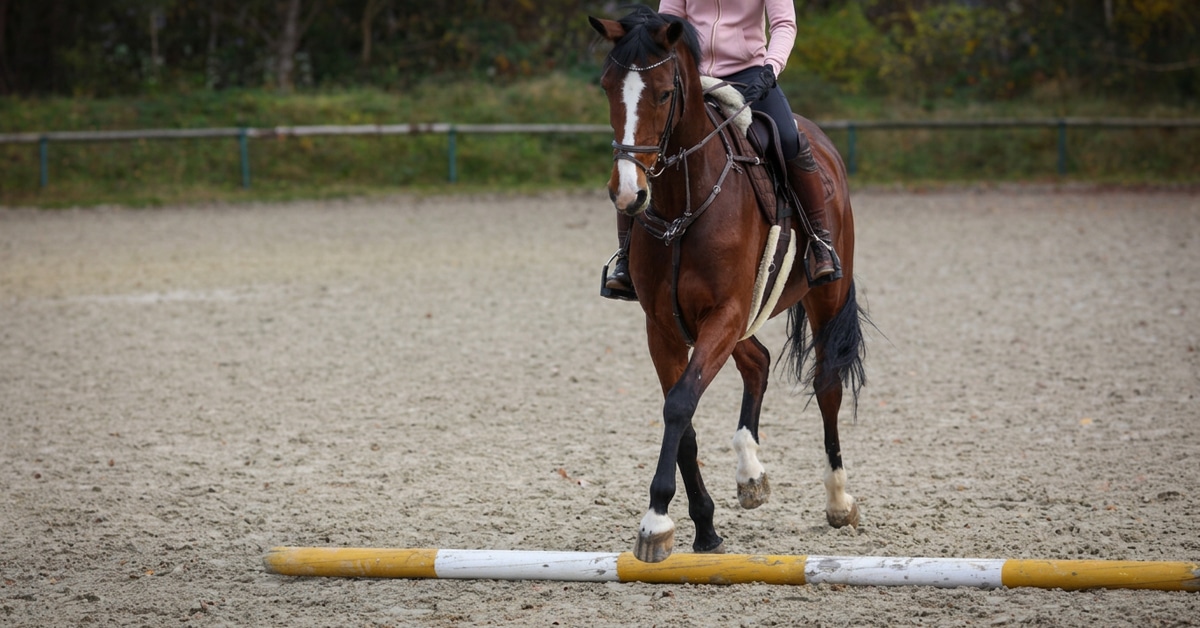
Here’s a simple exercise that you can practice in almost any ring, at any time. All you need is one pole set across the middle of the arena.
Start your ride at the trot with a simple figure eight over the pole. Rather than thinking of it as one continuous change of direction, break it down into three sections:
Bend → Straight → New Bend
As you change direction, your horse should yield to your inside leg while staying straight and connected between your reins. You’re looking for the horse to change the bend without falling through the shoulder or drifting through the outside rein. If you have a particularly wiggly horse, you can widen your hands a little, almost as though you’re driving a big truck, to give yourself and the horse a little more stability.
Once you have this feeling established at the trot, move up to the canter. Now, instead of riding a traditional figure eight, canter the pole on a circle and begin changing the line you take to the pole. I like to think of these as an early turn, middle turn, or square turn. Ride each variation until you can control the line confidently in both directions. Then you can introduce the change of direction, just as you did at the trot. The key to doing this exercise well is the straightness across the pole.
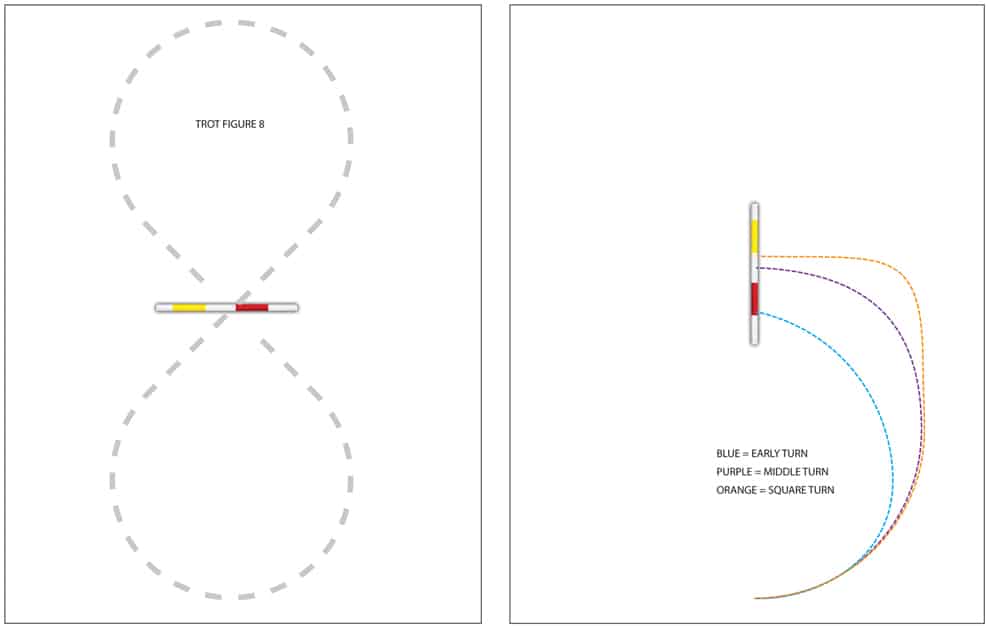
No matter which line you choose into the pole, you need to have a moment — or at least a stride — of straightness across it. The horse needs to be straight before you ask for the new bend and the new direction. And be very careful not to twist your body in an attempt to “help” the horse with the lead change. It’s tempting, especially when you know the horse needs to change, to throw your body in the direction you want them to go. Don’t. Twisting will often make the problem worse by taking away the very straightness and balance you are trying to create. Your horse might change leads after the pole. He might miss the change completely. He might change in front but not behind. The line is more important than the change.
This exercise is a great way to mimic what we see on course. Often, you have to make a particular turn or ride a specific line to a jump, and then you need to be able to hold that line on the landing. The ability to change direction while maintaining straightness, balance and control is something we use constantly in show jumping.
So have fun with it, and don’t be too hard on yourself. For such a simple-sounding exercise, it can be surprisingly difficult to keep all the pieces separate and organized.
Bend. Straight. New bend.
Keep it simple, and let the straightness do the work.
The Latest