Being able to read and understand feed labels is an important part of horse ownership and will go a long way in helping you determine what feed product might be best suited for your horse’s needs. It can be overwhelming to begin reading through the information, however, demystifying the nutritional information provided on the bag is a great way to ensure your horse is receiving what they need.
Let’s start with what information is required on the bag.
In Canada, the CFIA (Canadian Food Inspection Agency) oversees labelling of livestock feeds, which includes feeds for horses. They require a feed label to provide information on the purpose of the feed, the species it is designed for, the nutritional content, feeding instructions and any safety information.
The Purpose Statement
The purpose statement on the feed bag will provide information on the species and class of animal that the product is designed for. For example, a ration balancer might have a purpose statement such as ‘Feed this product as the sole ration to easy-keeping horses to provide essential nutrients without adding excess calories.’ On the other hand, a senior feed might have a purpose statement as simple as ‘for mature and senior horses.’
Evaluating your horse’s weight and body condition score ahead of evaluating their feed program is critical, as that information will provide valuable insight into what type of commercial feed product might be best suited to their nutritional requirements.
In addition to the information on the product packaging, many reputable equine feed companies will also have pamphlets or online resources detailing their various products to assist the horse owner in choosing the correct product.
Guaranteed Analysis
The guaranteed analysis is the section of the feed label that tells you the nutritional content of the product. The information is provided on an as-fed basis, which is how the product would be fed to the horse.
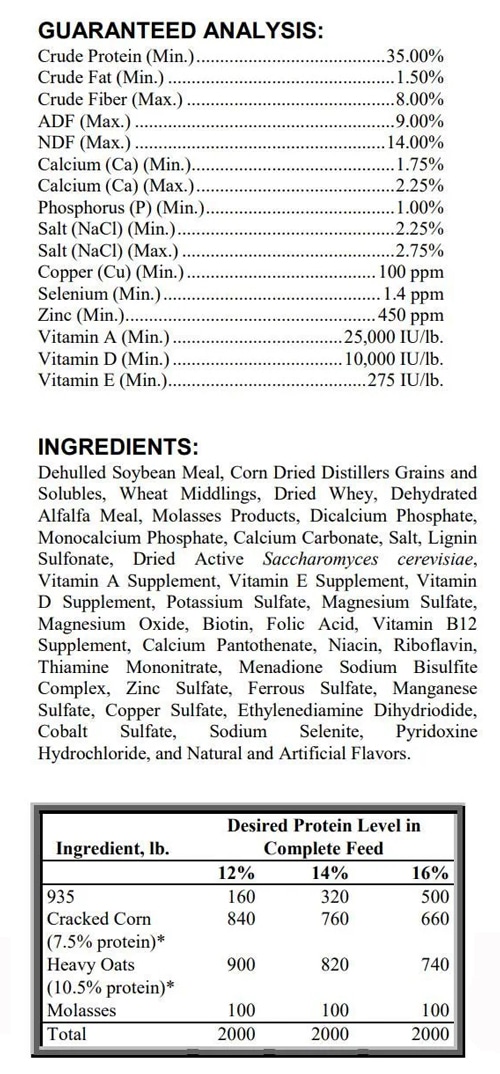
A sample of a feed label.
Anecdotally, this is the area of the feed tag that owners tend to jump to. If you’ve ever overheard, or been a part of conversations about feeds at the barn you have likely heard owners discussing metrics such as the crude protein percentage of the feed e.g., a 30% protein feed, or a 8% fat, 16% fibre. These values come from the guaranteed analysis.
The product type will dictate what information must be included in this area. For example, if you are looking at a complete feed for a horse, the company must include the minimum percentage of crude fibre, however, this is not the case for a mineral feed.
Along with the individual nutrient, and the amount in the product. There will be some nutrient values that are listed as ‘min’ or ‘max’. This is when the nutrients are not listed as their exact amount and instead provided as a guaranteed minimum or maximum.
These values are helpful for comparing products, however, only when you are always incorporating the feeding rate.
Feeding Instructions
The feeding directions on a product are critical; it is a common mistake to overlook this information. Quality commercial horse products are designed by equine nutritionists to be fed in a specific way to meet nutrient requirements. When these instructions are not followed, there are often deficiencies in the ration.
One of the most common mistakes is focusing on the percentage of a nutrient, for example, crude protein or non-structural carbohydrates (NSC), without taking the feeding rate into consideration. Both the feeding rate of that product, and the information on the guaranteed analysis must be combined to accurately inform decision making.
Let’s say my horse requires 300 grams of crude protein in addition to what their forage is providing; reading a guaranteed analysis that a product has 20% crude protein does not tell me how many grams it will provide. If the feeding rate on that product is 1 kg (1000 g), it will be providing 200 grams of crude protein.
As previously mentioned, the other percentage that horse owners tend to focus on is the NSC content, which is especially important to consider for horses with metabolic health issues. Relying solely on a percentage is not recommended, instead ensuring the concentrate ration does not exceed 0.1 g NSC/kg body weight/meal is the gold standard. Similar to the protein content, you must combine the feeding rate with the guaranteed analysis information. Understanding how these values come together to provide useful information is critical.
For homework, take time to look closely at your horse’s feed bag. Start by reading the purpose statement and evaluating if you are feeding the product at the recommended rate for your horse’s body weight. If you are feeding below the recommended rate, but increasing the amount you are feeding would cause excess weight gain, consider switching products. On the other hand, if you are feeding a product at the top end of the feeding rate and your horse is underweight, you should be considering switching to a higher calorie product that is designed to be fed in larger quantities.
Ingredient List
The final area of the feed tag is the ingredient list. Most companies will include the ingredient list on their feed bag, however, there are some companies that you must contact for this information. The ingredient list provides the information usually in a descending order by weight.
One important consideration when choosing a feed product for your horse is if it is a ‘fixed-formula’ or a ‘least-cost’ formula. When the formulation is fixed, it uses a specific set of ingredients such as dehydrated alfalfa meal. This ensures that the diet is consistent.
Least-cost formulations are a bit different as they will generally list non-specific ingredient names such as ‘grain products’, and the order of the ingredients might change batch-to-batch. These products have less consistency, but will still meet the guaranteed analysis, even with the ingredient content shifting.
Take Home Message
Learning about the various parts of a feed tag and how to utilize that information to make informed decisions for your horse is a great way to strive towards better nutritional management. If you have questions about your horse’s feeding program, please reach out to your veterinarian or qualified equine nutritionist.
The Latest