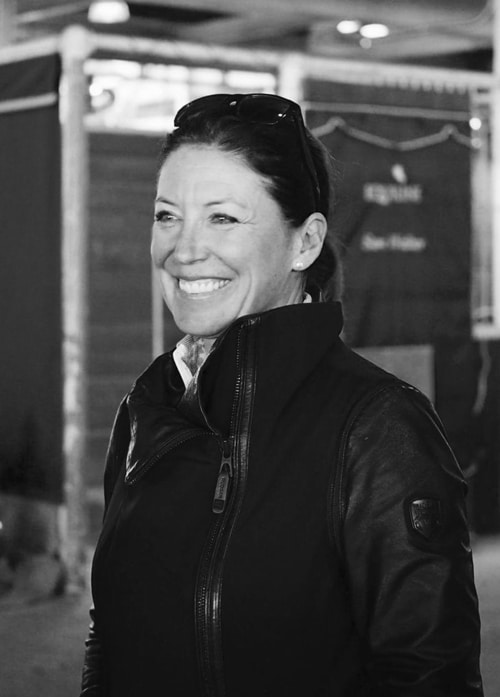
Dee Walker is a Canadian equestrian professional and Senior “R” Hunter and Equitation Judge in Canada and the United States, with 35 years-plus of experience in the hunter/jumper industry. In 1992, Dee and her husband, Scott Walker, founded Forest Hill Farm, which they operated for more than three decades, developing horses and riders for national and international competition. Her career spans riding, training, coaching, and judging, with students earning multiple championships and achieving success at national and international competitions.
What do you look for when a horse first enters the ring?
My first impression is the quality of the horse, the turnout of horse and rider, and the horse’s expression. From there, my expectations depend on the level of competition. What I expect in a top professional division is naturally different from what I expect in a lower-level or intermediate class.
Ultimately, I judge the performance in front of me. A horse’s quality may catch my eye when it enters the ring, but the performance is what determines where it finishes.
“I want to see a rider who can recognize when something isn’t going according to plan, make an intelligent adjustment, and carry on without falling apart.”
What are the most common errors you see in the hunter ring?
Some of the most common errors involve leads and distances, including picking up the wrong lead to begin a round, swapping leads on the approach to a fence or in the middle of a line, missing a lead change altogether, or taking five or six strides to complete one. Missing distances, adding strides, and inconsistencies in rhythm are also common faults.
Speed is another significant error. A hunter should maintain an appropriate, consistent pace throughout the course, without appearing rushed or excessively slow. Then there are horses that become difficult or unrideable during their rounds. A hunter should give the impression of being willing, comfortable, and pleasant to ride.
All of these faults influence the overall impression of the performance, although significance depends on the severity of the mistake and the level of competition.
When you score a class out of 100, how much do certain errors cost you?
Not all errors carry the same weight, and the severity of the mistake is important. We evaluate the complete performance: manners, way of going, jumping style, and overall quality.
Excessive speed is a significant fault. A horse travelling too fast would generally receive a score between 50 and 55. If the speed becomes dangerous, it would be closer to 50. A horse that kicks out behind, whether during a lead change or over a jump, or bucks, would generally receive a 50. A horse may jump spectacularly, but poor manners remain a significant fault. We are judging the entire performance, not simply the quality of the jump.
A good round in which the horse breaks stride and trots just one or two steps would generally receive a 55. A good round with one rail would generally receive a 45, while a particularly naughty refusal could take the score into the 30s.
Moderate errors, such as adding a stride in a line, missing a lead change for five or six strides, or a significant distance mistake, will generally score in the mid-60s. A horse that chips badly at the base of a fence, or leaves excessively long and puts the rider in the “chair in the air” position, will be penalized accordingly. Smaller mistakes, such as stepping off a lead for a single stride, getting slightly quiet or deep to a fence, or jumping a little long, receive smaller deductions.
Regardless of whether I’m judging a novice, intermediate, or professional class, a solid, well-executed round deserves a solid score.
Naturally, expectations differ according to level of the class. We’re continually being asked for open scoring, and while I understand its value, I also believe we need to consider its effect on younger or less experienced riders. A score that might be perfectly reasonable in a top professional class can be discouraging to a novice or intermediate.
The expectations in a novice or intermediate class are naturally different from those in a top professional class, and our scores should recognize that distinction. This doesn’t mean overlooking mistakes or compromising our standards. It means evaluating the quality of the performance within the context of the class. A well-executed round at any level deserves a score that appropriately reflects its merit.
How do you break a tie?
When two horses deliver equally good performances, I look more closely at the quality of their movement, their gaits, and particularly the way they jump. Does the horse jump around the fence, or jump a little flat? Does it land shallow, or does it demonstrate a beautiful bascule, creating an even parabola from one side of the fence to the other?
I look for a horse that maintains a beautiful, balanced canter, jumps with quality and consistency, jumps through its body, and finishes behind, producing an equally beautiful effort at the next fence. The quality of gaits and movement certainly come into play. But ultimately, a horse has to make me want to watch it. The horse that made me want to watch it the most is the one that breaks the tie.
How can you best ride a hunter under saddle class?
Remember that the judge is watching long before the class is officially called to order. When you enter the ring, make sure you’re seen. Find space for yourself, show off your horse’s best gait, and make a good first impression. Don’t spend the first few minutes wandering aimlessly or riding carelessly. Showmanship matters.
Don’t get buried in the crowd. Find your own space and stay by yourself so the judge can see your horse properly. Ring awareness is essential. Know where the other horses are, anticipate traffic, and position yourself so that your horse can be seen at its best.
Understand your horse’s strengths and weaknesses. If it has a spectacular trot, showcase it. If its canter is its greatest strength, make sure the judge sees that beautiful canter. Use your position in the ring, including your distance from the judge’s booth, to present your horse’s strongest gaits to their best advantage.
Don’t overlook the walk. A beautiful walk deserves to be shown just as much as a beautiful trot or canter. I want to see a working walk, a working trot, and a working canter. Every gait should be ridden with purpose.
Equally important is the horse’s frame. In a hunter under saddle class, I don’t want to see a horse over-flexed or excessively bent at the neck. I want to see a horse travelling forward from behind, light in front, relaxed, and carrying itself naturally. The head should be neither excessively high nor too low.
Too often, I see riders trying to package their horses into an artificial frame that does nothing to demonstrate their natural qualities. In fact, it can diminish them. If a horse has quality, allow that quality to come through. Don’t ride it out of the horse by trying to manufacture a picture. A horse doesn’t necessarily have to possess three equally exceptional gaits to place well. Knowing how to showcase its strengths while managing its weaknesses can make a tremendous difference.
Ultimately, it’s about showmanship, and that’s something I find lacking in many hunter under saddle classes today. Riders need to do more than simply go around the ring. They need to understand their horses, ride with awareness, and make the most of every opportunity to present them beautifully. Showmanship is an art, and I would love to see more of it.
What is your advice for equitation and medal trips?
Horse and rider should be impeccably turned out, as they should be in every class. The rider’s collar should be done up, their boots polished — preferably by the rider themself — and their equipment properly fitted. They should enter the ring prepared and ready to go to work. I want to see a rider come in with conviction. Be workmanlike.
Pick up your gallop and ride to the fences in an even, smooth manner, maintaining a consistent rhythm and beautiful track. It doesn’t have to be the tightest track, but it should be smooth, deliberate, and well-executed.
Position is important, but effectiveness comes first. Too often, riders become preoccupied with looking pretty rather than riding effectively. When a rider understands how to use their aids correctly, a beautiful position becomes the natural result. I look for a secure leg, correct stirrup placement, quiet hands, and an upper body that follows the horse naturally. I don’t want to see a rider falling back in the air or a lower leg sliding eight inches to a foot behind the girth. As the old saying goes, “pretty is as pretty does.” Looking pretty doesn’t accomplish much if the riding isn’t effective.
The trip isn’t finished after the last fence. Finish with a proper lead change if required, followed by a smooth downward transition. Then relax, allow your horse to walk on a soft rein, and leave the ring quietly. Small mistakes happen. A distance that’s slightly deep or a little long doesn’t necessarily have to be costly if the rider remains composed and makes the performance look intentional. Don’t advertise your mistakes or your decisions. Ride with determination, discipline, and dedication, and make your aids invisible. Make the judge believe that’s exactly what you were aiming for.
What is one thing you wish trainers paid more attention to when setting up a horse-and-rider combination for the show ring?
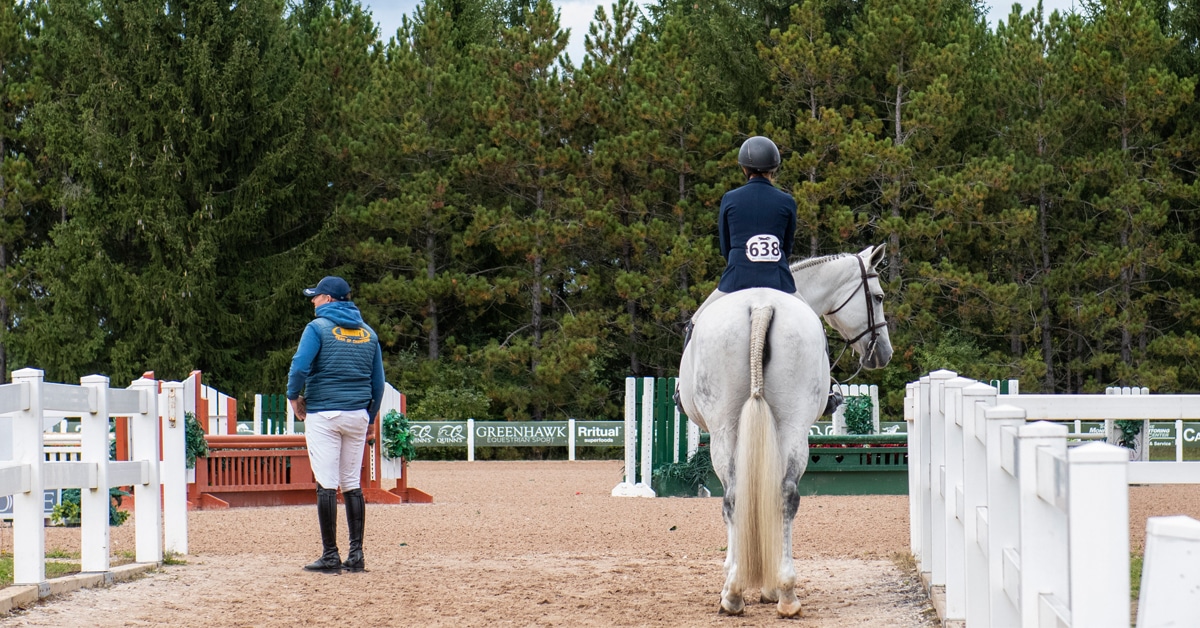
Independence. I wish more trainers would teach their riders to think for themselves and trust the education they’ve received. An enormous amount of preparation should happen before a horse and rider enter the competition ring. The course has been walked, the plan discussed, the horse warmed up, and the rider prepared. But once that rider comes through the in-gate, the performance should belong to them.
From the judge’s chair, I find it disappointing to hear a constant stream of instructions coming from outside the ring. Not only can it be distracting, but it makes me wonder how much of the performance is truly the rider’s own. I want to see a rider who can recognize when something isn’t going according to plan, make an intelligent adjustment, and carry on without falling apart.
Independence has to be taught and practiced, just like finding a distance, maintaining a rhythm, or executing a lead change. A trainer’s job is not simply to produce a good round on a particular day. It’s to develop a rider who understands what they’re doing and why.
Do all judges judge the same?
Not necessarily, and I think that’s one of the interesting aspects of our sport. Judging requires an unusual balance of confidence and humility. We must be able to make informed decisions while recognizing that another equally knowledgeable and experienced judge may see the same performance a little differently.
Although we work within the same standards and expectations, judging is not an exact science. We evaluate quality, correctness, execution, manners, and those sometimes indefinable characteristics that distinguish the very good from the exceptional.
Some days, the winners announce themselves. Other days, the differences are so subtle that one virtue must be weighed against another. Two experienced judges may recognize the same qualities in a horse, but place slightly different emphasis on those qualities. Both may have perfectly sound reasons for their decisions.
Experience teaches us what to recognize, but it doesn’t necessarily make every decision obvious. I believe the important thing is that each judge approaches the responsibility with knowledge, fairness, consistency, and an open mind.
Ultimately, we may not always arrive at precisely the same order of placing, but we should all be working toward the same objective: recognizing and rewarding the best performances. Good judging allows for slightly different opinions while maintaining the same commitment to fairness, integrity, and respect for the sport
The Latest