There has been a notable increase in competitions operating outside the traditional Equestrian Canada structure, but the trend does not appear to be driven by a lack of interest in showing. If anything, the opposite may be true.
Riders still want goals. Trainers still want useful outings for horses and students. Organizers still see demand for competition days that feel worthwhile, professional and enjoyable. What appears to be changing is where some participants are finding those opportunities.
Across Canada, riders, trainers and organizers are experimenting with different competition models. Some events are fully unsanctioned. Some are high-end schooling shows. Some, particularly in Alberta, are provincially sanctioned competitions with their own rules, officials and drug testing.
The details vary, but the broader question is the same: does the current EC competition structure always fit the realities of cost, time, geography, horse development and rider progression?
Headwaters Derby Series
The new Headwaters Derby Series, founded by Kevin and Ashley Maxie of Struck Apparel, offers one example of why that question is being asked.
Kevin Maxie says the series was created to fill a gap between lower-level sanctioned or schooling competitions and the full commitment of a week at a Gold show.
“We felt there was a gap for people who wanted to show at a higher level than what is generally offered at Bronze, Silver or a typical schooling show, but without the attendant cost and time commitment of going to a Gold show for a week,” Maxie says.
Headwaters offers jumper classes from .90m to 1.35m, with a one-day ship-in, ship-out format. Riders can pay by the class or by division, with a simple fee structure and no additional office, nomination or hidden fees.
“For the .90m to 1.20m levels, three rounds paid in advance are $250, or riders can pay $90 per class,” Maxie says. “For the money class at the end of the day, a $5,000 1.35m jumper derby, the entry fee is $150. No nomination, no other attendant fees. It is a very flat rate.”
That simplicity is part of the appeal. So is the format. Maxie describes Headwaters as a bare-bones competition but with all the essentials and designed with professional standards: good footing, inviting but legitimate courses, qualified course design and adjudication, medics on site, event insurance and warm-up supervision.
“Headwater competitions have one ring, one discipline, but high quality throughout,” Maxies explained. “It’s a competition where there is a judge and a timer, just as you would find at a gold show. Minus the VIP and jumbotron.”
“I don’t think we have offered less of a service or less of a product because we are unsanctioned,” he says. “The feedback we’ve received so far is that people are impressed with the quality of the show at the price point it is offered.”
A Bridge Between Levels
Maxie does not present Headwaters as an attack on sanctioned sport. He sees it as a bridge.
For young horses, riders moving up, or professionals looking for an efficient development opportunity, Headwaters offers something between a casual schooling show and a more technical, expensive Gold competition.
“What you would find at our shows is something between Silver and Gold in terms of technicality,” he says. “We want inviting courses that are built to size, where people can bring young horses or riders moving up to a new level to try jumping a little bigger without the maximum degree of technicality.”
That middle space matters. Maxie says many riders are comfortable at .90m, 1.0m and 1.10m, but do not always have an accessible place to try the next step. Some may not have the horse, budget or confidence to move up at a Gold show. Others may simply need a lower-pressure place to test whether they are ready.
“Come and try it at .90m or a metre or 1.10m,” he says. “Then, when you’re feeling confident, come and jump 1.15m or 1.20m and see how it feels. If you’ve practised in a low-key environment, maybe you’re ready to go and try that at a Gold show.”
The intention for the series is to offer riders a chance to compete in a lower-pressure atmosphere so that they are ready to go and compete successfully at a multiday Gold rated show. He points to one young rider who had been showing at the metre and 1.10m level and used Headwaters to try her first 1.20m.
Headwaters is not pulling riders away from sanctioned sport so much as offering a place where some riders may become better prepared for it.
“She had been worried about the big step up at Gold and how hard that would be,” Maxie says. “But over an inviting course with a bit of size, she gave it a try for the first time and loved it. That might not have happened if her only option had been to do it at a Gold show.”
In that sense, Headwaters is not pulling riders away from sanctioned sport so much as offering a place where some riders may become better prepared for it.
Variety for Horses
For many of the riders and trainers attending Headwaters, the appeal is not only lower cost. It is also the opportunity to give horses a different experience.
James Gillam of G & G Sporthorses competes at Gold shows, but he also brought horses to Headwaters.
“I thought it would be very nice and beneficial for the horses to see something different,” Gillam says. “Going on the grass is always a lot of fun, and I wanted to support my friends.”
Gillam competed at 1.10m at Headwaters and says he would “absolutely” return. He also competed at Angelstone the same day, jumping the Grand Prix there after competing at Headwaters. That ability to use both types of competition is important. For riders like Gillam, Headwaters is not replacing Gold competition. It is adding another tool.
Julien Moreau of Longchamps Equine works with a number of young horses and says the series fits a clear development need.
“We do a lot of young horses, and it is very important to go to new facilities and different jumps,” Moreau says. “It is a great way to school the horses, give them experience and do something different with nice people, nice footing and nice jumps.”
For Moreau, the difference between Headwaters and lower-level sanctioned shows is not simply height. It is the type of test. Schooling over jumps at a different venue is not the same as warming up in a separate arena, entering the show ring, waiting for the buzzer, and jumping a course – that is the experience Headwaters is providing.
“The Bronze and Silver series are made for a different public,” said Moreau. “They are great for lower-level education, but the course at Headwaters was a little more technical, with more questions for the horses. It was a great place to test your training at home and see if your horse is ready to move up.”
Moreau says he plans to attend every Headwaters event this season, choosing which horses to bring depending on what each needs at that point in the year.
That flexibility is part of the series’ strength. A rider might bring a young horse to see new jumps. Another might bring a jumper ready to try a bigger height. An eventer might use it to get show jumping miles on grass. A Gold competitor might use it as a useful, low-pressure outing between bigger shows.
The Alberta Example
John Anderson, who runs competitions in Alberta, brings another perspective to the conversation.
He is clear that his shows are not unsanctioned. They are provincially sanctioned through the Alberta Equestrian Federation, and he believes strongly that competitions need governance.
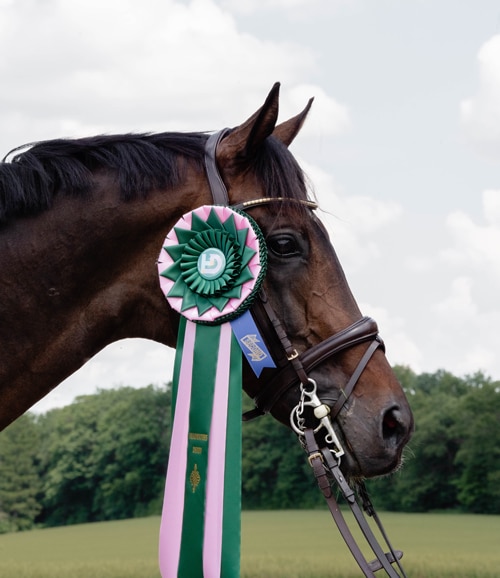
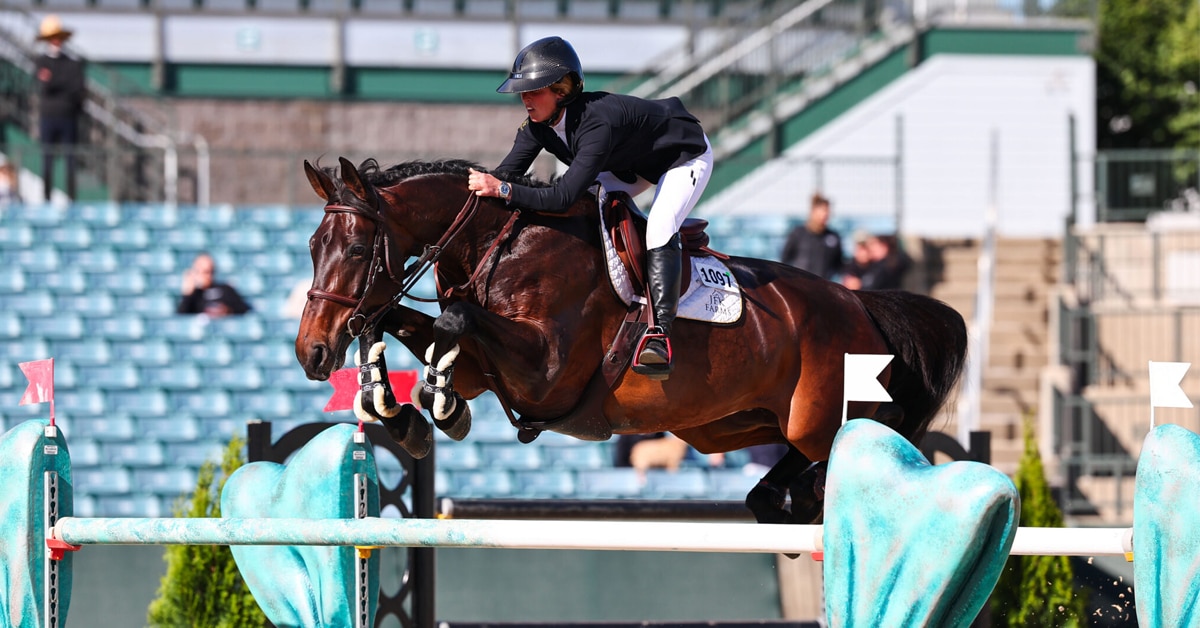
Headwaters is a ‘bare-bones’ competition, but with all the pro essentials: good footing, legitimate courses, qualified course design and judging, medics on site, insurance and warm-up supervision. (Astrid Caie Photography)
“I never ran unsanctioned horse shows,” Anderson says. “That would be foolish. You need a governing body. You need rules and regulations.”
Anderson says his competitions use EC officials, including judges and stewards, and operate under a provincial rule structure that has evolved significantly in recent years.
“I believe in a national federation,” he says. “I have never not believed in a national federation. But I got fed up with what our federation was doing, or not doing.”
His main concern is not governance itself. It is whether EC’s competition structure reflects the current sport.
For Anderson, the biggest issue is prize money. He argues that the cost of horses, the scale of competition and the expectations of exhibitors have changed dramatically, while the prize money limits attached to lower EC levels have not kept pace.
“The sport has changed,” he says. “All the prices of horses have gone through the roof, but the prize money you can offer has stayed the same for 30 years.”
In Alberta, Anderson says the provincial system provides a more realistic tier structure, allowing significant prize money while still maintaining provincial oversight. He sees that as a useful middle ground: governed sport, but with more flexibility than the national Bronze, Silver and Gold structure allows.
That model complicates the usual debate. The alternative to EC sanctioning does not have to be unregulated competition. It could also be stronger provincial delivery, with clear rules, officials, insurance and drug testing.
Why Not Bronze or Silver?
From the EC perspective, the obvious response is that lower-barrier competition levels already exist.
Bronze and Silver competitions are designed to provide sanctioned opportunities below Gold and Platinum. They offer EC rules, recognized officials and a connection to the formal sport pathway without necessarily requiring competitors to enter the higher-cost Gold circuit.
Maxie is careful not to dismiss those levels.
“Silver and Bronze offer a really great alternative for competitors,” he says. “They serve a purpose. People are moving up and trying that level.”
“What we are offering is a hybrid between Silver and Gold.”
But he also argues that Bronze and Silver do not meet the same need Headwaters is trying to meet. At the Silver level, the jumping height does not reach the upper range Headwaters is offering. He also believes the character of the competition is different.
“I don’t think it is comparing apples to apples to look at 1.10m at the Silver level versus 1.10m at a typical Gold show,” Maxie says. “Usually the courses are more inviting, a little simpler and maybe not quite built to the same size specs. That is great. It serves a purpose. But what we are offering is a hybrid between Silver and Gold.”
Moreau sees the distinction in a similar way. Bronze and Silver shows can be useful, he says, but they are often designed for a different stage of athlete development. Headwaters offered a place to ask more of the horse without moving straight into a full Gold show environment.
The issue is not whether Bronze and Silver have value. The question is whether they are flexible enough, attractive enough and modern enough to serve riders who are looking for something between lower-level sanctioned competition and a full Gold show experience.
Running an EC-sanctioned horse show also brings costs that are not always visible to exhibitors. Sanctioning fees, required officials, administration, insurance, drug levies, medical coverage, facility standards, reporting requirements and discipline-specific fees all become part of the financial equation. Many of those costs support important functions, including safety, consistency, accountability and horse welfare. But they also have to be recovered somewhere, whether through entry fees, office fees, stall fees, sponsorship, prize money structures or the organizer’s own margin.
For a one-day event designed to be simple, affordable and easy to attend, those added layers can change the model quickly. Maxie says the cost of EC sanctioning would “dramatically increase the cost” of offering Headwaters and make it difficult to maintain the flat-fee structure that has become part of the series’ appeal. Anderson makes a similar point from the organizer side, noting that while some level of sanctioning fee is reasonable, the cost structure has to make sense for the level of competition being offered.
Governance Still Matters
One of the risks in any discussion of unsanctioned sport is oversimplification. It would be easy to frame EC competition as expensive and outdated, while presenting non-EC sanctioned competitions as flexible and rider-friendly. But that misses the point.
Sanctioned sport provides important protections and standards. Rules matter. Qualified officials matter. Medication control matters. Safe Sport policies matter. Consistent records, rankings, pathways and accountability all matter.
Even the people creating alternatives are not necessarily rejecting those principles.
Maxie requires Headwaters competitors to hold an Ontario Equestrian membership and says the series carries liability and event insurance through BFL. The shows have medics, qualified people monitoring safety, and professional course design and judging.
Anderson wants the provincial system to retain governance functions such as drug rules and testing.
Together, the two perspectives show that this is not a simple choice between rules and no rules. The real question is what level of governance is appropriate for different types of competition, and whether the current EC structure offers enough flexibility to keep riders and organizers inside the system.
A Question of Relevance
The rise of competitions outside the traditional EC model should not be viewed simply as a threat. It should be read as a signal.
Riders are showing what they value. They want affordability. They want flexibility. They want useful mileage. They want courses that prepare horses and riders without overwhelming them. They want opportunities close enough to home that one show does not consume an entire week. They want the chance to try something bigger without taking on the full financial and emotional weight of a Gold show.
Organizers are sending a signal, too. They want to run competitions that are financially viable, appealing to sponsors, manageable for exhibitors and responsive to local demand.
EC has already begun a competition review. The challenge will be whether that review can move quickly enough, and boldly enough, to respond to a landscape that is already changing.
Maxie believes EC should be looking at the entire competition pathway, not just individual fees or rules.
“I would be looking for a structured competition ladder,” he says. “A pyramid with a big base, but with distinct levels and a clear progression.”
In his view, the current system does not always make those distinctions clearly. Riders can find poles-on-the-ground and crossrail classes at a riding school show, but also at a Gold show, at a dramatically different cost. For Maxie, that raises a larger question about whether the competition structure is truly guiding riders through the sport, or simply allowing each show to be everything to everyone.
That kind of reform would not be easy. Show organizers often need to offer many levels in order to fill stalls, rings and schedules. Trainers often have clients at a wide range of levels and need competitions that can accommodate the whole barn. A more defined pyramid might be better for sport development, but it would disrupt existing business models.
Maxie acknowledges that.
“It would be unpopular for some businesses,” he says. “But maybe, for the greater benefit of the horse community, there should be start and end points for each level.”
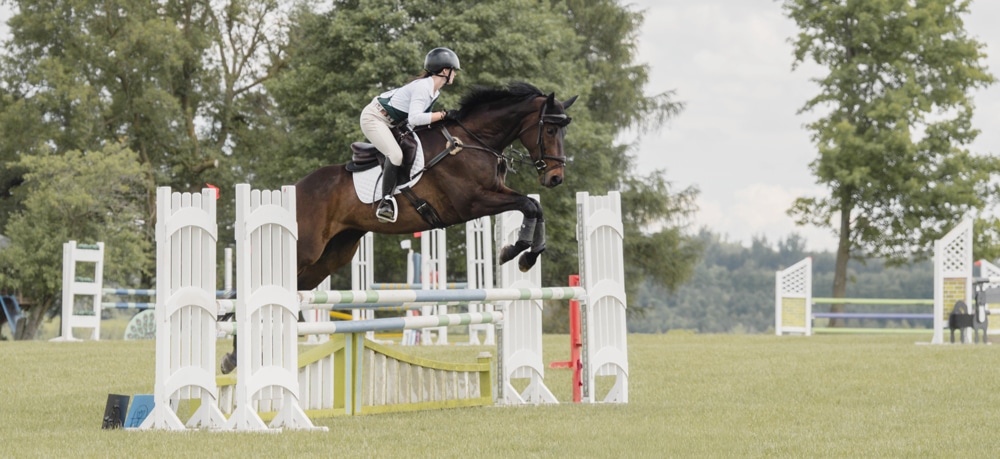
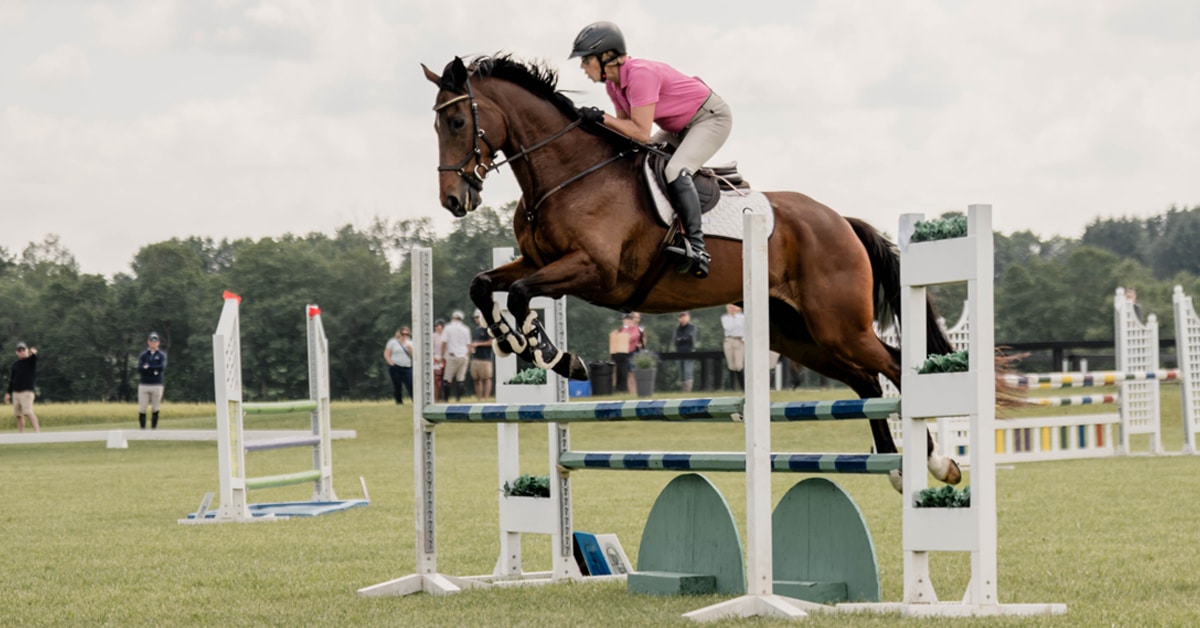
Headwaters offers jumper classes from .90m to 1.35m, with a one-day ship-in, ship-out format. Riders can pay by the class or division, with no additional office, nomination or hidden fees. (Astrid Caie Photography)
What Comes Next
The popularity of Headwaters, and the success of provincially sanctioned models in places like Alberta, suggest that riders are not walking away from competition. They are choosing competition that fits. That distinction matters.
If riders were leaving competition altogether, the concern would be participation decline. But if riders are choosing different kinds of competition, the issue is more nuanced. The desire to show is still there. The format, cost, governance and pathway may need to evolve.
For EC, the implications are significant. When riders compete outside the EC system, the organization can lose more than sanctioning fees. It can lose data, licensing revenue, rankings participation, pathway visibility and regular contact with the grassroots base.
But blaming non-EC organizers misses the point. Events like Headwaters are not creating the demand. They are responding to it. The more useful question is what sanctioned sport can learn from them.
Could Bronze and Silver be modernized? Could prize money limits be reconsidered? Could provinces play a stronger role in delivering flexible, lower-barrier competition? Could EC create clearer progression between levels? Could high-quality non-EC events become part of a broader ecosystem rather than being viewed as outside the system entirely?
A healthier future may include all of these pieces: the polished Gold show, the championship pathway, the provincial circuit, the grassroots schooling day, the high-end derby series and the local event that gives a young rider or green horse the confidence to take the next step.
For a junior trying 1.20m for the first time, an eventing student looking for jumping miles, an adult amateur returning to the ring or a young horse learning its job, a competition outside the traditional EC structure can be more than a fun day out. It can be the experience that keeps them connected to the sport.
That may be the most important point.
The rise of these competitions is not just about avoiding fees or skipping rules. In many cases, it is about relevance. It is about creating places where more riders feel that competition still has a place for them.
If sanctioned sport can understand that, the growth of these events may not be a threat. It may be an invitation to rebuild the competition system from the ground up.
The Latest