When choosing a horse feed, most owners look at protein, fat, fibre and perhaps sugar and starch. But there is another part of the feed tag worth paying attention to: not just which minerals are in the feed, but the form in which those minerals are supplied.
Copper is copper and zinc is zinc, right?
Not necessarily, at least when it comes to how those nutrients are presented to the horse’s digestive system.
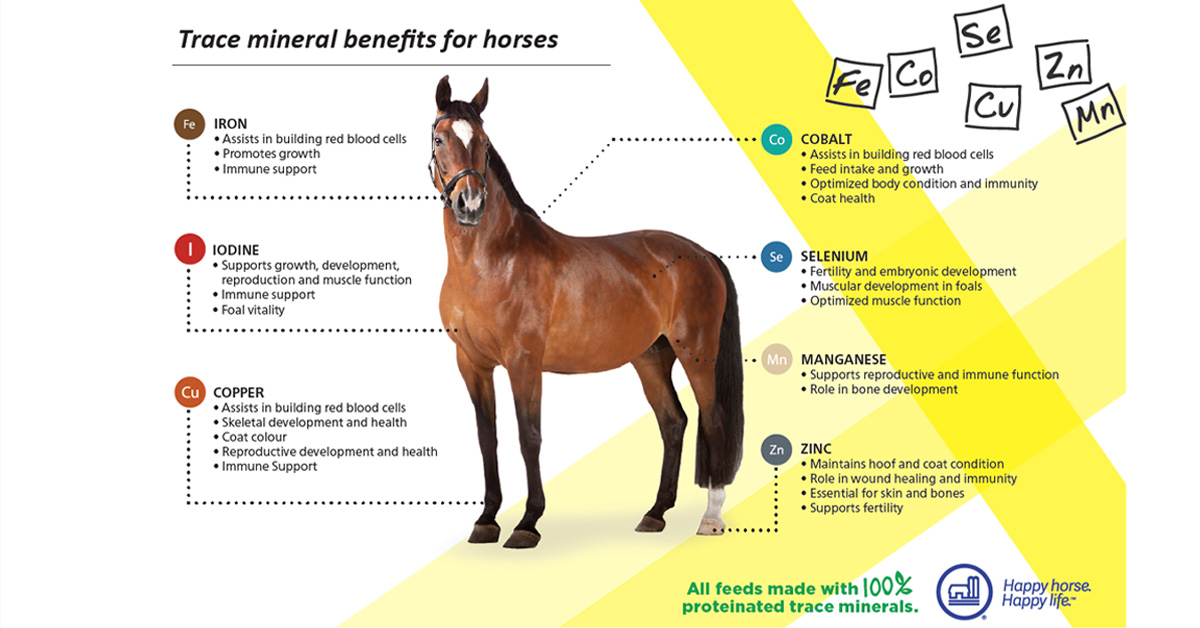
Minerals are required in relatively small amounts compared with protein, fibre and energy, but they have an outsized role in equine nutrition. Trace minerals including copper, zinc, manganese and selenium are involved in functions throughout the body, from maintaining healthy hooves and supporting bone and cartilage to antioxidant and immune functions. Most complete horse feeds provide these essential nutrients. Where Masterfeeds takes a different approach is in the source of its trace minerals.
Masterfeeds equine feeds are formulated using Alltech’s Total Replacement Technology™ (TRT), which replaces inorganic sources of trace minerals and selenium with a proteinated mineral (a mineral compound bound to a protein or amino acid) to help the body absorb it better. The minerals in Masterfeeds equine feeds are 100% proteinated and 100% useable by the horse.
For Tony O’Sullivan, Equine Sales Manager for Masterfeeds, that distinction is one of the most important things horse owners should understand about the company’s feeds.
“The Masterfeeds advantage is because the minerals are bioavailable, the feeds are more efficient,” he explains.
Mineral source matters
Traditionally, many of the supplemental trace minerals used in animal feeds have been provided in inorganic forms, such as mineral salts or “rock” form. Proteinated minerals, by contrast, more closely resemble the form in which horses encounter minerals in plants. Using Alltech’s technology, trace minerals are bound to amino acids and peptides, creating compounds designed to remain stable as they move through the digestive system. The concept behind TRT is therefore relatively simple: provide trace minerals in a form intended to make them bioavailable to the animal.
“It’s as close to mimicking nature as possible,” says O’Sullivan.
Importantly, that does not mean every molecule of a proteinated mineral is automatically absorbed by every horse. Mineral absorption is complex and can be influenced by the horse’s diet, mineral status and interactions among nutrients. The Masterfeeds philosophy, however, is that using proteinated sources provides the minerals in a form that can be more effectively absorbed, stored and utilized.
Why does better utilization matter?
Masterfeeds’ believes that nutrition should not simply be about putting more nutrients into a feed. The goal is to provide the right nutrients in forms the horse can use efficiently.
O’Sullivan describes one of the philosophies behind the Masterfeeds program as “less is more.”
If a mineral source can be utilized efficiently, simply adding increasingly large quantities shouldn’t be necessary. Masterfeeds technology allows significantly lower trace-mineral inclusion levels while still providing the nutrients horses require. That also has the potential to reduce the amount of excess mineral entering manure and ultimately the environment.
There is another benefit from the owner’s perspective: simplicity.
Anyone who has spent time in a feed room has seen how quickly a horse’s ration can grow from a scoop of feed into a collection of powders, pellets and supplements. One product is added for hooves, another for minerals, another for vitamin E and another to fill a perceived nutritional gap.
O’Sullivan says Masterfeeds tries to take the opposite approach.
“We try to simplify it for the end user,” he says. The company’s goal, he explains, is to formulate a feeding program that meets a horse’s requirements without automatically adding multiple additional products.
That doesn’t mean every horse eating a complete feed will never need supplementation. Forage quality, workload, life stage, health concerns and the amount of fortified feed actually being consumed all matter. But when a Masterfeeds product is fed at its recommended rate as part of an appropriately balanced ration, the intention is that the feed itself supplies the vitamins and minerals it was formulated to provide.
“Because of the bioavailability of the minerals, we feel confident in doing that,” O’Sullivan says.
Science backed by horse people
The mineral technology originates with Alltech, the global animal nutrition company that owns Masterfeeds. Alltech develops nutritional technologies across numerous livestock species, while Masterfeeds’ nutrition team incorporates applicable technology into its feed formulations.
But O’Sullivan says there is another part of the company’s approach that is less technical. Its equine team is made up of horse people. O’Sullivan spent approximately 20 years training Standardbreds. Other members of the team come from backgrounds including barrel racing, heavy horses and racehorses.
“We’re all horse people, we all have horses,” he says. “We’re very much boots on the ground.”
That experience informs the company’s objective of making feeding programs practical as well as scientifically formulated.
Masterfeeds offers feeds for horses at very different stages and levels of activity, including growing horses, breeding stock, easy keepers, performance horses, seniors and horses with special nutritional requirements. But across its equine feed line, TRT provides a common nutritional foundation.
And it highlights an important lesson for horse owners examining any feeding program. The numbers on the feed tag matter. But they don’t always tell the entire story. When it comes to minerals, how much is supplied is only one question. The form in which those minerals are supplied matters, too.
The Latest