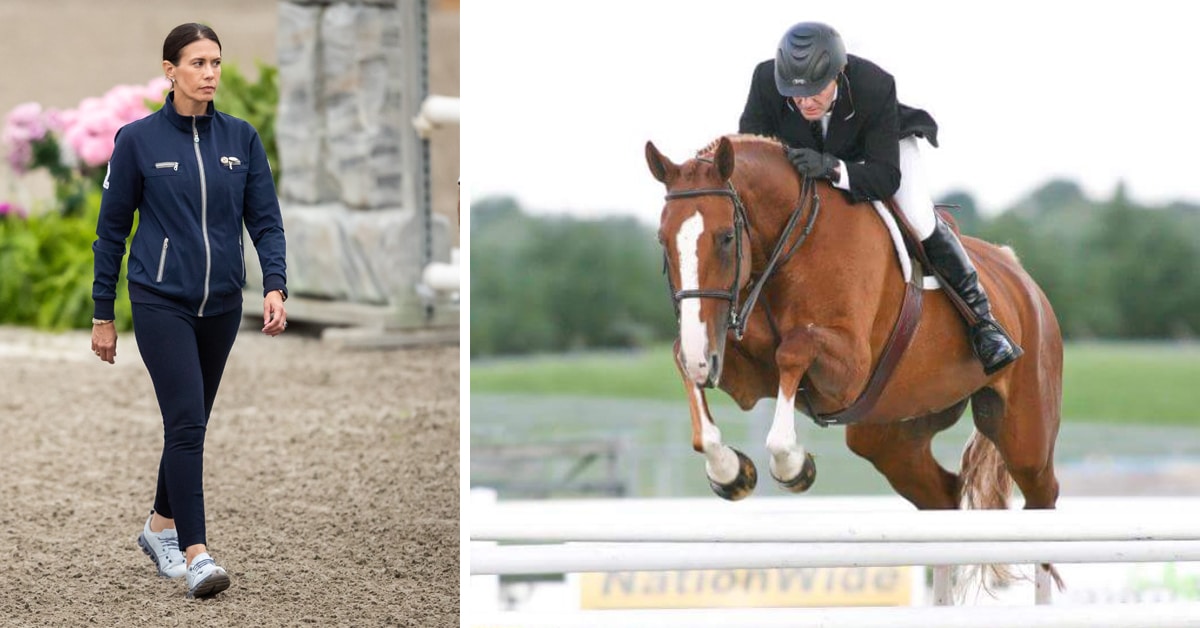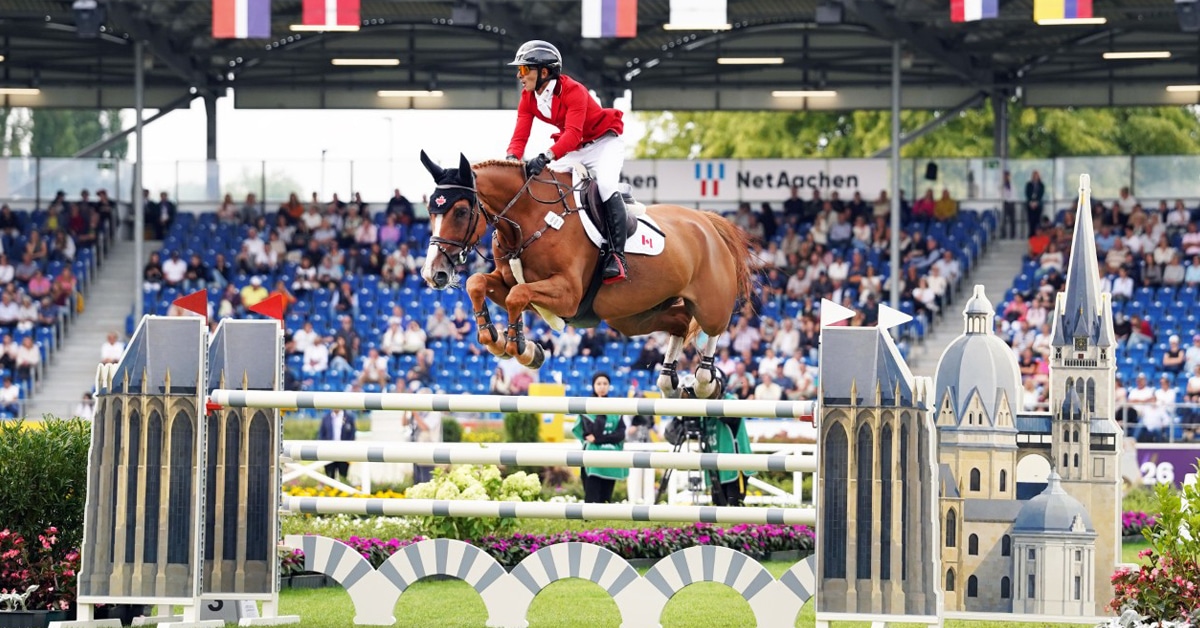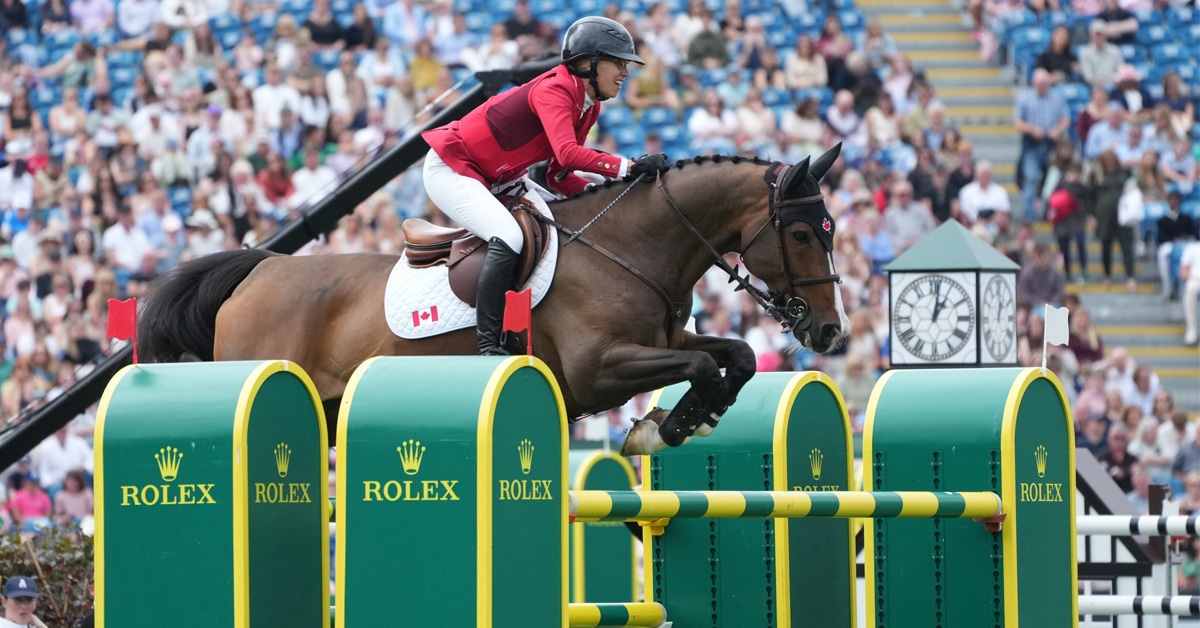
Stal Hendrix: You have been selected to represent Canada at the 2026 FEI World Championships in Aachen. How significant is this moment within your career?
Amy Millar: It is very exciting for me. I competed at the World Championships four years ago with Truman, and I can tell you that I think it is the ultimate challenge in show jumping. I think it is harder than any of the other things that we ever do. I am honoured to have been selected to represent Canada again, and I am excited to have a partner like Jagger HX for this Championship. We are up for the challenge.
You will compete with Jagger HX, a 12-year-old gelding bred by Stal Hendrix. For those unfamiliar with him, how would you describe his character and qualities?
AM: Jagger HX is a really interesting horse with a lot of personality. In terms of his qualities as a show jumper, he is incredibly scopey and very careful, with a big stride.
When you look at him, you might not immediately realise it, but he is also extremely sensitive. I have had him for quite a while, and it has taken us a long time to build our relationship and for me to understand what he likes and what he does not like. Having that relationship is really important to him. As he is so sensitive, Jagger likes to be around the people he knows. He knows and trusts his team, but he acts differently around people he does not know. He is a really cool character.
“Emile Hendrix found Big Ben for my father, Ian Millar, many years ago, and the relationship between our two families developed from there.”
You bought Jagger HX from Paul Hendrix when he was seven-years-old. How did the opportunity arise, and what convinced you that he was the right horse for you?
AM: It is actually a funny story because I think most people in our industry know that the Millar and Hendrix families have a very long-standing relationship. Emile Hendrix found Big Ben for my father, Ian Millar, many years ago, and the relationship between our two families developed from there.
Erica Hatfield, from Team Eye Candy, owns Jagger HX in partnership with Millar Brooke Farm. Erica and I had been discussing the possibility of buying a horse together. At the time, my brother, Jonathan, was already in Europe looking at horses, so I sent him to look at a couple of potential horses for us. I did not actually try Jagger HX before we bought him, Jonathan tried him for me. My brother knows the way I ride very well, and he has previously selected other horses for me without me trying them first. He knows what I like and do not like, what I can work with and what I would rather not deal with.
Jonathan tried a couple of horses in Europe and then told me, “I think this is the one.” Due to the trust I had in Jonathan and the Hendrix family, we decided to go ahead and buy Jagger HX. As I said, it took Jagger HX and I a little while to build our relationship, but I have found that to be the case with many of the great horses I have ridden. When you spend time with them and really get to know them, they can eventually give you more than you would ever expect.
You have produced Jagger HX from a talented young horse into a five-star performer. Which moments have been particularly important in the development of your partnership?
AM: Developing my partnership with Jagger HX has been about understanding what he likes and does not like and ensuring that we are always doing the right things for him. A lot of that has involved his training, but his day-to-day care has been equally important. There have been certain points during our journey together when I have discovered something Jagger HX needed as part of his care program. That might have related to his feeding regime or the care of his feet. As he is such a sensitive horse, discovering those individual details has made a dramatic difference to his performance.
“We have always known that he could jump over “the barn” and that he was careful enough to jump clear, provided his mind and body were properly organized to do it.”
Jagger HX is also quite strong and has always pulled, so understanding his mouth and developing the connection between my mind, his mind and his mouth has been important. Finding the right bridle and the right bit for him at the right time has been critical to his development.
Those details might not be such a significant issue for some horses, but figuring everything out has been a really big part of Jagger HX’s development. It has also been about creating a relationship in which he likes and trusts me and wants to do his job for me, while also having enough respect for me that he does not try to take advantage. That is part of his character, so it has been about finding the right balance.
I believe we are in a really good place now. I have Jagger HX’s respect, he feels amazing in his body, his training has progressed, and he really loves his job. There has never been any question about whether Jagger HX has the scope to jump these courses or whether he is careful enough. We have always known that he could jump over “the barn” and that he was careful enough to jump clear, provided his mind and body were properly organized to do it.
The relationship between the Millar and Hendrix families began more than 40 years ago, when your father, Ian Millar, found Big Ben through Stal Hendrix. How has your own relationship with the Hendrix family evolved over the years?
AM: I have known Emile and Paul Hendrix since I was young and first started travelling to Europe. I remember sitting in the back seat of Emile’s car, with Emile and my father in the front, as we travelled around looking at horses.
It is a little different now, but when I was a child, we would get on the road and drive for hours to try one horse. We would then get back into the car and drive for several more hours to try another horse. We would spend days travelling around Europe and looking at horses in that way.
I was a child when the relationship began, and now the Hendrix children are our friends. The relationship between the two families continues from one generation to the next. Whenever I am in the Netherlands, it is always lovely to see Paul and Emile.
I also regularly speak to Paul and ask him for breeding advice. We have a small breeding program at Millar Brooke Farm in Canada, so I am always tapping into his considerable knowledge. It is great to have that relationship.
You have chosen to spend the final weeks before the World Championships at Stal Hendrix. Why did you make that decision, and what are you hoping to gain from your time there?
AM: Stal Hendrix has a beautiful farm and a fantastic arena, and we can take our horses hacking in the forest. It is a lovely environment for the horses. The farm is also centrally located for anything we might need, so it is a fabulous base for our final preparations.
It is great to be around the Hendrix family members. When you are so far away from home, it makes life much easier to have experienced people around you who can help you work through all the different things needed to prepare the horses for a competition of this level.
The Canadian team arrived in Europe a couple of weeks ago. We competed at Chantilly and then Hickstead, and we are now spending the remaining time at Stal Hendrix before travelling to Aachen.
Every time I come to Europe and compete at a couple of shows, I notice the small differences between the way we compete in North America and the way competitions are run in Europe. Those apparently small differences can become very significant when you arrive at a Championship.
Competing at Spruce Meadows was extremely important to our preparation for Aachen, particularly because of its expansive grass arena. However, I also believe it was important for us to compete at a couple of European shows and become accustomed to the feeling and style of competition here. Combining those experiences means we should be prepared for everything we might face at the World Championships.
Aachen is renowned for its expansive grass arena, technical courses and intense atmosphere. What do you expect to be the greatest challenge of the Championships?
AM: I expect the World Championships to be extremely difficult and challenging. I do not think anyone who has competed at a World Championship before could expect anything less.
The level of difficulty will be combined with competing at an iconic venue like Aachen, where there will be around 40,000 spectators watching in the Main Stadium. Additionally, they are not simply spectators; they are knowledgeable and educated horse people. I have competed at Aachen once before. I remember that, particularly when a German rider entered the arena, you could hear a pin drop because the crowd became so quiet. For me, it was a moment of thinking, “Wow, this is incredible.” It demonstrated the crowd’s level of knowledge and the genuine interest in the sport among the people attending.
“I expect the atmosphere to be a major factor and one of the greatest challenges of the Championship.”
That is going to create a particular feeling in the arena and add so much atmosphere. Being at such an iconic venue in the centre of horse country will generate an incredible amount of energy. Sometimes, when you enter the arena at an event like this, you can feel that energy in the air. I expect it to be like that at Aachen.
In that moment, it becomes important for both the horse and rider to use the energy to rise to the occasion. I hope that is what happens for Jagger and me. Every rider and horse competing at Aachen will be affected by the atmosphere in one way or another.
I hope the atmosphere will have a positive effect on Jagger HX and me, but I know that some horses will shrink from it. That is simply how it goes. I therefore expect the atmosphere to be a major factor and one of the greatest challenges of the Championship. There will also be the technicality of the course design combined with a significant test of bravery. During my time competing at Championships, I have only competed in sand arenas. That does not mean there cannot be an imposing wall or another visually challenging fence, but those courses are usually focused on the delicacy and technicality of the fences, as well as their size. From what I understand, Aachen will present a different type of challenge. The courses will still be delicate and technical, but the expansive grass arena will also require a bold horse and perhaps some strong riding.
Spectators see a rider and horse during their time in the arena, but there is an enormous team working behind the scenes. What has it taken from the wider team to bring you and Jagger HX to this point?
AM: It requires an incredible investment of time, energy, money, care and thought to take a horse from the age of seven, when we bought Jagger HX, to the age of 12 and prepare him to compete at this level.
I have an amazing team around me. That includes Jagger HX’s co-owner, Erica Hatfield, and Danny Ingratta, who has worked with me for around 15 years and has known Jagger HX since the day he arrived in Canada. There are also our vets, farriers, my father, Ian, and the other people who have helped me train and develop Jagger HX along the way.
I really believe that it takes a village to produce a horse to this level and that you need to have an open mind. We have a very strong programme at Millar Brooke Farm and a system for everything we do because horses are creatures of habit. Jagger HX has progressed through our entire system. Once he had done that, we looked at the elements we could take from other systems and other experienced people. Everyone involved, including our vets and farriers, have contributed to ensuring that Jagger HX has received everything he needs to be successful.
***
About Stal Hendrix
Founded in 1977 by brothers Emile and Paul Hendrix, Stal Hendrix has grown from a family-run Dutch stable into one of Europe’s most respected names in sport horse breeding, sales and competition. For almost five decades, the Hendrix family has played an influential role in the development of international show jumping, producing and sourcing horses that have gone on to compete at the highest levels of the sport. Today, the business continues to combine deep horsemanship, proven expertise and a strong family ethos, with the next generation – Janou, Tim and Michel Hendrix – helping to shape its future.
The Latest