Kyle Ecclestone’s introduction to horses began in a way familiar to many children growing up in Toronto: at summer camp. What followed was less typical.
The riding lessons that began as a childhood interest eventually led to junior competition, work behind the scenes at horse shows, ownership of a riding school and, ultimately, the creation of Ecclestone Horse Transport, one of Canada’s increasingly visible equine transportation companies.
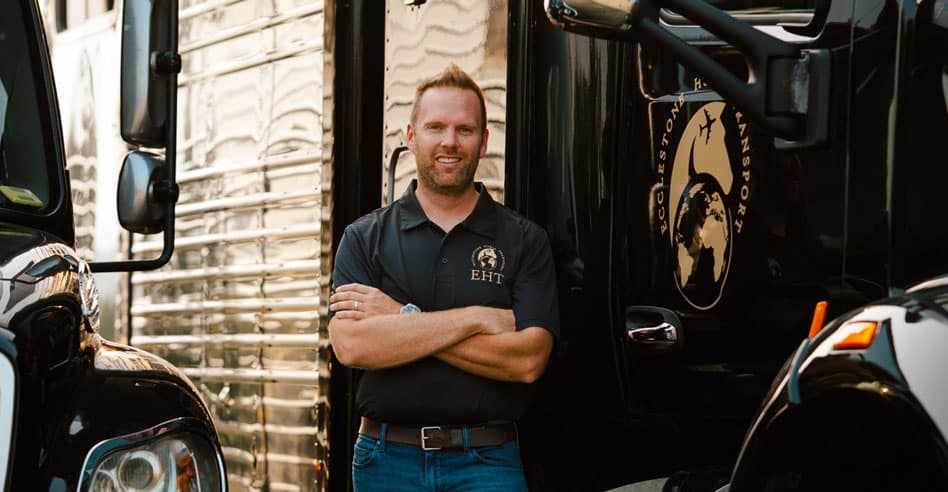
Today, at 35, Ecclestone is the owner of EHT, as well as a horse owner, sponsor, Royal Agricultural Winter Fair board member and active participant in the equestrian community.
Although EHT has grown rapidly, Ecclestone’s connection to the horse industry was established long before the company’s first truck went on the road.
He grew up in Toronto with parents who supported his interest in horses. His first experience came through a summer camp operated by Diane O’Brien at the Whitchurch Pony Club. From there, he began taking lessons at the former King Equestrian, operated by Jim and Kathy Henry.
The lessons developed into a serious involvement in the hunter and jumper world. Ecclestone competed throughout his youth and teenage years, gaining an understanding not only of riding, but also of the culture and rhythms of horse shows.
His first job brought him even closer to that world. When he was about 15, Ecclestone began working at the Royal Canadian Riding Academy. He started as ring crew, later spent time in the show office and eventually helped manage events. The facility hosted different breeds, disciplines, competitions and organizations, giving him exposure to a much broader section of the horse industry than he would have encountered through the hunter/jumper circuit alone.
“That experience was invaluable because it exposed me to so many different disciplines and breeds that came through that facility,” he said.
Ecclestone studied radio and television arts at Ryerson University, now Toronto Metropolitan University. After later pivoting to a business program, he chose an entrepreneurial path and built a large riding school. It was through that business that the opportunity in transportation began to reveal itself.
“While operating the riding school, I began to see that horse transportation was becoming the dominant revenue stream of the business,” Ecclestone said. “More and more industry professionals started approaching me to arrange transportation, particularly for trips to Florida, and I recognized that there was a growing demand for a reliable, professional horse transportation service.”
Rather than remaining committed to the original business model, he followed where the demand was leading.
“As an entrepreneur, I understood the importance of recognizing opportunities and adapting to where the market was leading,” he said. “It became clear that transportation had the potential to grow into something much larger.”
EHT was founded in 2015 with a four-horse gooseneck trailer and a 15-horse tractor-trailer unit. The equipment was modest compared with the company’s current fleet, but the business quickly began attracting larger assignments.
Its first major trip involved transporting horses for Cavalia from Chicago to Toronto during the company’s North American tour. After EHT successfully completed the move, the company was invited to bid on the transportation contract for the remainder of the tour – and won the contract.
The assignment became an important turning point.
“The opportunity to secure the contract for the remainder of Cavalia’s North American tour demonstrated that EHT could compete with the well-established carriers,” Ecclestone said. “This experience validated our capabilities and opened the door to pursuing larger opportunities within our sector.”
EHT now operates 16 units and employs 13 people. The company transports horses throughout Canada and the U.S. and ranges from individual horses and domestic shows to major championships, border crossings and international flight connections. The company also supports international movements involving air travel.
Ecclestone believes the opportunity for a new company arose partly because the transportation sector was changing.
“I saw a growing need in the transportation market as many existing operators were aging out of the business and were not reinvesting in their equipment or operations,” he said.
At the same time, the value of many competition horses was increasing, and owners expected a higher standard of care during transportation.
“First and foremost, we are all horsemen at EHT, and it makes a big difference in how we approach our business,” he said. “At EHT, we are transporting some of Canada’s top horses, all of which have their own needs. We approach them all as individuals and cater to their specific care requirements.”
Ecclestone wanted the company to distinguish itself through customer service, modern equipment and strong biosecurity practices.
“EHT was built with the goal of setting a higher standard,” he said.
That meant investing in equipment and systems that supported the safety and comfort of the horses, but it also meant becoming more involved in the sport itself. Ecclestone did not want EHT to be a company that appeared only when a horse needed to move from one location to another.
“We believed in being actively engaged within the sport at various levels, building strong relationships and contributing to the industry beyond just providing transportation services,” he said.
That philosophy is reflected in EHT’s sponsorships, bursary programs and growing presence at major equestrian events.
The company has become involved with Angelstone and the Royal Agricultural Winter Fair, where Ecclestone has also joined the board. EHT has worked to make its horse show sponsorships more experiential through exhibitor hospitality, merchandise and other activities intended to add to the atmosphere of the event.
Ecclestone has said that sponsorship is not simply a marketing expense. He views it as a responsibility that comes with building a successful business within the horse industry.
“I think that we benefit off the industry every day,” he said. “It’s our lives. I think that we as business owners in this space have an obligation to help see that the sport thrives.”
A decade after EHT was founded, the four-horse trailer and single tractor-trailer have grown into a 16-unit fleet serving clients across North America and beyond. The scale of the business has changed considerably, but Ecclestone says its success has also brought a greater responsibility to the community that helped build it. For him, EHT’s role is not simply to transport horses, but to support the people, events and organizations that keep the sport moving forward.
The Latest