When Greenhawk Equestrian Sport opened its first U.S. store in Natick, Massachusetts, just over two years ago, the plan was simple: learn. The Canadian retailer had ambitions to expand south of the border, but rather than attempt a massive rollout, CEO Ian Russell, President Garry Millage and the senior Greenhawk team decided to open one store, figure out the American market and build the infrastructure required to operate in another country.
Then Dover Saddlery collapsed, and an opportunity appeared that would dramatically accelerate that timeline.
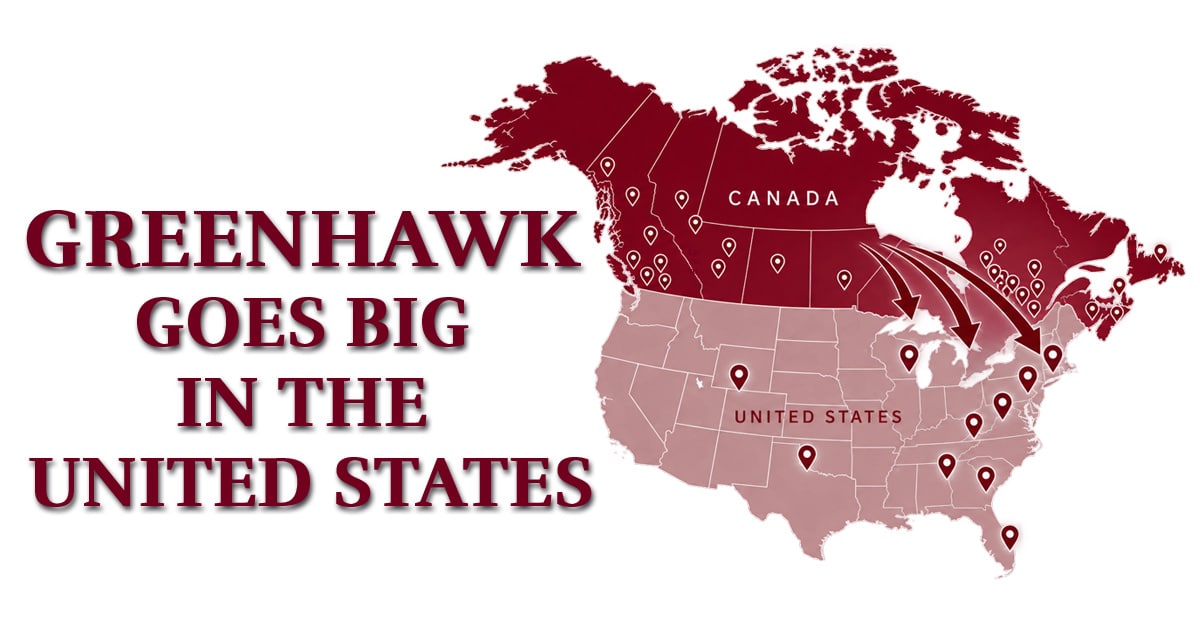
Greenhawk is now preparing to open 10 new U.S. stores starting this fall in retail spaces formerly occupied by Dover. Locations include: Wellington, Florida; Alpharetta, Georgia; Chantilly and Charlottesville, Virginia; Dallas, Texas; Branchburg, New Jersey; Aiken, South Carolina; Ridgefield, Connecticut; Libertyville, Illinois; and Parker, Colorado.
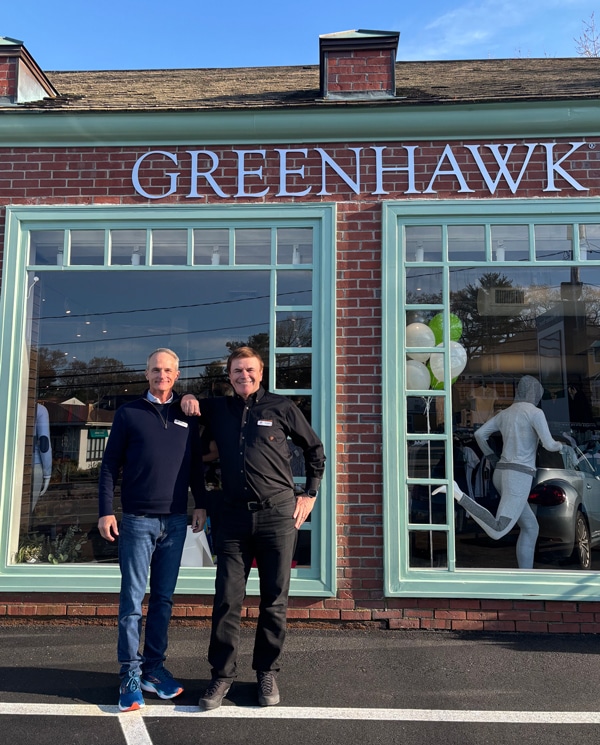
Greenhawk CEO Ian Russell and President Garry Millage in front of the new store in Nantick, Massachusetts. (photo courtesy Greenhawk)
With its existing Natick store and 49 Canadian locations, Russell says the expansion will bring Greenhawk to approximately 60 stores across North America along with its sizeable Canadian e-commerce site and its growing USA site. It is a remarkable next chapter for a company that was founded by Russell’s father, Gordon Russell, in 1985 in a 20-foot trailer on the backstretch at Mohawk Raceway in Campbellville, Ontario. Greenhawk gradually expanded from the racing community into the broader equestrian market, eventually becoming Canada’s largest equestrian retailer. Ian Russell took over as CEO in 1992.
As part of the expansion, Russell noted that the company did not buy Dover Saddlery, the Dover name, its customer database or its inventory.
“We have acquired ten former Dover locations. We did not buy the business. We did not buy the name,” Russell explains.
Instead, Greenhawk purchased store fixtures and secured the opportunity to negotiate new leases with the landlords. It is essentially taking over 10 former Dover spaces and reopening them as Greenhawk Equestrian Sport stores, stocked with entirely new merchandise.
Dover, founded in Massachusetts in 1975 by U.S. Equestrian Team members Jim and David Powers, grew into America’s dominant national equestrian retail chain. The company was first acquired by private equity firm Webster Capital in 2015 and then by another, Promus Equity Partners, in 2022. By this spring, control had passed to its lender and subsequently to restructuring and liquidation firm Gordon Brothers, which began liquidating its approximately 30 remaining stores.
The Dover name itself has since been acquired by an as-yet-undisclosed buyer, with the Dover website announcing that the brand will return under the ownership of a “dedicated, multi-generational horse family.”
Greenhawk, meanwhile, wanted something different from the remains of Dover’s physical retail operation.
The People Came First
Greenhawk selected 10 stores that Russell believed were in particularly strong equestrian markets, and resisted the temptation to take on more at once.
“We will continue to add stores,” he says of potential U.S. markets. “The initial 10 were our best markets to start in.”
And these are not small stores. Russell says the new locations range from approximately 6,000 to 11,000 square feet, with the Wellington store at about 11,000 square feet. All 10 will be corporate-owned, although he says U.S. franchising may eventually follow with different locations.
Asked what made those Dover locations attractive, Russell doesn’t start with sales numbers, square footage or geography. He starts with employees.
“The number one thing on the list was, can we get the former staff to come on board with us and help us open those stores?” he says.
Greenhawk wanted former Dover senior and middle management, but particularly store managers and frontline employees who already understood their customers and local horse communities. That effort, Russell says, has been overwhelmingly successful.
“I’ve always liked the Dover team. They are good people that are smart and passionate.”
Former Dover employees have joined Greenhawk at multiple levels, creating what Russell describes as two sides of an equestrian retail family finally coming together. The American operation will ultimately be run by an American management team, while Greenhawk’s experienced Canadian management will help establish systems and share best practices.
Starting With Empty Shelves
Greenhawk also chose not to acquire Dover’s remaining merchandise. From Russell’s perspective, that presents an advantage rather than a problem.
Long-established tack stores inevitably accumulate products that have sat unsold for years. Opening the former Dover locations with empty shelves gives Greenhawk the chance to build each store from scratch with current inventory.
“The opportunity was to put all completely brand-new contemporary merchandise on the shelves,” he says.
Doing that across 10 substantial stores represents a huge investment. Russell won’t disclose the number, other than acknowledging that Greenhawk is investing “many millions of dollars ” on the expansion, with inventory representing the largest component.
The response from suppliers, he says, has been overwhelmingly positive. Greenhawk already deals with many of the same international equestrian brands sold in the United States, meaning the company isn’t building a supply chain from scratch. Its relationships with some suppliers stretch back decades.
The initial U.S. assortment will emphasize brands North American riders already know, with Greenhawk’s own exclusive brands increasingly incorporated as customers become familiar with them.
Greenhawk’s exclusive labels, including Elation, Shedrow and Supra, have become a significant and highly regarded part of its Canadian business. In some categories, Greenhawk has worked with manufacturers for decades and spends years developing its proprietary brands. An Elation breech, he notes, can spend two years in development before reaching the store.
At the same time, he stresses that international brands remain critical to the business. Greenhawk has significantly expanded its sales of brands including Horseware Ireland, LeMieux and Ariat in Canada and expects established brands to be central to its U.S. stores as well.
There could also be an opportunity flowing in the opposite direction.
Greenhawk already carries Canadian companies including Mad Barn and Omega Alpha, and Russell expects Canadian products that make sense for the U.S. market to eventually appear in the new stores.
“It’s in our interest to see North American equestrian brands be successful,” he says. “It’s good for the sport. It’s good for the inventory selection. It’s good for the rider.”
A Bet on Bricks and Mortar
Perhaps the most intriguing part of Greenhawk’s expansion is that it represents an enormous investment in physical stores at a time when conventional wisdom has spent years predicting their decline.
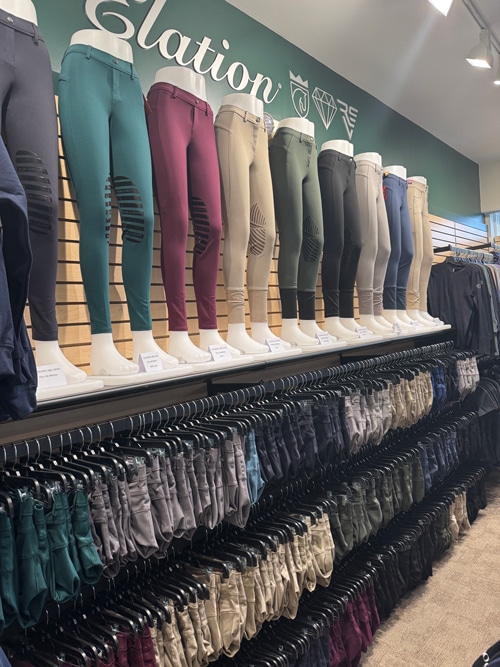
As Greenhawk did not purchase the existing Dover inventory, Greenhawk customers can be assured of fresh merchandise at all the new stores. (photo courtesy Greenhawk)
Russell isn’t betting against e-commerce. Greenhawk has an established online business and launched a dedicated U.S. e-commerce platform in 2025. But he believes specialty retail has something the internet can’t entirely replace.
“I think there is a comeback at retail,” he says. “It’s not like e-commerce is going away by any means, obviously, as it continues to grow.”
The difference, he believes, is whether a store gives customers a reason to visit.
“When stores are experiential. And when the stores exude passion, and the people managing the stores exude passion. I think it’s like a magnet to the consumer.”
Equestrian retail may be especially well suited to that approach. Riders want to try on helmets and boots, feel breeches, compare tack and, perhaps most importantly, talk to someone who actually understands horses.
“They want knowledge,” Russell says. “They want to walk into a store and talk to someone who rides.”
That philosophy helps explain Greenhawk’s determination to recruit Dover’s former staff. Russell believes the people behind the counter are as important to a successful tack store as the products on its shelves.
Bigger Could Also Benefit Canada
For Canadian customers, Greenhawk’s American expansion may eventually bring benefits closer to home.
Russell stops short of promising lower prices, particularly given inflation and the continuing uncertainty surrounding tariffs. But doubling down on scale gives Greenhawk substantially more purchasing power with manufacturers.
“If you go to them and you say, here was last year’s purchase order, and here’s this year’s purchase order, and it’s significantly bigger, yes, we’d like a better price, right?” he says.
Those savings can be reinvested in staff, technology and expansion, he says, while also helping Greenhawk hold or reduce retail prices where possible. A larger American business could also expose Greenhawk to brands or products that eventually migrate north.
The company isn’t finished growing in Canada either. Greenhawk opened a new Ottawa location at Wesley Clover Parks this spring, which Russell describes as “phenomenally successful,” and he says further expansion is planned on both sides of the border.
For now, though, there are 10 stores to open.
Wellington is expected to be first, with Greenhawk targeting late September, followed by the other nine. At the time of the interview, leases were signed, employees were being hired, fixtures were in place or arriving, and the biggest challenge was simply moving enough merchandise into 10 large stores. Russell expects all of them to be open within roughly two and a half months.
He is reluctant to claim that the expansion makes Greenhawk America’s largest bricks-and-mortar equestrian retailer, although after some consideration he concedes, “I think we are the biggest.”
It isn’t a title he seems particularly interested in pursuing.
“What I want to be is the best brand, the best equestrian brand in North America,” he says, “known, renowned for service, stock levels, friendliness, great prices.”
That ambition now stretches a long way from the trailer at Mohawk Racetrack where Gordon Russell started selling to horse people 41 years ago.
“My dad started this business 41 years ago in a trailer,” Russell says. “I’m sure he never imagined what we’ve become. I certainly didn’t.”
For Russell, however, getting there isn’t really the point.
“It’s not the end goal. It’s the ride.”
The Latest