We’ve all heard that ulcers are common in horses. Studies have reported gastric ulceration in approximately 40 to 70 per cent of sport horses, although the prevalence varies with discipline, management and intensity of work. The demands of training, competition, travel, changes in routine and periods without access to forage can all increase the risk.
With ulcers so common, it can be tempting to simply treat a horse showing suspicious signs and see if he gets better. But symptoms such as girthiness, changes in appetite, resistance under saddle and poor performance may make us suspicious of gastric ulcers, they do not give us a diagnosis. Even when ulcers are present, we still need to determine what type of gastric disease your horse has. Before you can choose the right treatment, you need to know what you are treating.
1. Not all gastric ulcers are the same
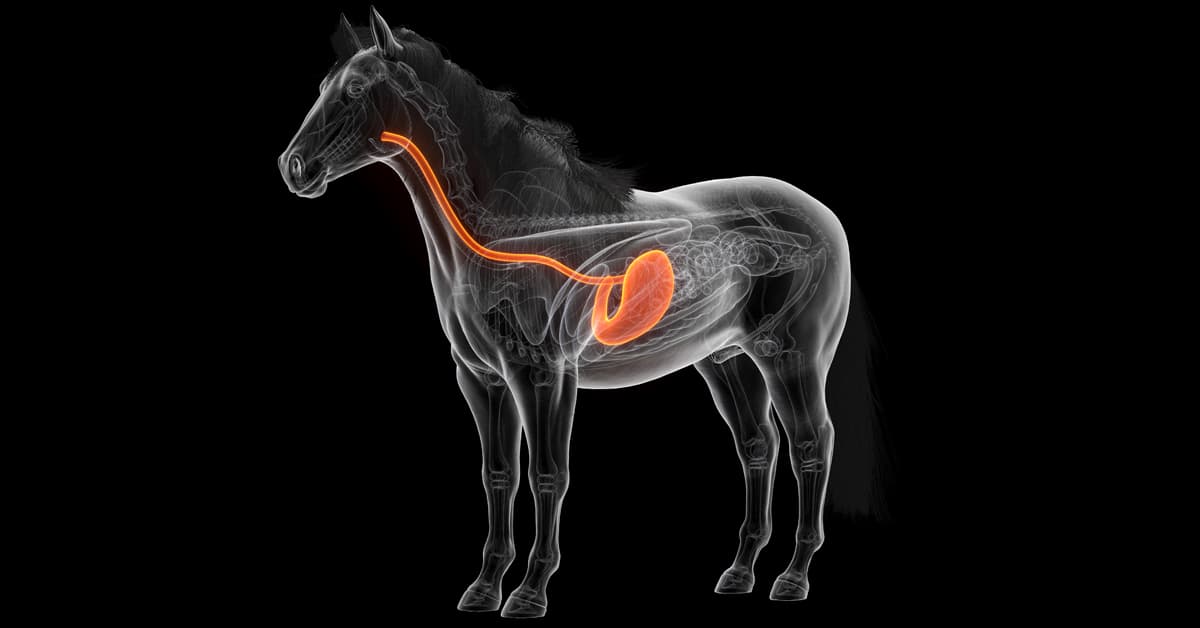
When we look inside a horse’s stomach with a gastroscope, we are essentially looking at two different environments.
The upper portion is lined by squamous mucosa. Ulceration in this region is known as equine squamous gastric disease, or ESGD. The lower portion contains glandular mucosa. Disease affecting this area is known as equine glandular gastric disease, or EGGD.
That distinction is much more than terminology. The two conditions behave differently and may require different approaches to treatment. Your horse can have squamous disease, glandular disease, both or neither.
That last possibility is worth remembering.
2. How Diagnosis Changes Treatment
If we find squamous ulcers, treatment commonly includes omeprazole, the medication in GastroGard, along with changes to feeding and management. GastroGard’s paste is formulated to protect omeprazole as it passes through the acidic stomach so it can be absorbed. Compounded omeprazole is not necessarily formulated the same way, and some preparations may not suppress acid reliably. Your horse might seem more comfortable for a time on compounded omeprazole, but an improvement in symptoms does not tell us whether the ulcers have healed. If acid suppression is inadequate, the ulcers may persist despite weeks of treatment.
Glandular disease can be more stubborn: omeprazole may still be part of the plan, but your horse may need a longer course or an additional medication such as sucralfate or misoprostol. The different medications for the two types of gastric ulcers emphasize the need for a diagnostic scope. A follow-up scope lets us see whether treatment has worked.
3. What we find when we scope horses
When a horse presents with signs commonly associated with gastric ulcers, it is easy to make the leap from ‘this could be ulcers’ to ‘this horse has ulcers.’ Gastroscopy sometimes tells us a very different story.
Of the more than 200 horses we have scoped in our practice, approximately 41 per cent have predominantly squamous disease. Another 39 per cent have a combination of squamous and glandular disease, approximately 6 per cent have predominantly glandular disease, and about 14 per cent have a normal stomach. These findings tell us that 59% of horses with ulcers will not respond to treating with omeprazole only.
Those numbers demonstrate something we see repeatedly in veterinary medicine: the same outward signs can be produced by very different problems.
A horse that is girthy or reluctant to go forward may have gastric disease. But discomfort involving the musculoskeletal system can also affect behaviour and performance. So can respiratory disease, dental problems, nutrition and a variety of other conditions.
If you assume the stomach is the problem and begin treatment without a diagnosis, improvement can be reassuring. Lack of improvement, however, leaves you with more questions than answers. Did your horse not have ulcers in the first place? Did he have glandular disease that required a different approach? Was another problem contributing to the signs? Or did he have more than one problem?
Diagnosis gives you a starting point.
4. Seeing what you are treating
Gastroscopy allows us to pass a flexible camera into the stomach and examine its lining. That changes the conversation considerably.
Instead of saying, ‘Your horse might have ulcers, so let’s try treating him,’ we can say, ‘This is what we found, this is where it is located, and this is how significant it appears to be.’ From there, you and your veterinarian can make an informed treatment decision.
There is another benefit that is sometimes overlooked. If your horse’s stomach looks normal, that is valuable information too. It means you can stop concentrating on gastric ulcers and ask the next question: if the stomach is not causing the problem, what is?
That takes us back to the whole horse. Depending on the history and examination findings, we may need to consider soundness, respiratory function, nutrition, dentistry or other potential sources of discomfort or poor performance. The goal is not to perform every diagnostic test available. It is to use the information we gather to decide which question should be answered next.
5. The economics matter, too
There is an understandable temptation to avoid the expense and inconvenience of gastroscopy and put that money toward treatment instead. But treating something that is not there is not saving money. Neither is using one treatment approach when your horse has a form of gastric disease that requires another.
This becomes particularly relevant when treatment continues for several weeks. You can spend a considerable amount of money before discovering that your original assumption may have been wrong. A diagnosis allows you to direct those resources toward the problem your horse actually has.
There is an old saying in veterinary medicine that if the treatment is not working, you should reconsider the diagnosis. We would rather establish that diagnosis at the beginning.
6. Treat the horse, not the suspicion
None of this means that every horse with a change in behaviour or performance needs to be scoped. It means that when gastric ulcers become a significant enough concern that you are considering treatment, it is worth asking whether you should first determine what is actually happening inside your horse’s stomach.
For the sport horse, this is especially important. Small changes matter. A little resistance, a subtle reduction in appetite or a slight deterioration in performance may be the first indication that something is not right. Your job, together with your veterinarian, is not simply to make that sign disappear. It is to understand why it is happening.
At McKee-Pownall Equine Services, we give horse people peace of mind with their horse health care by helping them make informed decisions.
Sometimes the most useful result from a diagnostic test is finding the problem you expected. Sometimes it is discovering something completely different. And sometimes it is finding nothing at all.
All three results move you closer to answering the question that really matters: what does your horse actually need?
The Latest