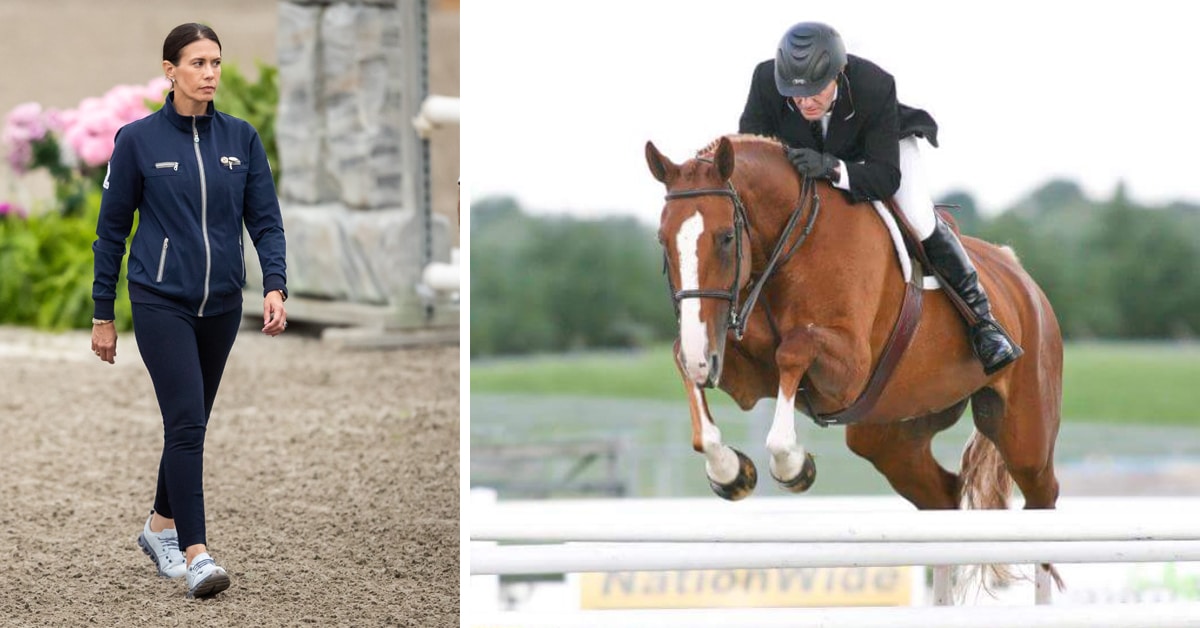
Jennifer de Neef of Mount Forest, Ontario has extensive international experience in the equestrian world as owner and co-founder of Triskel Equestrian (with French show jumping rider Yannick Patron). She currently holds Senior Equine Canada Hunter, Hunt Seat Equitation, and Hack Judging Statuses, “R” USEF licenses in Hunters and Hunt Seat Equitation and is a FEI Level 1 Jumping Judge.
What do you look for when a horse first enters the ring?
Outside of the hallmarks of good health, condition, and horse management, I look for four Ps: Preparedness, Polish, Poise, and Presentation. If a horse and rider are appropriately prepared, they will present with polish and poise, calm confidence. Confidence comes from competence, which comes from evidence of correct training.
Expression, attractiveness, quality movement, and conformation further help me to categorize a horse and/or horse/rider combination based on quality. I will often use a capital Q or lower-case q to annotate a quality category, HQ for High Quality, ExQ for exceptional.
I love scope, balance, and elasticity. For me, these characteristics serve as natural indications for athletic range, not just at the jump, but for movement. They account for the ability to cover the ground, travel down lines, and serve as the base of a good jumping trajectory. They help demonstrate brilliance and also help the horse adapt its centre of gravity to conceal mistakes with style.
Late lead changes, cross-cantering, and no lead change are errors where I strongly consider things like how often the error happens and/or does the error occur in both directions or just one.
What are the most common errors you see in the hunter ring?
Incorrect tack, inappropriately sized or positioned tack. Inappropriate class or division participation for a horse and rider. Inappropriate use of the stick on the shoulder.
Another one I call “I-95” is taking too much of an extended tour before jumping Jump 1. Another is arriving at Jump 1 under pace and behind the leg, causing a poor jump/landing. Jumping belly down with quick legs though tidy knees is often confused for good technique, but it is simply quick legs, not a true/natural scopey bascule.
When you score a class out of 100, how much do certain errors cost you?
Numerical deductions are relative to the quality of horse. Depending on the error, it is possible that a high-quality athlete receives slightly more lenience for minor mistakes compared to a lesser-quality athlete.
The division is also highly relevant. The overly exuberant, authentically playful horse in an adult amateur hunter class could be scored lower for its enthusiasm versus the same horse with a professional rider in a green working hunter division where it might be better received.
This playfulness can carry positive annotation in a professional division where the rider is likely better equipped to cope with such enthusiasm, compared to the adult amateur or child rider who might not share the same finesse or skill (and therefore requires a little more containment on behalf of their equine partner).
Late lead changes, cross-cantering, and no lead change are errors where I strongly consider things like how often the error happens and/or does the error occur in both directions or just one. If the error is consistent and happens in both directions, it may indicate deficiencies that need to be professionally addressed. In addition, it needs to be clear if there is a safety issue with the error.
Lead changes or rails are usually good examples of scoring within a specific range. A quality mover and a quality jumper with a missed lead can sit in the high 60s, while a lower-quality competitor could sit in the low 60s. A spectacular jumper with a rail could sit in the high 50s compared to an average (or below average) jumper who will be scored in the low 50s.
I carry the same philosophy forward with other mistakes such as breaking step/pace, refusals, adding strides, ignoring a test, etc. Quality will always sit in the higher range of a standardized score block.
How do you break a tie?
Tie-breaking always comes back to the quality of the horse. The higher the quality, the higher the odds in one’s favour. Other factors such expression, presentation, quality of movement, and effort all contribute to tie-breaking. Easy-to-identify things like tack simplicity, turn-out, and style also contribute.
How can you best ride a hunter under saddle class?
Entice me with your first steps into the ring. Believe it or not, that first impression (for better or for worse!) will help me remember the entry for an indefinite time frame. This applies for all class formats and often serve as a reminder later on.
I do not necessarily look for a horse travelling in a specific shape or frame so much as a well-balanced, elastic, good mover ridden to showcase its strengths to the maximum.
Present yourself early. First impressions often happen before the class is called to order. Use all ring time effectively to showcase the best, most attractive characteristics of the horse and rider. The earlier a horse and rider can capture my attention in a positive way, the better. Once you know that you have my attention, don’t overdo it. It is possible to hover too much, and this becomes more of a distraction for not only me, but fellow exhibitors as well.
I do not necessarily look for a horse travelling in a specific shape or frame so much as a well-balanced, elastic, good mover ridden to showcase its strengths to the maximum. I prefer to see a horse moving in front of the leg with a light but present contact between horse and rider across the top that creates connection between the front and back end. They cover the ground with smooth action, a free shoulder, with good push behind. I look for ones that make me think I’d like to ride it (or depending on the division, that I would be confident to put my dearest friend or family member on).
I consider factors such as degree of flexion, amount of contact between horse and rider (includes hand, seat, and leg pressure), and conformation, to name a few. A smart rider in an under-saddle class will understand how to manage these traits and show the horse at its best. A crafty rider will use traffic to their advantage by positioning themselves to increase (or decrease) their visibility based on movement quality of their horse in each gait. This allows the pair to be seen (or hidden) to present the obvious qualities at the desired times.
The finishing line up should never be underestimated. Don’t just line up anywhere in the line of horses. Put yourself in the direct view of the judge to show your centered back number to ensure it’s not missed as the line-up is the your final reminder to the judge of who you are.
What is your advice for equitation and medal trips?
Outside the classically effective, beautiful position, riding with feel and understanding how to interact with the environment and the horse is important to me.
I like to see a proactive/confident rider that understands how to maneuver intelligently in their environment with the horse, while jumping how they perceive depth at speed, and be able to assess how jumping distance and trajectory affects stride length and ground coverage (especially in relation to other obstacles).
Overall, a rider who understands how they influence their horse, its centre of gravity, and how it travels is part of “equitation intelligence” and feel. It demonstrates one’s ability to process information and troubleshoot in real time to achieve a positive experience/result. A true competitor rides with calculated accuracy, identifies risk, and knows how to apply the “risk to reward” relationship. Success with risk requires accuracy, foresight, and rider responsiveness to obtain the best possible result by preventing or limiting a poor outcome. It will often separate a good competitor from a great one and should be used as a tool to really highlight and showcase one’s strengths.
What is one thing that you wish trainers paid more attention to when setting up a horse/rider combination for the show ring?
Sport development mainly happens in daily training environments, not just the competition arena, in-gate area, or warm-up ring. As people responsible not only to the client, but also to the horses that grant us these privileges, we should all be held accountable to do our best by these amazing partners for all that they allow for us.
If people could learn things the right way from the very beginning and become educated with accurate knowledge, preparation, understanding of life around horses, etc., as trainers, riders, owners, and persons responsible, it would be far easier on everyone.
In addition, especially now with the requirement of certified and registered coaches, a listed trainer/coach should be educated and up-to -date on the rules and regulations of the federations and sport bodies.
Not being aware of even the basic rules and regulations for competition, horse welfare, tack/equipment, etc., exposes the trainer/coach, owners, and competitors to unnecessary risk, poor results, and some cases, elimination and/or disqualification that might otherwise be preventable with a little bit of education and preparation.
I am very passionate about horsemanship, “the why”, and education, and do my best to apply this ethos. I believe in sustainability, and that it is best achieved by remembering that patience and proper application of good skill and knowledge supersede shortcuts.
Do all judges judge the same?
Judges are trained to understand and apply the rules, regulations, and standardized scoring system in theory for each discipline. I believe that judging is a personalized expression of the sum of the accumulated experiences as a horseperson (for better or worse) that creates a philosophy that as officials we have the possibility to share.
We all have different experiences, levels of exposure to sport, and depth of industry participation that shapes our philosophies. My own judging decisions filter through a thought process that has been shaped – and will continue to be shaped – by my own previous experiences, shared experiences with others, and/or mentally archived “things” relating to horses, scenarios, athletes, other officials, and people over time.
Personally, I value and embrace the ability to communicate and interact with my peers, colleagues, trainers, competitors, and owners in positive ways that encourage positive education and development.
The Latest