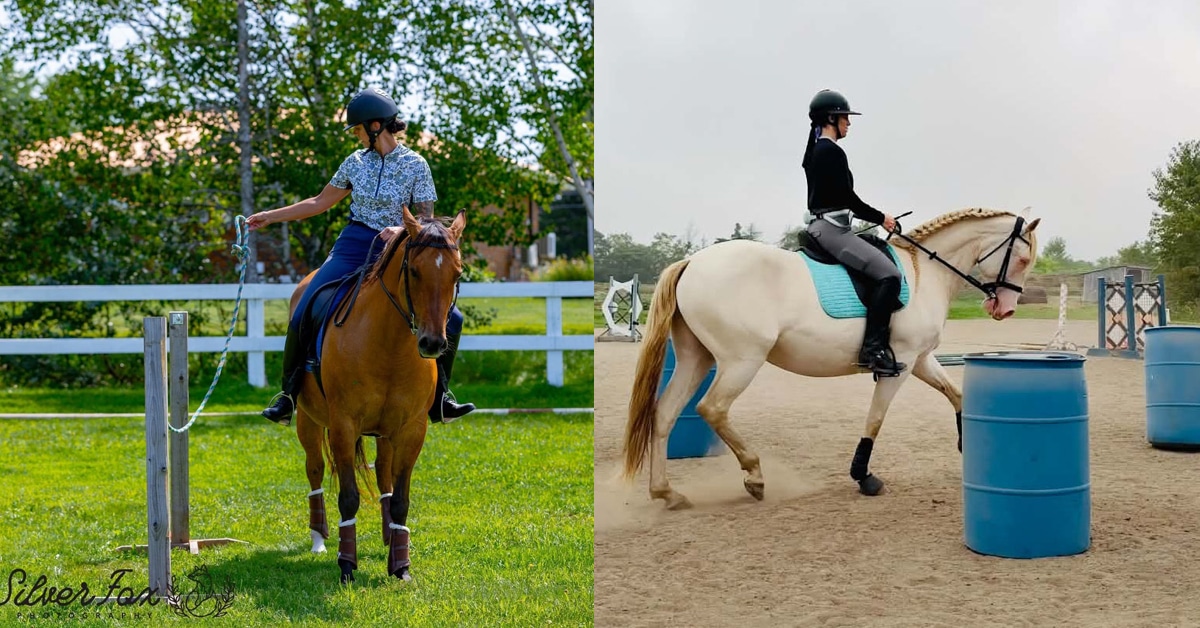
From the first time Noemie Wheatley picked up a garrocha pole and navigated a bell corridor, she was hooked on working equitation.
The Prince Edward Island rider heard of the discipline 10 years ago from western dressage clinician Lesley Elchuk. What started as a small group with Wheatley and some rider friends learning the basics of the sport from Elchuk has grown into an interprovincial grassroots organization, East Coast Working Equitation, with 100 members.
Working equitation (WE), a sport started in Europe in 1996, combines classical horsemanship with traditional ranch work skills, such as seen in Spain, Italy, France and Portugal. Competitions have up to four phases: dressage; ease of handling (an obstacle course with gates, bridge, etc); a speed phase; and an optional/advanced cattle handling phase.
The discipline has slowly been growing in pockets of Canada over the past decade, but its popularity is gaining momentum.
“People are starting to see it more and it’s getting more attention on social media,” says Kristi Newman, EC coach and founder of the Silverfox Equestrian Club in Whitby, Ontario who recently added working equitation to her barn’s dressage and eventing lesson options.
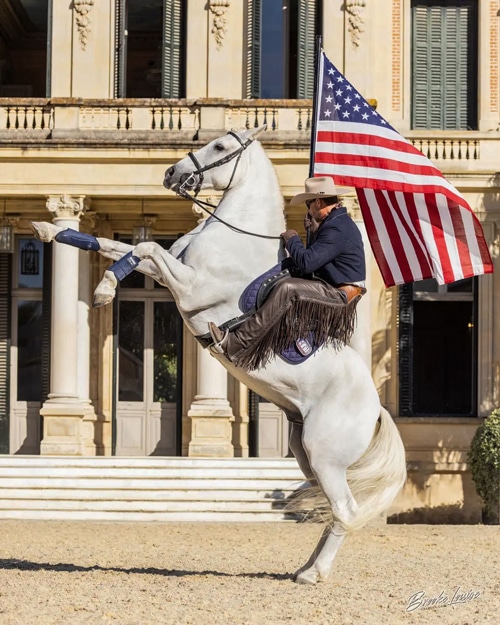
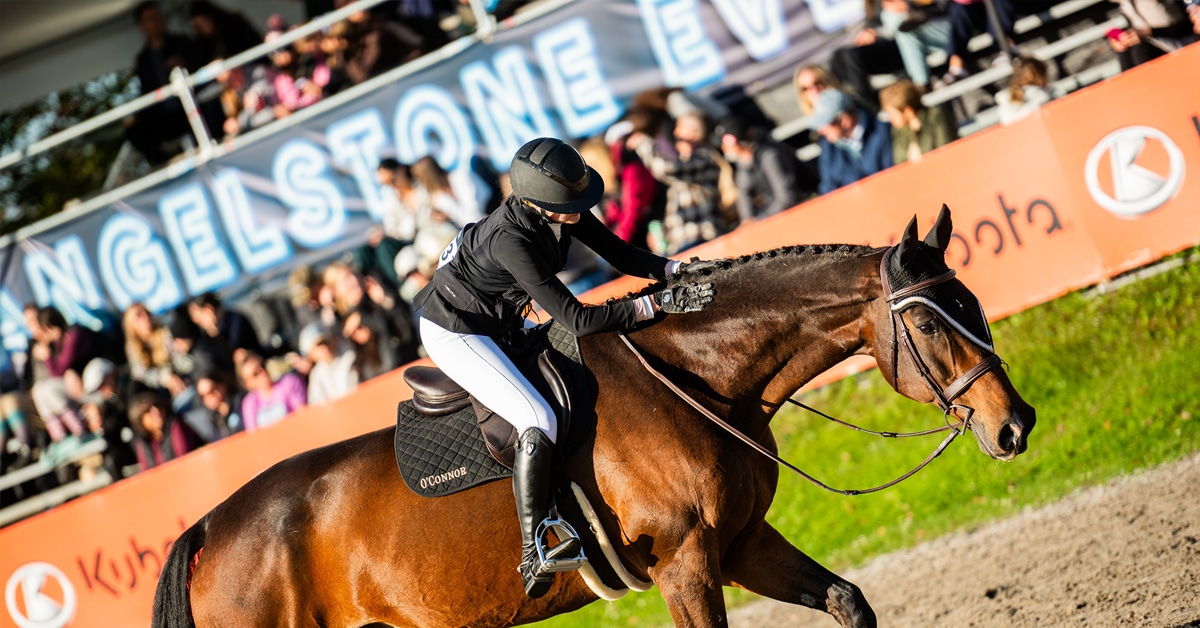
Matt French (a former Medieval Times rider) and his mustang Navarro helped the US team place 8th at the recent Worlds. (Rearing is not a required skill!) (Brooke Louise Creative photo)
Videos of American rider Matt French riding his rescued reservation mustang, Navarro, at the World Association of Working Equitation (WAWE) World Championships in Jerez de la Frontera, Spain, in September went viral on social media, with hundreds of thousands of view to date. highlighting the Cinderella story of French and Navarro, while raising the profile of the sport. (For the first time, a Canadian Working Equitation team competed at the same championships.) Matt will be giving a clinic at Stonehedge Stables in Stratford, Ontario July 30 and 31, 2027.
Inclusive and Challenging
“Once people see it, they can’t unsee it,” Newman says. “It’s very inclusive and it can be very challenging. People are challenged by the sport, not by each other. There is a big camaraderie and it’s friendly.
“At the lower levels, anyone can do it,” Newman adds, but riders who enjoy challenge will find a high degree of technical skills are required at the higher levels. The introductory level, the first of seven, includes dressage and ease of handling phases, that riders negotiate at walk and trot and ride with two hands. As riders progress, the speed phase is introduced, and at Level 6, they must ride with one hand. Cattle phases are optional, though mandatory at WAWE world championships for team competition.
“It’s a bit of a showy sport and I love that you can wear western tack and clothes. It’s less stuffy than dressage and uses more skills,” says Newman. “It’s less abstract than disciplines like dressage where you may think you rode a good test, then the scores don’t reflect that. In (WE) ease of handling, each obstacle is scored. You either speared the ring with the garrocha, or you didn’t. I think that’s going to be appealing.”
Mallory Haigh, owner of Jamesview Dressage near Belleville, Ontario was focused on dressage until she tried Working Equitation a couple of years ago, “and I haven’t looked back.” She has loved Lusitanos since she was a child, and imported a dressage-bred one four years ago from Portugal with the intention of doing FEI dressage, but he came with challenges.
“I did an introductory WE clinic and watched my horse turn on in a different way,” she says. “The challenge it presents is like nothing else. It’s a more classical way of working with the horse. It’s very much dependent on the horse and rider relationship.”
Haigh says it that can be done with any breed, and while the recent WAWE World Championships had many Lusitanos, there were also Mustangs and Quarter Horses. Clinics Haigh’s held have attracted eventers, western, dressage, hunter-jumper and pleasure riders.
She says “every single movement in dressage” has an application in ease of handling. She often incorporates WE obstacles to help her students improve dressage skills, such as using the garrocha/bull line to teach straightness, and barrels to achieve bend.
“I hear from people looking for something different,” says Wheatley. “They might have a versatile horse that’s a jack of all trades, master of none. I appreciate dressage and enjoy western trail, and for me, Working Equitation is a blend of those two. You do dressage and obstacles. You don’t need a fancy horse, you don’t need to replace all the equipment you have (you can ride in any type of saddle). It’s so versatile and welcoming.”
Our Own WE Identity
East Coast Working Equitation is an interprovincial organization that brings together riders from New Brunswick, Nova Scotia and Prince Edward Island interested in growing the sport. It’s a member of the Island Horse Council.
Wheatley says Canada has to forge its own WE identity, as the sport is new here, and the horses and riding culture are different from Europe’s. Her East Coast WE group is tailoring the discipline to suit Canadian/Maritimes riders.
“We want to make it easy for people to learn,” Wheatley says. “We don’t disqualify riders for errors on course, for instance. We’ve taken the sport and simplified it at the grassroots level.”
They’ve added an in-hand WE class at their shows so people can expose their young horses to the obstacles, and offer a children’s lead-line division and a grasshopper class, where coaches accompany their young riders in the ring.
“We are even discussing the rule about garrochas (the long pole used in WE) and reducing it from eight to twelve feet to six to ten feet, as some riders struggle with the long pole. It’s difficult to hold onto a green horse as well as holding a garrocha,” says Wheatley.
Newman is planning to hold a WE pop-up clinic at Silverfox in mid-October; Silverfox’s assistant trainer Ciara Tonno just returned from training in Portugal with WAWE World Champion Gilberto Filipe. Silverfox also has a 10-acre farm in Wellington, Florida and in addition to serving as a base for its dressage students who come south, a WE course will be set up there for riders to school. There is a healthy contingent of WE riders in Florida, says Newman.
Canadian Organizations
Canada has two national Working Equitation clubs: Working Equitation Canada, formed nine years ago, and the Canadian Working Equitation Federationformed in February, 2026. Both are volunteer, not-for-profit organizations.
Presently, WECan is Canada’s official organization recognized by WAWE. WAWE accepts member organizations that are recognized by their country’s national equestrian federation. However, if the national federation, such as EC, has not yet formally recognized the discipline, a dedicated national WE association can be accepted by WAWE, as in WECan’s case. Only one organization per country can be a WAWE member.
WECan has its own proprietary rules, governance structure and licensed officials’ programs (though no LOP applications are being accepted presently). It does not work with independent local or regional groups, but instead has 15 WECan chapters across Canada. Its rules are copyrighted and written permission must be obtained by organizers to use these rules at all non-sanctioned events, including clinics and schooling shows. It managed the selection process for the first Canadian team to ride at the WAWE Championships in September.
Its stated mission is to highlight the functional use of horses in ranch work true to the traditions of the sport’s founders in Europe, inspire riders’ involvement in the sport, and nurture a passion from national participation to international competition.
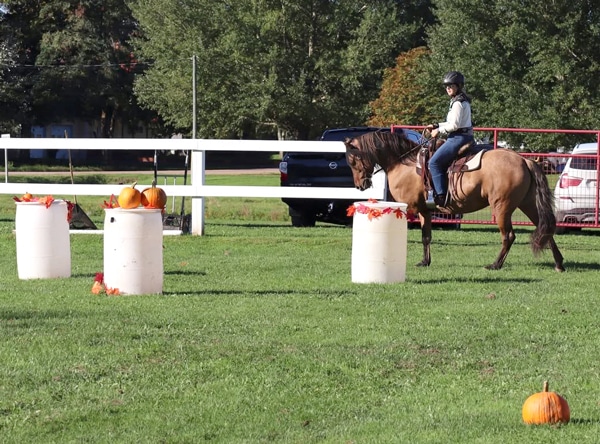
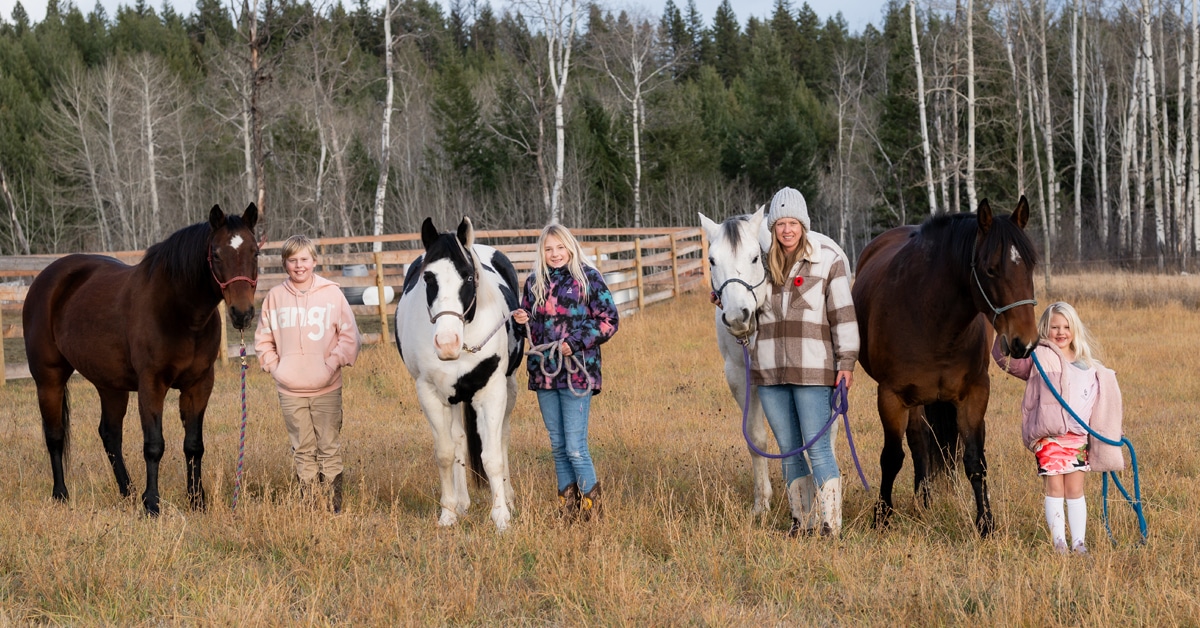
Part of the appeal of working equitation is that it is challenging, but can be done by all ages of riders and all breeds of horses. (East Coast Working Equitation Facebook)
Among the reasons CWEF was formed, according to president Kimberly Cox, was in response to members’ issues with WECan, including lack of transparency, refusal to submit code-of-conduct matters to an independent external review, revoking of memberships, and lack of response to questions including on financial matters.
CWEF’s goal is to become a transparent sport organization with an infrastructure to grow the sport safely and fairly for all levels of participation. Its rules and programs are developed to align with EC standards, which Cox says is an important step toward achieving credibility as an organization.
CWEF also plans to offer an alternative path for those wishing to become licensed WE officials, including technical delegates and judges. WECan’s LOP (Licensed Officials Program) is its own and does not recognize existing officials in dressage or other disciplines. CWEF has designed its officials’ program to align with EC standards and will recognize existing EC officials from other disciplines in its LOP.
CWEF rules will be available to anyone who wants to hold a clinic or show without having to seek permission, to make the sport more accessible.
Currently, there are four CWEF board members and two directors at large. CWEF intends to work with Regional Stakeholders Groups, with each stakeholder group having one representative on the CWEF board. These groups would operate with their own governance and programs, as each group will have different priorities and needs.
CWEF does not have a goal to send a team to the next WAWE championships; its current mission is to build a solid foundation for the sport from the grassroots up, for all levels of riders.
In April, CWEF applied to become a Category C, or Special Interest Affiliate, with Equestrian Canada. WECan contacted EC in August to also inquire about the Category C affiliation application process, confirmed by EC CEO Meg Krueger. All current applications are on hold until EC completes its operational review.
Category C status provides a formal affiliation with EC for registered national or regional equine organizations not represented by other breed or industry affiliates. Category C organizations are responsible for leading, supporting, governing and advocating for equestrian activities within their jurisdictions, while recognizing EC as the national governing body for equestrian sport. Presently, Category C does not include voting member status or automatically provide access to EC programs and services. CWEF members will not have to become EC members even if CWEF achieves Category C affiliation.
However, Krueger says as part of the EC Leadership and Collaboration Forum planned for February/March 2027, the board will be engaging with existing and potential affiliates, including CWEF and WECan, to review membership structures and affiliations and explore how the model could be improved going forward.
Looking Ahead
Beyond their different approaches to developing the sport, the emergence of two national organizations raises broader questions about governance, accountability and the future of working equitation in Canada. As the discipline grows, issues such as independent dispute resolution, transparent decision-making and the separation of governance and operational responsibilities will become increasingly important. These are challenges facing sport organizations across Canada, and ones highlighted in the Future of Sport in Canada Commission’s March 2026 report, which called for stronger governance standards and greater accountability throughout the sport system.
The Latest