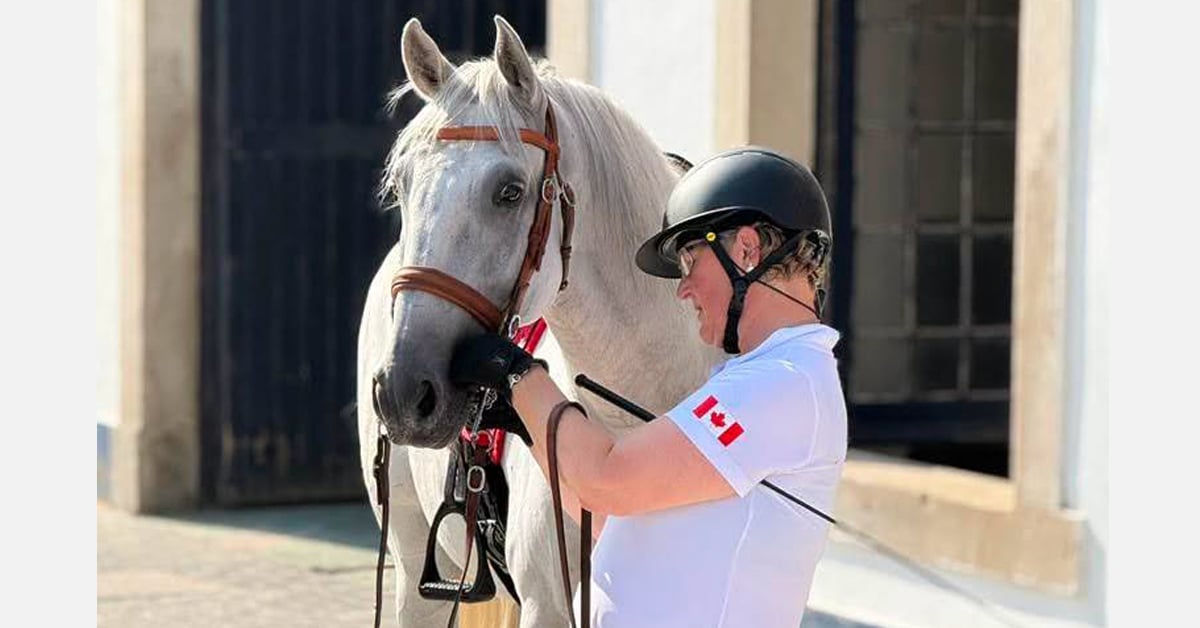
For the first time, Canada sent a team to the World Association of Working Equitation (WAWE) Championships in Jerez, Spain September 8 – 13. Team members were Susanne Zimmerman of Kelowna, BC, Ilona Berbekar of Calgary, Alberta, Pam Esteves of Oro-Medonte, Ontario and Kerry Marit of Cochrane, Alberta; alternate was Sarah Bradley of Roberts Creek, BC.
In the individual final standings (after dressage, ease of handling and the speed phase), Marit, Zimmermann and Berbekar placed 61, 63 and 64 in a field of 66 riders from 22 countries. Esteves did not ride as her leased horse was injured during transport to Jerez and did not pass the jog; Bradley was not activated as alternate. Berbekar rode her own horse and Marit and Zimmermann were on leased horses. The Canadian team withdrew from the cattle phase, citing the cows as too large; teams that do not participate in the mandatory cow trial lose team classification.
No doubt the experience was a valuable learning experience for the three Canadian riders who competed. There are also significant lessons for team selectors, governing bodies and those aspiring to ride on future WE Canadian teams to learn from Canada’s participation at its first Championships.
Bradley, Canada’s top-ranked rider globally, and with the highest qualifying scores, sent a letter with a comprehensive list of recommendations to the Working Equitation Canada (WECan) board for consideration prior to future international competitions. As well as being a Masters level Working Equitation rider, Bradley has been short-listed and long-listed multiple times to the Canadian eventing team and is a high performance and EC Level 3 coach.
Here are some of the main recommendations raised in Bradley’s letter to the WECan board:
Establish Horse-and-Rider Qualification Standards: Athletes must qualify on the horse they will ride at Championships, so qualifications apply to the specific horse-and-rider combination seeking selection. Bradley recommends a two-tier qualification standard: At international or WAWE-level competitions, horse and rider combinations must meet the baseline qualification, and at national competitions, require a score above the international baseline to account for possible differences in national and international judging. The goal: A qualification standard that is measurable and applied consistently to every prospective team member.
Establish a Formal Alternate Rider Policy: Clearly define the role of the alternate in writing before selection and address expectations such as travel, horse transportation, accommodation, credentials, financial obligations, activation procedures, participation in team functions, etc. Clearly establish whether the alternate is considered a member of the Canadian team. If selected athletes are expected to undertake the expense and responsibility necessary to remain competition-ready, their position should not be ambiguous.
Some of the issues Bradley faced prior and during the competition: No routine check-ins regarding her and her horse’s status or preparations; no inclusion in team meetings or discussions, or integration with the Canadian team at the venue; no provided team uniform or riding jacket. Bradley also paid for her own admission to the venue after being told she would not receive entry credentials. On September 3, she was told she would not be activated – a mutual decision as her horse’s owner needed time to complete paperwork/logistics to get the horse to Spain. On September 8, with two hours’ notice, she was asked to activate and ride another horse, then the request was withdrawn.
Increase Team Selection Objectivity: Selectors must be publicly known in advance of decision making. (One of the confidential WE selectors was a professional colleague of Bradley’s). Selection processes should be heavily weighted on objective, performance-based criteria, with competition scores forming a substantial component. Where factors other than scores are necessary, those factors, their purpose, and relative importance should be known.
Publish Evaluation Rubrics: Any subjective component of team selection should be supported by a published rubric or scoring matrix. Athletes should know what is being evaluated, how each criterion is weighted, who is responsible for evaluating it, and how those evaluations contribute to the final selection decision.
Establish Regular Team Communication: Regular team meetings should be scheduled leading up to major international events, with participation by selected athletes, alternates, support personnel, team leaders, and the ITD Chair. During the championship, short daily team briefings would ensure that everyone understands schedules, responsibilities, horse welfare concerns, changes in plans, and decisions affecting the team.
Define Decision-Making Authority: A written chain of responsibility should identify who has authority to make decisions regarding team composition, alternate activation, horse substitution, veterinary or welfare concerns, logistics, and other matters.
Create Clear Logistics and Financial Policies Expectations: Expectations re: travel, horse transportation, accommodation, accreditation, team clothing, entry fees, and other expenses should be communicated before athletes make significant financial commitments. Alternate-specific logistics should be established as early as reasonably possible. This would allow athletes and horse owners to make informed decisions about financial and logistical commitments required for international competition.
Conduct a Formal Post-Championship Review: Following each international championship, the organization should conduct a structured debrief involving athletes, the alternate, team leadership, relevant support personnel, and appropriate committee representatives. Participants should be given an opportunity to provide feedback confidentially
WECan issued a statement October 1 saying the board of directors had received a copy of Bradley’s letter and invited her to meet with the board, the international development team committee and selection committee, but she declined.
WECan said it had already initiated a review of the 2026 international program, gathering feedback from the five riders, grooms, chef d’equipe, team coordinator and the committees mentioned above. It said the review would be overseen by an impartial WECan board member, who will compile feedback and develop recommendations to present to the board, and once complete, outcomes of the review will be shared with the WECan general membership.
More News