Twelve-year-old Marlies Irwin has been having a fun summer in the Ontario show ring, competing in Training Level Junior Bronze dressage classes on Fancy That, a 20-year-old Oldenburg mare.
While her mom, Grand Prix rider and coach Tina Irwin, is thrilled that her daughter is embracing dressage like her parents (her dad is Grand Prix rider Jaimey Irwin), she wishes more youth were involved in the discipline. While there’s a lively community of adult amateur women at the Irwins’ Stoney Lake Equestrian in Stouffville, and a handful of teens, there are no kids Marlies’ age.
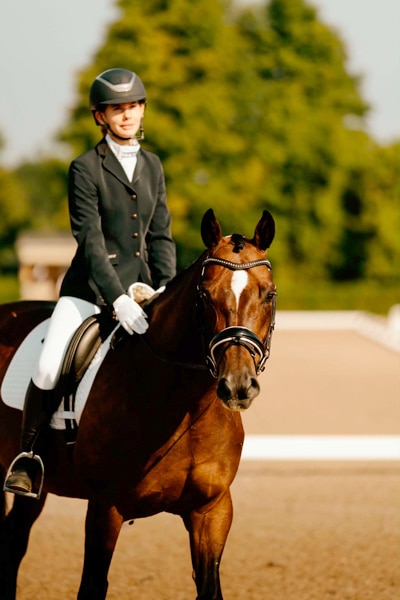
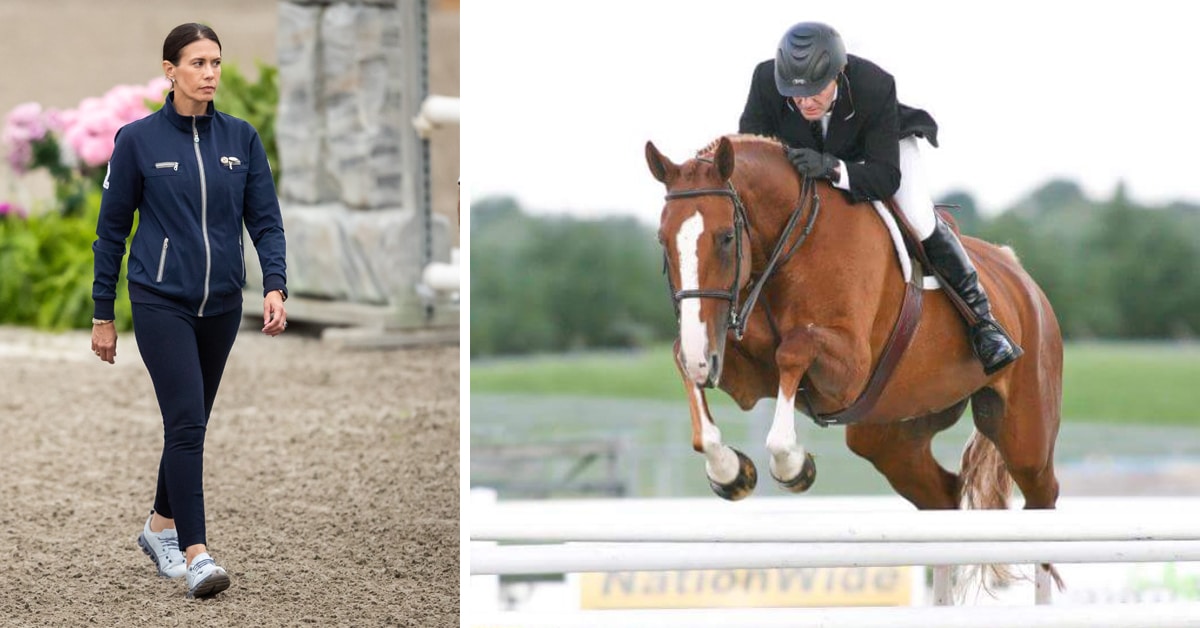
Marlies Irwin and Fancy That, her mother’s former Grand Prix horse. Schoolmasters can be tough to find, as many are ridden until retirement, or sold on.
That is typical of most dressage barns in Canada, where the demographic is mostly adult amateur women in their 40s and beyond. Why are so few kids choosing to take up dressage, or staying with it, and what can be done about it?
“It’s not only dressage, it’s riding, period,” says Siri Ingebrigtsen, FEI trainer and rider, who owns and operates at Avant-Garde Equestrian Farm in Luskville, Quebec. “One factor is cost, and another is that parents don’t have the time or don’t want to drive their kids and stick around. Parents used to drop their children off, left for three or four hours, and came back. Today, SafeSport won’t allow that. It’s a problem to get parents to commit.”
Irwin says lessons, boarding, training costs and show fees have become luxuries many families can’t afford. Developing an in-barn social group, such as where kids can chat while cleaning tack, is difficult too, since Equestrian Canada has adopted the Safe Sport program. The ‘rule of two,’ requires at least two screened adults (coaches, parents, or volunteers) to be present at all times, and a minor can’t be left alone with a coach. A parent typically has to stay while their child is at the stable.
Anna Swackhammer and Kiara Williams-Brown, recently appointed to the Ontario Dressage board as its first co-directors of youth advocacy programs, agree multiple factors are hampering youth participation. With a voting seat, they will advocate for the needs of young riders. Swackhammer is working toward the U25 Grand Prix level, and Kiara Williams-Brown is an FEI dressage rider and multi-medalist at the North American Youth Championships.
They say the financial demand, limited access to mentorship, geographic barriers to quality training, difficulty finding a barn with lesson programs, and fewer horse-and-rider opportunities are hampering youth participation. Many young riders are interested, but don’t know how to take the next step, whether that’s finding a coach, attending their first clinic, or entering their first competition.
Emmanuelle Lord of Pakenham, Ontario, an Equine Canada Competition Coach who owns Kehres Lord Dressage with her husband, Daniel Kehres, says in her area just east of Ottawa there aren’t enough barns or enough trainers to train dressage, especially to children.
“Not enough people even know what dressage is,” Lord says.
An Image Problem?
Irwin says dressage has an image problem. “One thing Jaimey and I talk about is when you look at our sport, unlike other sports like hockey, there are not a lot of role models. When I was growing up, you knew all the top dressage riders and aspired to be like them. There are not a lot of role models in dressage now, or they are not brought to kids’ attention.”
Swackhammer’s and Williams-Brown’s role models were their mothers. Williams-Brown grew up at Queenswood Stable and her mother is Grand Prix rider Simone Williams. Swackhammer’s mother rode dressage, and was coached by Ute Busse at Sonnehof Stables.
“We are still going on hacks, cantering through woods, doing cavalettis. You have to have a variety of things and part of it is horsemanship.”
Irwin says many people are intimidated to approach high-performance riders/trainers like her or her husband, but she says “we’re not scary and we want to teach people.” Irwin says a few years ago there was a proposal to form teams of youth riders, amateurs and pros to act a buddy system, but it never happened.
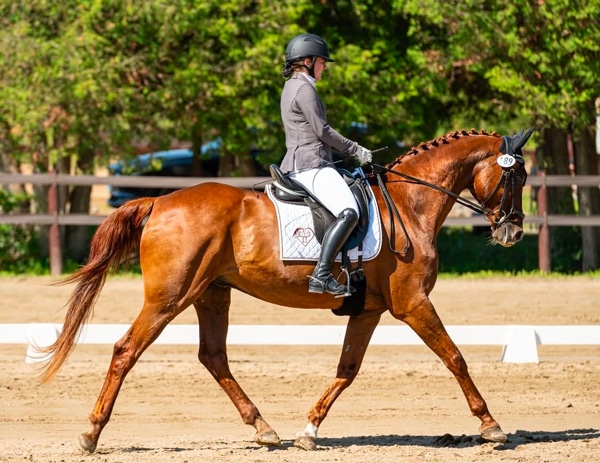
Arianne Fournier, shown riding Fuerst Gemini, owned by Carolyn Healy, discovered a love for dressage in her mid-teens. (Hold Your Horses photo)
The Rising Stars Youth Dressage Program started in British Columbia in 2015, with the aim of encouraging participation of youth riders. It’s now a country-wide Equestrian Canada recognized program. Riders who are 18 years and younger as of Dec. 31, 2026, are automatically eligible for Rising Stars ribbons, awards, and prizes at Training, First, Second Level and FEI Children, FEI Pony and FEI Junior divisions at shows.
“It’s a super program that gives the kids the social aspect, and partners them up to become a team. It’s a great way for kids to know each other,” Irwin says.
But to get to shows, kids first have to learn dressage. And there’s the perception is that it isn’t as fun as other disciplines such as jumping, or is limited to riding in a ring.
“I disagree,” says Irwin. “With the right coach and environment, dressage can be fun. It is challenging and rewarding. We are still going on hacks, cantering through woods, doing cavalettis. You have to have a variety of things and part of it is horsemanship.”
Ingebrigtsen also believes it’s important to get kids out of the ring to hack and do other things.
“We are not just drilling dressage (at Avant-Garde). We start our young horses long-reining and we try to teach kids how to do that, for example.”
The need for schoolmasters
Fournier of Luskville, Quebec, discovered a passion for dressage in her mid-teens. She was 15 years old and looking for help with a mare she wanted to event when she started taking lessons with Ingebrigtsen eight years ago. Ingebrigtsen told her she needed to first improve her dressage skills.
“I got good training and never went back to eventing,” Fournier, now 23 and a coach herself, says. “I really liked Siri’s farm. She was really supportive and I got a lot of good opportunities.”
When Fournier’s own horse didn’t enjoy dressage, she got to ride several of breeder Marie Gravel’s horses at Avant-Garde Farm, including Esscapade MOA, an Arabian mare trained to Third Level Fournier continues to compete with, along with Carolyn Healy’s Fuerst Gemini, a gelding trained to Prix St. Georges.
“In Europe, there is an abundance of horses and a lot of people will give their horse to up-and-coming riders,” says Irwin. “That doesn’t happen often here. Schoolmasters are what these kids need, as they quickly learn from these horses that are gems. People may have a horse like this here, but ride it themselves or sell it.”
Although Irwin was concerned that her former Grand Prix mare, Fancy That, would be too much horse for Marlies, who was moving up from a pony with coaching from Marlies’ grandmother, Ute Busse, the pair has clicked.
The path forward
Ingebrigtsen and Fournier are big proponents of a U.S. program, Dressage4Kids, started by Olympian Lendon Gray. The non-profit organization provides educational and competitive opportunities for youth riders and the adults who support them. These includes clinics, intensive summer and winter training, unmounted programs, and a horse donation program that matches donated horses with a young rider. Its annual flagship event, the Youth Dressage Festival, for riders from ages four to 25 in Saugerties, New York, is a three-phased competition with a written test, dressage test and equitation ride. There are also fun events such as stall decorating contest, costumes, etc.
“We don’t have anything fun like this,” says Ingebrigtsen. “It’s a very good program and it has a lot of sponsors. Here, everyone is doing their own thing, and it’s almost like cliques in barns. In the U.S., it’s more inclusive.”
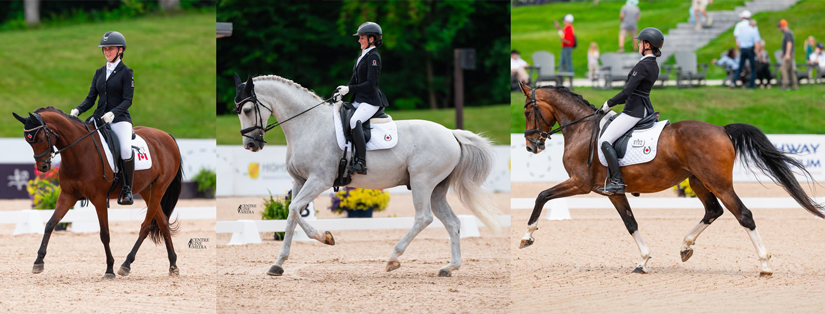
While the dressage pool of teens and pre-teens may not be large in Canada, the talent is undeniable, highlighted by their recent gold medal performance in the FEI Children’s Team competition at NAYC. (L-r) Annabelle Gauthier and Northwind Marrakesh, Estella Gosniak and Impact, and Isla Grant and Wonder Woman. (Centre Line Media)
Fournier has found D4K programs “invaluable” in her own development. What she’s learned has influenced her own teaching – such as using Dollar Store balls under kids’ elbows and other games to make riding fun, and incorporating theory and groundwork. Fournier has three adult students and about the same number of kids who ride biweekly.
“Ultimately, our goal is to help cultivate a long-term development pathway that encourages more young riders to stay involved in the sport and become the next generation of athletes, coaches, volunteers, and leaders.”
“I would like a bigger lesson program, but you need to find good horses to match to riders,” she says. She and Ingebrigtsen like to encourage young riders who shown an interest. Ingebrigtsen will exchange help with chores for lessons, and Fournier will exchange lessons for having a student help at shows with things such as removing bell boots or wiping a horse’s mouth before they go in the ring.
Irwin says Germany’s annual Horses & Dreams international competition has a popular lead line class for riders ages four to 10. At least 40 small children are in the main arena on ponies with handlers. The judge stands in the middle and comments on riders’ positions, and participants get ribbons and medals. Irwin says a similar program in Canada could be do-able at the lower levels.
Swackhammer and Williams-Brown say one of their first initiatives with Ontario Dressage is development of a Youth Dressage Development Series. The goal is to create a clearer pathway between riding schools and participation in dressage by increasing the accessibility of education and mentorship opportunities. These will include clinics, virtual lessons and webinars, athlete Q&A sessions, and educational presentations. The aim is to support riders from first introduction to dressage through competition levels.
“Ultimately, our goal is to help cultivate a long-term development pathway that encourages more young riders to stay involved in the sport and become the next generation of athletes, coaches, volunteers, and leaders,” said Williams-Brown. “Juniors and young riders are the future of our sport – they drive the growth and long-term sustainability of the dressage community, so investing in their development benefits everyone.”
The Latest