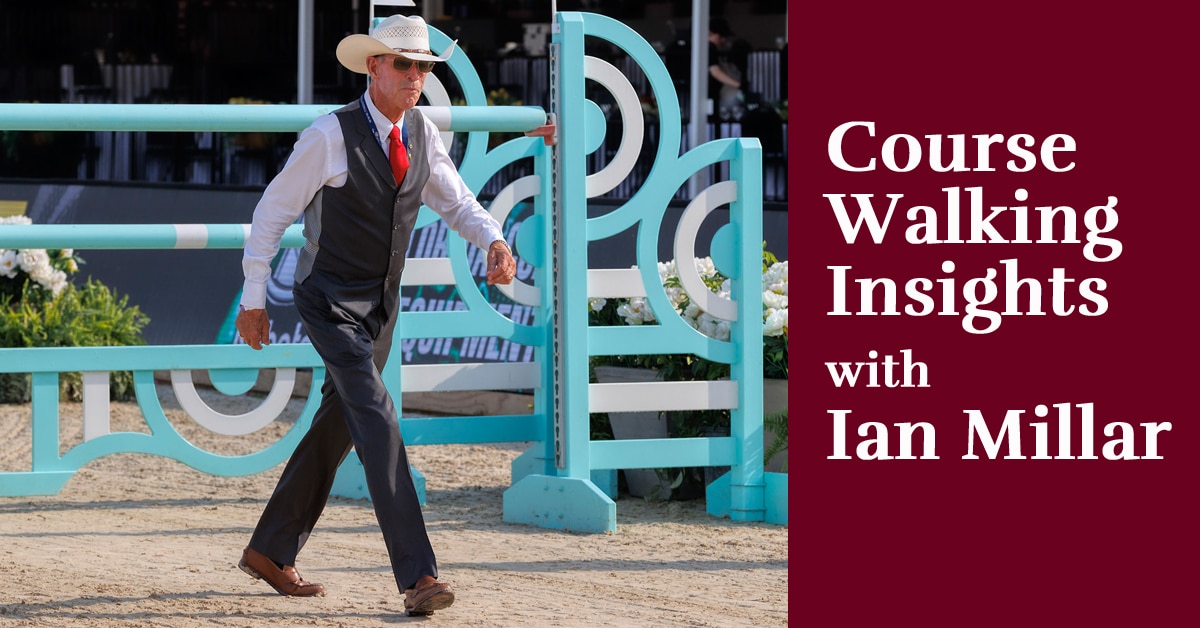
A few years ago, Ian Millar graciously agreed to wear a microphone and provide a running commentary as he walked a CSI2* $36k Table A 1.45m class. Ian is widely regarded to be one of the most analytical riders of all time and any opportunity to listen to him dissect a course is time well spent.
Recently, I collaborated with Ian to summarize some of the key messages from this course walk and we hope that the terminology and explanations expand the reader’s ‘toolbox’ when they plan their own course strategy.
The beauty of listening to Ian is his ability to blend competition experience, theoretical knowledge, and deep understanding of each horse and rider’s strengths and weaknesses to build a plan that is achievable.
~ Tim Worden
Considerations When Riding a Related Distance
- Horses typically gallop on a 12-ft (~3.66 m) stride, but course designers rarely measure on a 12-foot stride. Related distances will either be a little longer or a little shorter, requiring the rider and horse to adjust their stride. Additionally, the requirements before and after jumps will impact the gallop to a significant degree.
- In larger rings, course designers will often set distances on multiples of 13 ft (3.96 m). A main reason is that today’s competition surfaces are firmer and allow the horse to more efficiently cover the ground, while softer surfaces in the past would ‘rob’ the horse of power on each stride, resulting in shorter stride lengths.
- To walk a related distance:
-
- Place yourself at the approximate landing point after the first jump in the line.
- Put your eye on the second fence and plan the track that will get you to that jump efficiently.
- Begin walking and count off the strides in 12 ft multiples (i.e. 1 canter stride (12 ft) = 4 human walking strides (3 ft)).
- Arrive at the take-off point for the second jump and plan which ride will place your horse in the most effective position to jump (e.g. patient 7 strides, forward 6 strides, etc).
- Consider what happens before and after this related distance. While we walk courses in multiples of 12 ft, each related distance will ride differently depending on what came before and what is to come after. For example, a line can walk in multiples of 12 ft, but will ride shorter if a horse is carrying a lot of pace off the jump before. Or a 6-stride line may walk long (i.e. averaging 13 ft per stride), but if the line is approaching a large oxer requiring a powerful jumping effort, then it will actually ride nicely in 6 strides and give the horse-rider pair the perfect opportunity to build to this jump.
- Consider the time constraints. If the time allowed is tight, or if it is a jump-off, can you shave off a stride anywhere (e.g. taking a more direct line in a bending line)?
- The higher the jump, the steeper the jump’s trajectory will be – which will affect the stride on landing. The rider must always think about landing and immediately getting back on pace.
- After verticals you may land with a shorter and/or slower stride and it is critical to immediately restore the pace back to your required ring speed so that your eye will read the upcoming distance correctly. Your eye will perceive distances differently when you are travelling at 300 m/min vs 400 m/min.
- 90-degree turns are difficult to ride due to the awkward angle. The rider must get their eyes on the next jump as soon as possible. If you turn too early or too late there are limited options to fix the approach and get perpendicular to the next jump.
- A normal one-stride combination is 24 to 25 ft (7.32 to 7.62 m). If the course designer gives you an extra foot it typically gives the horse more room to execute the jump, but does not require much additional pace or effort.
- A 36 ft two-stride combination is considered quite tight by today’s standards, while 20 or 30 years ago this would have been a normal two-stride distance.
Figure 1: Example of a typical approach in round 1 (black dotted line) vs the track you would need to take in a jump-off (blue dotted line).
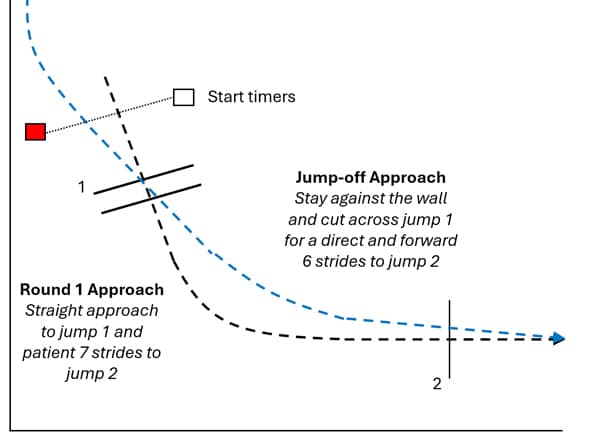
Figure 2: Example of a decision to take an inside (blue) line, or shape out when approaching a triple combination.
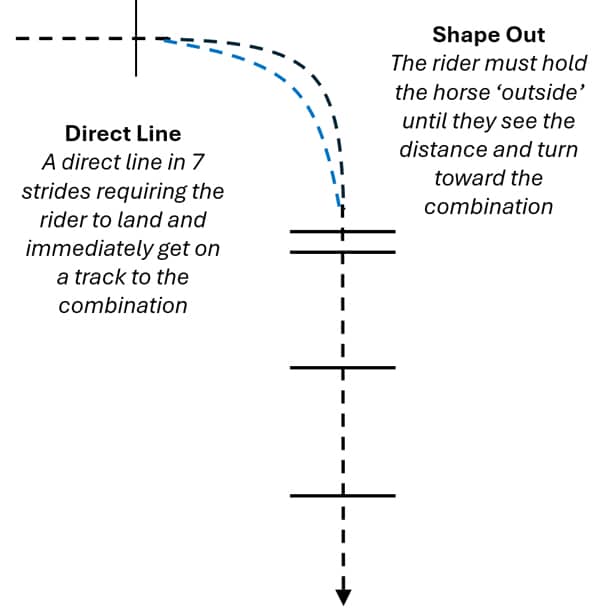 When analyzing combinations, the rider must determine the ‘key’ to jumping it successfully. For example, in this course there was a short rail vertical followed by a right turn to a triple combination (oxer 25 ft to a vertical 25.5 ft to a vertical). Here, getting a good approach and building to the big oxer needed to be the focus for the rider. It was up to the horse (using its athleticism and prior training) to figure out jumping the verticals – the rider could not do much in the combination itself to influence the jumping of these verticals. Since the oxer at A was the main challenge for this combination, the plan was to add some shape to the approach – having the rider land from the vertical and stay on the outside line until they spotted a distance where they could turn in and build toward the sizable oxer (resulting in an 8-stride approach). Ian’s cue was to ‘stay out and then spot when you can build into the combination…but remember that you need to actively hold and stay outside to do that’. Some riders chose to take a direct line (7 strides), but Ian was not a fan of this approach as it risks having the horse-rider pair arrive at the combination too soon with too much speed without giving them enough time to build into the oxer.
Turns to Jumps
Rollbacks to jumps, especially in the first round, are meant to force riders to choose whether they will turn back tight to a jump or risk time faults. The key here is efficiency. These turns are an extension of flatwork and training. If there is no other place to make the time allowed it can be done here, but riders should typically avoid doing tight rollback turns (especially when presented early in the course). In general Ian doesn’t love aggressive, tight rollbacks in the first round…he feels those questions should be reserved for jump-offs.
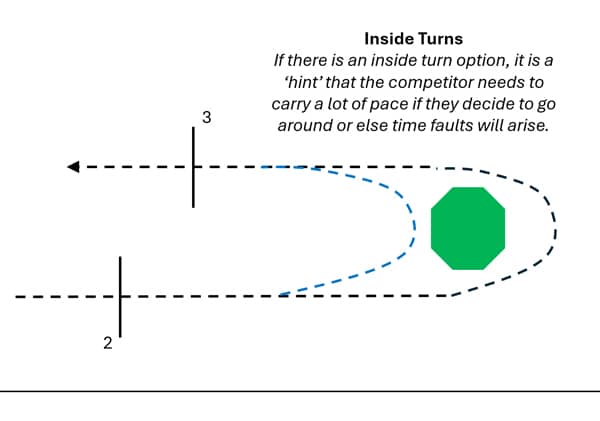
In those situations where there is an option for a tight inside turn, usually you do not need to take it in the first round (if you did it would indicate the time is too tight). However, these are hints to the rider that you must carry good pace when going around – time faults are guaranteed if you just lope around the turn.
When turning to jumps that are impressive looking (e.g. large oxers) it is critical to have pace and a well executed track (don’t go out too far but don’t come in too tight). The take-off location will be a bit longer to account for jump height and the pace you are carrying on approach. Always think about building into it!
There will be times when you want a horse to come across the jump at as great an angle as possible to set up a better approach into a bending line. This is something that needs to be trained often at home so that horses have the confidence to execute this in competition.
Figure 3: Example of a potential inside turn in this class. Ideally in the first round you would carry good pace and go around. In the jump-off you would need to turn inside to be competitive.
Jump Builds
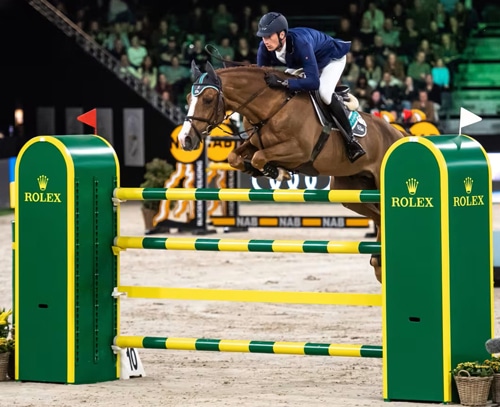
(Rolex Grand Slam of Show Jumping photo)
For the Rolex jumps with multiple sets of tracks (one at the front of the jump standard, one in the middle, and one towards the back of the standard), rails placed on the front tracks (as shown in the photo at left) are more difficult for horse’s to jump because their visual system detects the width of the standards and they perceive there is more room than is actually available (i.e. the horse gets drawn closer to the jump than their optimal take-off location). Conversely, rails placed on the track toward the back will produce better jumps from horses.
Water trays under jumps are designed to cause horses to drop their eye level, altering balance slightly and lowering the take-off angle (potentially causing a rail).
When landing after a big oxer, especially if you turned in on the approach, horses will land shallow and not covering the ground…so it is critical to get them moving forward so that you can sit up and balance to the next jump (if needed).
Short rail jumps are more difficult for horses to read due to reduced visual information (i.e. less width and contrast with surroundings to help gauge distance to the jump). For short rail jumps, triple bars and combinations, it is best to be perpendicular (at 90 degrees) on the approach.
Walk the course through the eyes of a horse. Their visual system is different from our own, so the rider must think about how their horse will perceive jumps, objects at the side of the ring, and so on.
An inviting oxer (not too wide and ramped) towards the in-gate is the easiest jump to have at the start of the course.
Summary
Building into large jumps is a recurring theme when Ian walks a course. He identifies the jumps that will require a powerful effort and makes sure to have a plan on approach that gives the horse the best opportunity to build up to it.
When he walks related distances, the decision on the approach/number of strides is never confirmed until he has considered how the horse will land coming into the line and what the horse must do after jumping out.
Ian is hyper-focused on the time allowed when walking the course. As times continue to get tighter, he is always reinforcing that pace needs to be maintained in corners and that certain cues from course designers indicate where riders really need to step on the gas if they want to avoid time faults.
He keeps detailed notes on where his horses have issues on course (jump design, approach, jump colour, etc). This information is used to develop an education strategy at home, where exercises are thoughtfully selected to address weaknesses in the competition arena. The ‘exam’ for the horse is the next competition – if Ian picked the correct exercises in training, then the horse will demonstrate clear improvements in the ring.
Ian mentions that walking a course, and the class itself, should be your sole focus. Plan your day in advance so that you do not have to juggle multiple commitments when you should be focused on big classes. Many young riders, especially, struggle to partition their days (for numerous reasons) to ensure they have protected time for competing.
***
Ian Millar is one of the most successful riders of all time, with a career spanning over five decades. Some of his accomplishments included being named to ten Olympic Games, an Olympic silver medal (Beijing 2008), being a 12-time Canadian National Champion, two-time winner of the World Cup Finals, three-time winner of the Spruce Meadows Masters Grand Prix, and producing over 100 horses to the grand prix level. He is currently the chef d’equipe for Canada’s Jumping Team and runs Millar Brooke Farm alongside his family in Perth, Ontario.
Dr. Tim Worden is a Canadian sport scientist who has worked with numerous FEI-level riders as a performance consultant and manager. He completed his PhD at the University of Guelph (Biomechanics) and specializes in applying high-performance training techniques to horses. He is passionate about disseminating evidence-based information and is frequently invited to speak at conferences around the globe on topics related to training program design, technical models, and workload monitoring.
The Latest