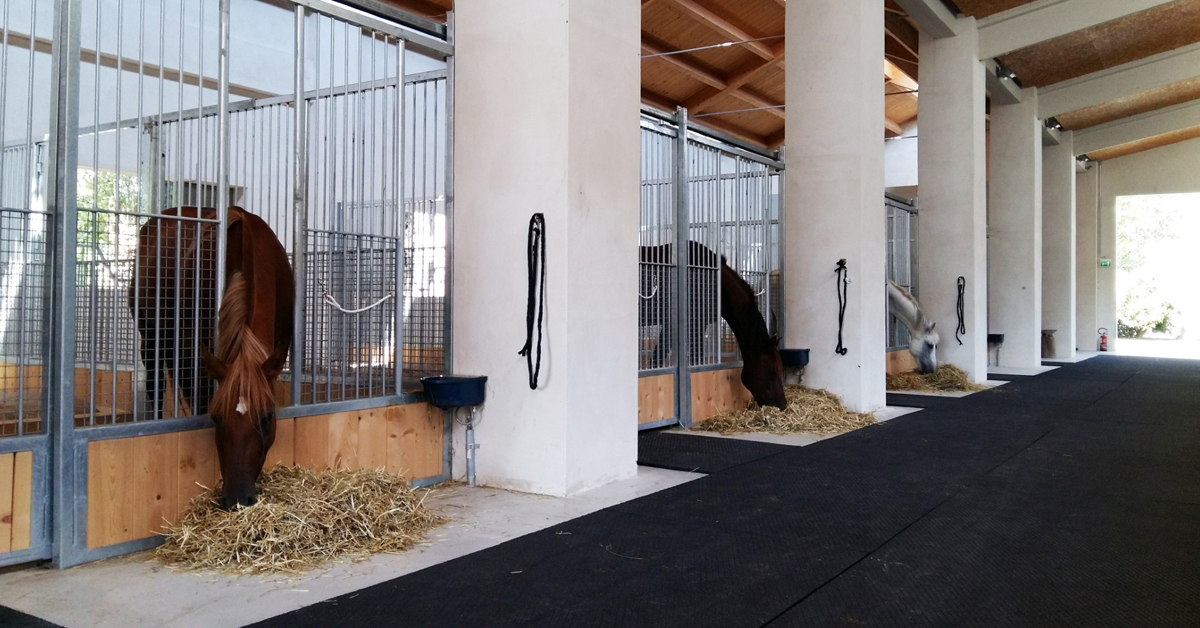
When HorseSport asked me to write an article about how the Five Domains Model might influence how we create or modify stable designs, I immediately turned to equine scientist Cristina Wilkins, editor of Horses and People, co-author on the latest revision of the Five Domains Model, and creator of the online course Applying the Five Domains Model to the Welfare Assessment of Sport and Recreation Horses. First, I signed up for Wilkin’s course, which I highly recommend to all HorseSport readers. Then I asked Wilkins for an interview.
I began our conversation asking Wilkins what she meant by good equine welfare. That did not work out well for me, as she immediately turned the question back on me and asked me how I defined good welfare. After a good bit of stammering and tripping over myself, I talked about what we provide for horses to make them comfortable, how they should be treated, and how (or even whether) we can provide horses with appropriate care while using them in sport.
She noted that what I was talking about was a care perspective and that care is not welfare. Indeed, my definition began and ended with considerations of the animal’s health and performance and was then viewed through the lens of what I was doing for the animal. A welfare perspective considers how well the animal is faring from the animal’s point of view.
Throughout the interview and as I delved into her course, this fundamental aspect of welfare was a recurring theme. What matters to animals in welfare terms is their perceived subjective experience. As Wilkins comments, “love is not a measure of welfare.”
The Five Domains Model
The Five Domains Model, originally developed by David Mellor in 1994 and revised numerous times since, assesses animals along five axes of:
1) Nutrition
2) Physical Environment
3) Health
4) Behaviourial Interactions
5) Mental State
(see the Five Domains Model chart here.)
Wilkins notes that Mellor’s Model shifts our attention from our perceptions of whether good welfare has been provided to “how the animal perceives, experiences, and copes with the conditions and situations that we impose” (Wilkins, 2023).
Refinements to the model over the years have emphasized that good animal welfare must go further than simply eliminating negative experiences. We also need to provide opportunities for positive and pleasurable experiences – for comfort, interest, attachment, confidence, agency, and so on. The latest revision also emphasizes evaluating the impact of human intervention (including zookeepers, veterinarians, shelter staff, livestock handlers, and you and me) – i.e. those who use animals for sport or competition.
The Five Domains Model allows us to break down the complicated question of good welfare into manageable chunks. Wilkins asks us to consider specific questions from each of the domains to objectively assess, situation related indicators (e.g. does the horse have access to a clean, dry, shelter with footing that would encourage lying down?), and animal-based indicators (e.g. does the horse voluntarily spend time in the shelter?).
If there is a hurricane outside and my horse is not using the state-of-the-art astoundingly expensive shelter that I just constructed, sadly, I have failed to provide good welfare. I can throw up my hands in frustration, or I can use the Model to keep looking across all indicators and all domains to determine why she might be reluctant and change it.
From the horse’s mouth
Wilkins remarks that, “The invention of the fence is a major technological turning point in the history of feeding and managing domestic horses.” Nomadic people migrated with their herd and aligned their lifestyle to the needs of the animals they kept. Once horses were confined, feed needed to be grown and distributed; feeding times became more rigid and the focus became human-centred. She encourages us to take even small steps to realign with a horse-centred perspective and bring our stables more in line with our horses’ telos.
Telos is the set of traits, characteristics, preferences, and interests that make the animal what it is – the “horseness” of the horse. Telos is critical to welfare assessment because it makes us step outside our own intuitions and assumptions. We need to look beyond pleasure and pain at the full range of possible experiences that matter to the horse to fulfill their nature, that are compatible with their evolved characteristics, and that align with their telos.
For example, when we evaluate whether a horse’s stall is of sufficient size to meet their welfare needs, we must compare that to what horses did before we came along – grazing with their lifelong buddies for 16 to 20 hours a day over vast ranges and covering approximately 30 km a day (McDonnell, 2025). Clearly none of that can happen in a 12’ x12’ stall; expanding it to a 14’ x 16’ stall makes us feel better, but does not bring the horse closer to realizing their telos. Rather, we need to think of housing from the point of view of what the horse would do in a natural environment and make even modest modifications toward emulating that scenario.
In the middle of our interview, I got a cramp in my calf and had to stop, jump up and walk around the room to stretch it out. Wilkins used my cramp to illustrate that horses need the ability to resolve negative experiences. She noted that it does not matter how many positive opportunities we provide, the horse will reap no benefit from them if they cannot resolve their negative experiences.
If, for example, she had insisted I ignore my cramp, and get back to the interview, it would have put me in an untenable situation. She noted, “We can’t think about anything until the cramp is resolved. Yet we do this to horses all the time.”
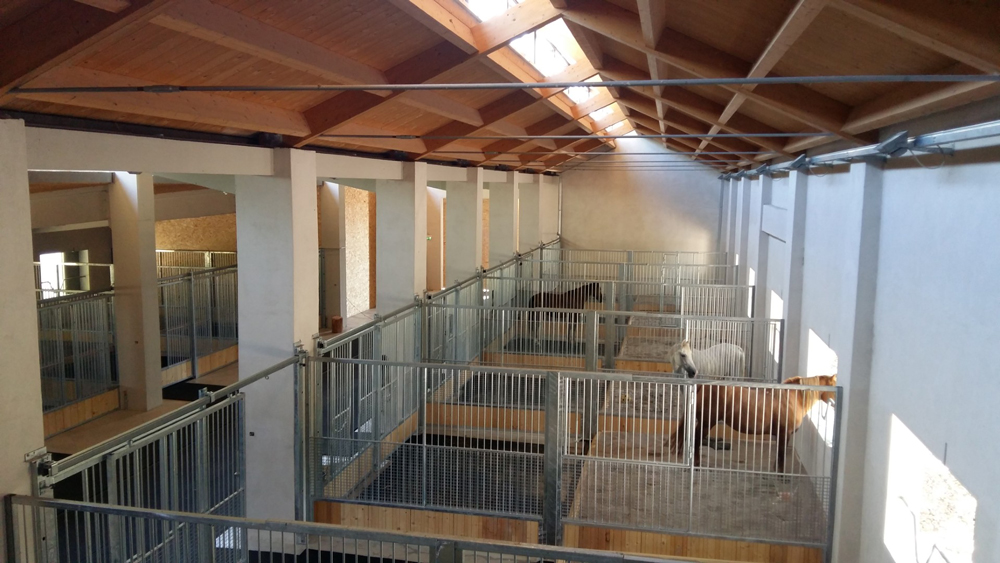
The metal stalls system at La Prospera Centro Equestre, designed by the architectural firm Oqu architettura, have openings to allow horses to see and interact with each other – a much more social and natural environment. (La Prospera Centro Equestre / Oqu architettura photo)
Resolving Negative Experiences
Typically, we believe that good welfare will be provided if we can eliminate negative experiences. Wilkins stresses that it is not practical or helpful to think about welfare in this way. Negative experiences are necessary; we need to feel thirsty to know that it is time to drink. What is important is that the animal can resolve negative experiences. Here are some of Wilkins’ thoughts on how we might do that.
Broaden visual horizons
As I have discussed at length in other articles, social interaction is the norm in herd living. Forming attachments with particular buddies fosters security and provides emotional support when perceived threats arise. Almost all equine scientists agree that simply seeing other horses is not sufficient. Horses need to be able to touch, groom, and physically interact even when housed in individual stalls.
Horses’ felt security also depends upon watching out for one another and knowing that others are watching out for them. With more horses on the job of keeping eyes and ears alerted to possible danger, the better the chances of averting a surprise attack. In herds, horses synchronize activities; everything they do – eating, drinking, resting, running, etc. – they do together.
Stalls that have solid walls from floor to ceiling prevent horses from touching, activities can no longer be synchronized, and horses cannot be a sentinel for each other – all working to disrupt this felt security. Once the horse lowers their head to eat or lie down, what minimal safety they may have felt is gone.
We can build in synchronization by managing horses as a group even when stabled individually – feeding, resting, exercising, or turning out at the same time. Stalls built with planks to the ceiling can have planks removed so that compatible neighbours can interact. Better still are stalls designed with visibility from floor to ceiling (see La Prospera’s dream barn). La Prospera’s exquisite stable is undoubtedly out of reach for most of us mere horse-poor mortals, but there are many creative ways to make stalls more horse-friendly and start thinking outside of the box (stall).
Build rather than sever friendships
Typically, equine bonds are discouraged in show stables; horses can become distraught when separated from a close buddy and become unable to concentrate on their job. But bonds between specific horses help buffer the stressors typical of show horse life. Rather than seeing these attachments as a problem to be remedied with immediate separation, Wilkins encourages us to see separation anxiety as a red flag that the horse is not coping in their current situation. Instead of removing their much-needed emotional support buddy, she urges us to build the horse’s security by modifying their environment and management to more closely align with their telos.
Equine scientist Andrew McLean proposes that separation anxiety tends to fade away when horses’ training becomes less mentally stressful – when lessons are consistent, predictable, and carried out with feather-light aids.
Separation tolerance can also be built with positive reinforcement training – separating horses for mere seconds initially and gradually increasing the duration, while rewarding the horse for calm behaviour before anxiety begins. Knowing that they will always return to their friend is yet another reinforcement and builds greater emotional security, so that soon close friends can work independently with confidence.
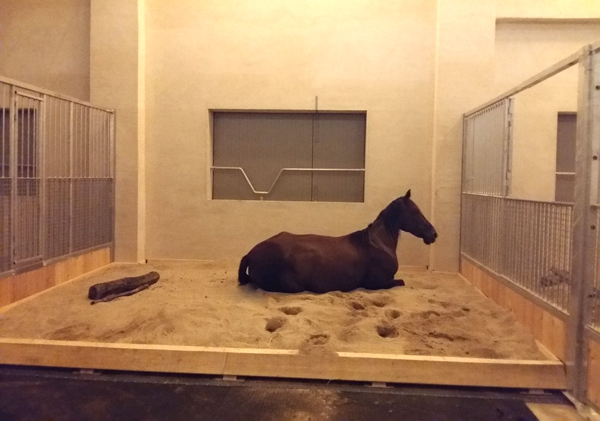
The stall is divided into two sections, with cushioned rubber mats in the front and sand in the back. The sand is washed and dust-free; underneath is a drainage system that allows urine to drain and get washed away with an automatic water system. Stall cleaning is easier because the manure doesn’t mix with hay or shavings. (La Prospera Centro Equestre / Oqu architettura photo)
Feed on the ground
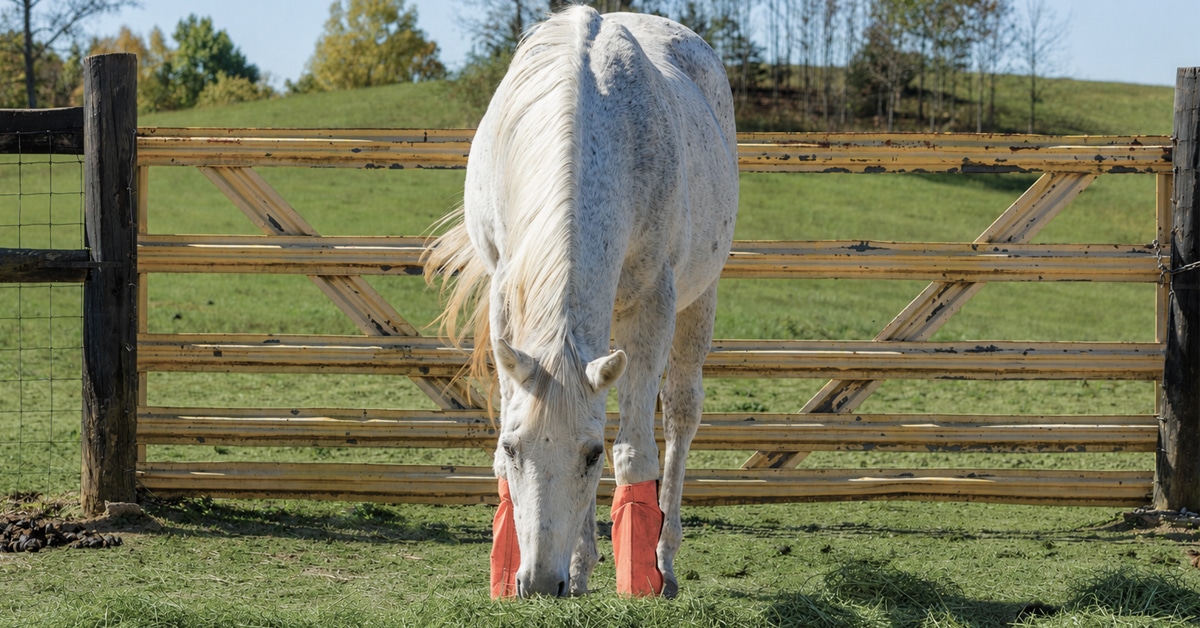
Spending the major part of your day with your head on the ground sounds cumbersome, but it works for horses. When horses’ heads are lowered in grazing, it drains their airway and so removes pollutants and dust particles in the air they breathe. When we restrict pasture, house horses inside, expose them to dust and ammonia, and lift their feed off the ground in haynets at chest height or higher we tax their respiratory resilience.
Wilkins encourages us to keep stables open, sweep when horses are outside of the stable, and allow horses to feed in a natural position either off the ground or in manger style slow feeders. And, where we have the situation to do so, it is not as radical as you might think to simply leave them outside, provided they have friends, hay, and appropriate shelter.
Consider the horse’s thermoregulation zone
A horse’s thermoregulation zone (the temperature range where one feels comfortable without blankets or clothes and without sweating or shivering) is much broader and colder than ours. Without clothes, we can comfortably maintain our core body temperature when the temperature range is between 20°C and 30°C. The horse’s thermoregulation zone is -5°C to 25°C, making them much more cold tolerant and heat sensitive than we are.
I find this new knowledge liberating. Instead of my former anxious deliberating … 100 grams? 200 grams? Hoody? No hoody? Now I generally ignore most mid to minor temperature changes knowing that my horse is quite comfortable. I am also more sensitive to when she may be finding it too hot. I remember an old-time hunter/jumper trainer commenting about the soaring temperature and humidity that it was “good hunter weather” (or as she said, “good honner weather”). She was referring to the horses’ heat-induced lethargy which would be well rewarded in the hunter ring where low affect and zero reactivity is a virtue. Yikes!
Ensure horses get their REM sleep
Have you ever seen horses out in a field where several of them are lying flat out on their sides and thought you were looking at some kind of equine Jonestown massacre? It is only recently that we now know that horses need total muscle relaxation to get REM sleep – as essential to them as it is to us. This is only achieved when they are lying out flat on their side or lying down with their chin resting on the ground.
Horses cannot get REM sleep standing up or even lying down with their head up. If they don’t get REM sleep, they may literally collapse into it. Sleep deprivation is more common that we once thought and horses who collapse can sustain serious injuries. Horses need to have dry, unthreatening, soft places to lie down. Here again, stalls constructed in such a way that horses can see all around them when recumbent can encourage an anxious horse to take a deep sleep.
Provide choices
In nature, horses choose when and what to drink or eat, who to hang out with, when to seek shelter, etc., but in our modern management systems most of these choices are denied. Wilkins cautions that when we impose our beliefs about what horses need, but without allowing the horse the opportunity to choose, we may not necessarily have improved welfare.
We address welfare from the horse’s perspective when we build in choices wherever possible – different forage choices, choice of friends, inside or outside, sun or shade, warm water or cold, and so on. Even small modifications – two forage choices instead of one, a bucket and an automatic waterer, the ability to interact with a neighbour or to walk away – all work toward improving welfare because we are checking back to the horse’s experience.
Care vs. Welfare
What struck me most about doing Wilkins’ course was how often I judge my horse’s welfare in terms of the care I provide. Within the confines of a show horse training stable, I do the best I can to provide her with the essential ingredients that I write about so often. Does it align completely with her telos? Not so much.
Shifting my focus to appreciate her perception of that care is challenging. I can’t interview her. Fortunately, she is not the silent stoic type; it is generally quite clear when things are not okay in her world. Still, my best guess of how she is faring is a crude measurement. The Five Domains model allows me to break down each element of her environment and assess it from her point of view, because good care does not equal good welfare.
The Latest