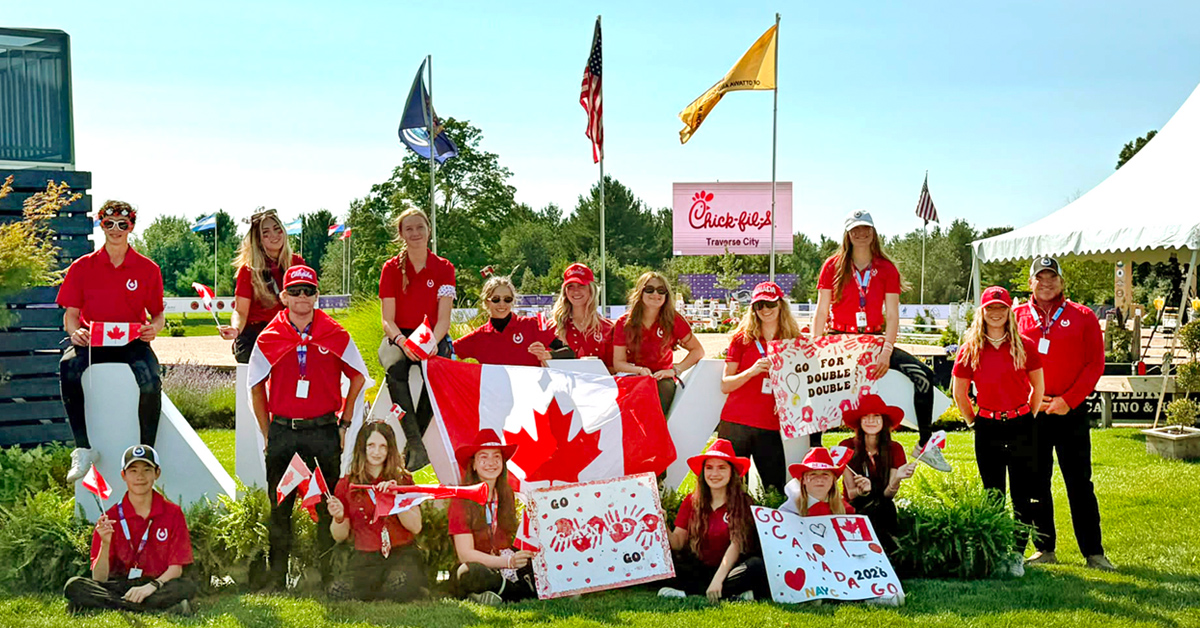
As the official carrier of Equestrian Canada, Ecclestone Horse Transport (EHT) is tasked with coordinating, managing and shipping the 12 horses that will represent Canada at the North American Youth Championships.
This requires considerably more than loading them onto a trailer and driving to Traverse City, Michigan. EHT collects the horses individually and brings them to a central staging location in Queensville, Ontario where they departed at 3 a.m. for the eight and a half hour journey.
“The horses need to depart from the Toronto area around 2:30 to 3 a.m. in order to arrive in Traverse City at their specified time for FEI check-in,” said EHT owner Kyle Ecclestone.
For many of the young riders, it may be their first experience travelling to a championship of this scale.
“We understand for a lot of these athletes, it’s their first time travelling to a significant competition like NAYC,” he said. “So we try and streamline the process for them as best we can, ensure that all the horses have a great journey, so they arrive ready to go.”
The company is also providing discounted transportation as part of its support for the Canadian athletes. Peter Gisborn is Equestrian Canada’s Youth Technical Advisor for Jumping and said that kind of assistance helps young riders gain access to important championship experiences.
“Kyle has stepped forward with a sponsorship to help get our athletes to these championships,” Gisborn said. “It’s fantastic that we get the support from companies like Ecclestone Horse Transport to help give these kids exposure to a championship like Young Riders.”
That exposure is important not only for the individual athletes, but for the future of the sport.
Arriving Ready to Compete
At a championship, transportation is not simply a logistical detail. It can influence how a horse feels and performs after arrival.
Ian Millar has spent decades preparing horses for Olympic Games, World Championships and major international competitions. In his experience, the transporter becomes part of the horse’s support team.
“If these horses don’t get to the competition rested and ready to compete, there’s no point,” Millar said. “That is where your shipper becomes a critical part of the team.”
The NAYC horses are being transported in 8’ x 8’ box stalls, which give them room to adjust their position and lower their heads during the journey.
Millar said horses often select a preferred direction to stand once they settle into a box stall. That makes it important for drivers and handlers to understand each horse’s behaviour and place hay and water where the horse can reach them comfortably.
Allowing horses to lower their heads is also an important consideration on longer trips. Millar explained that when a horse is tied with its head held up for extended periods, dust and particles from hay can enter the respiratory system. A box stall allows the horse to lower its head naturally.
“If they can put their head down, everything from the chest forward is going to drain onto the ground, and very little goes to their lungs. And that is why, when horses can ship and put their head down, they rarely get what is called shipping fever.” he said.
Millar added that he is reluctant to ship a horse tied-up for more than five or six hours. Beyond that, he prefers a box stall that gives the horse enough freedom to lower its head.
Drivers Who Understand Horses
The vehicles are only one part of the equation.
“The drivers have to be absolutely wonderful drivers, but they also have to be good horse people,” Millar said.
EHT trailers are equipped with camera systems that allow drivers to see and hear what is happening in the horse area.
“If these horses are shipping properly, it’s going to be pretty quiet back there,” Millar explained. “If there’s a lot of banging and crashing, that gets your attention.”
That ability to monitor the horses allows drivers to respond when something appears wrong rather than waiting until the next scheduled stop. Millar also pointed to the trailers’ suspension and air-ride systems, which are designed to provide a smoother journey.
“You see this equipment; it’s unbelievable,” he said. “The way this trailer is set up, its spring system, its air-ride system. It’s a lovely, lovely ride for the horses. It’s first class all the way.”
He was equally impressed by the practical design of the equipment.
The trailer he reviewed included eight box stalls, gently sloped ramps, a low trailer floor and extensive storage for the tack trunks, feed, equipment and other supplies that accompany show horses.
“I’ve seen a lot of trailers in my time,” Millar said. “I’ve owned quite a few, and this is as efficient, as safe, as beautifully designed as it comes.”
Getting Across the Border
Even when the horses and trailers are fully prepared, an international journey can still be disrupted at the border.
Health documents, customs requirements and import and export rules can change, and errors can lead to lengthy delays or even a horse being turned around.
Amy Millar described border requirements as a “moving target.”
“We are such a niche market that, other than Kyle, I have been unable to find anyone who correctly understands the most efficient and cost-effective way to move your horses back and forth from Canada to the United States to Europe to Mexico,” she said. “Kyle has found a way to find the right people to follow this moving target, and that’s critical because otherwise you’re turned around at the border, or you’re stuck there for hours.”
Gisborn has also used EHT for long-distance transportation and said the company’s handling of border documentation is one of its strengths.
“He does the long-haul stuff for me, and his drivers and his equipment are great,” Gisborn said. “He’s wonderful at the border and having everything organized. It’s always seamless at the border with the paperwork, so it’s an easy crossing and usually no muss, no fuss.”
For young riders heading to a major championship, avoiding those delays is particularly important. A prolonged wait at the border can disrupt feeding, hydration and arrival schedules before the competition has even begun.
Amy Millar summed up the stakes with a lesson learned through years of international competition.
“Sometime in my life, I’m going to write a book, 101 ways to lose a class without even walking in the ring,” she said. “And one of them is to have your horse arrive at the competition sick or injured.”
Supporting the Next Generation
Once the horses arrive in Traverse City, the trucks return home and come back at the end of the championship to begin the journey in reverse.
For EHT, the trip is both a transportation assignment and an investment in the next generation of Canadian athletes.
“Given our partnership with Equestrian Canada, it’s very important for us that it is affordable for all of the athletes. So we offered discounted rates for the NAYC to help them with the cost of the trip. We understand it’s a sizeable expense for all of them to participate and we want to help the next generation.”
The Latest