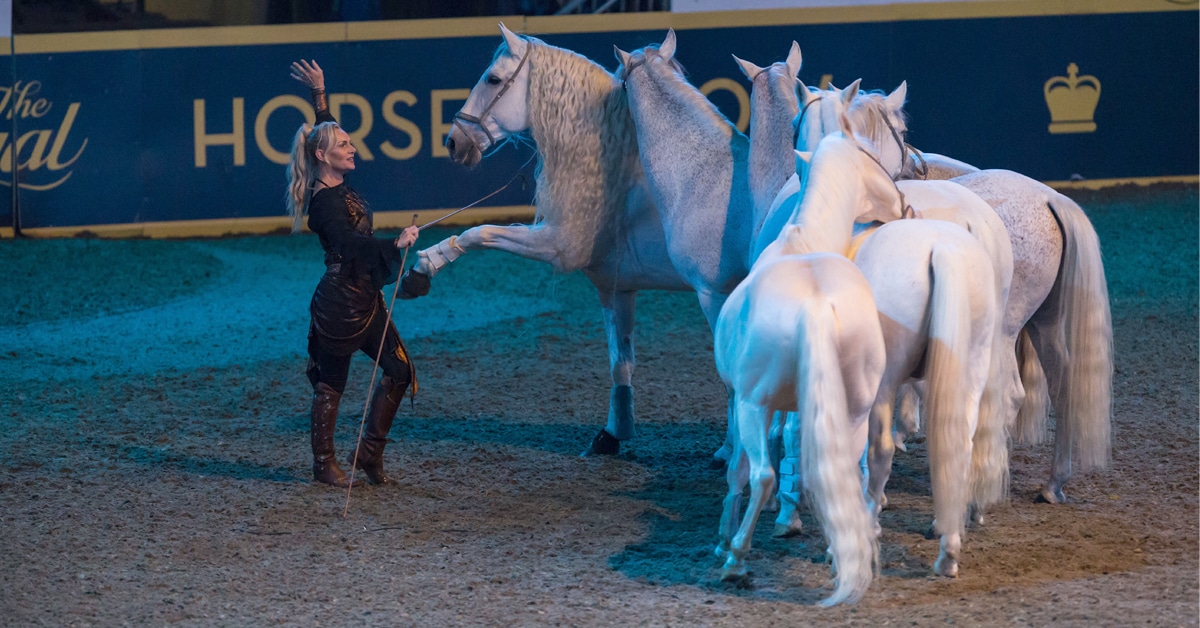
 Sylvia Zerbini was born into the circus life, a ninth-generation performer who went solo as an aerialist at 13. But it’s her remarkable connection with horses that propelled her to international fame. Zerbini has performed for audiences totaling nearly 10,000,000 worldwide as part of the biggest names in entertainment, including Ringling Bros and Barnum & Bailey Circus and as lead trainer with Cavalia. Zerbini has often thrilled audiences at the Royal Horse Show in Toronto with her spectacular liberty horses.
In this excerpt, Zerbini describes her introduction to vaulting and liberty work with her family’s circus horses, using her observations of how cows communicate which she gleaned while working on a farm in France.
***
When Sylvia returned to the United States in the late seventies, her father and mother were preparing to leave Mills Bros Circus and take their two premiere acts on the road (they were considered the best individual acts of their kind in the country). This preceded Tarzan Zerbini beginning his own show (what would become Tarzan Zerbini Circus), with his young family providing the backbone of the immense entrepreneurial effort. Sylvia continued intense body conditioning and acrobatic training in preparation for her aerial debut, as well as learning the art of vaulting (performing gymnastic and dance moves on a horse’s back). It wouldn’t be until she was fourteen that she began liberty work in earnest and brought the lessons she had learned moving livestock in the fields of France to the interactions she now had with the family’s circus horses, including Belgians, Percherons, Lipizzans, and Quarter Horses. Her mastery of the French language offered a trademark vocal component to the physical positions and movements she was using to communicate— she felt French words for cues and names had a “softer” feel than English, and therefore could provide a calming effect. (“English words tend to be strong even when you’re not trying to be strong,” Sylvia told Mary Ellen Barchi for her profile in Ocala’s Good Life.) She began to ignore the “rules” of the traditional circus liberty training she had been taught from an early age and develop her own methods based on her observations of animals, and specifically what she had absorbed watching cows and horses loose together in a more natural environment.
In addition, for the first time, Sylvia worked with the breed of horse that would eventually make her famous. “When I was fourteen, I met my first Arabian,” she told Denise Hearst in the profile “The Arabians of Cavalia” in Arabian Horse World, “and I totally fell in love with her. She was just so in tune with everything I did. The other horses didn’t pay so much attention to me; they were really reserved and I found it a little bit harder to connect with them…the Arabian helped me understand how to connect with the rest of the horses.”
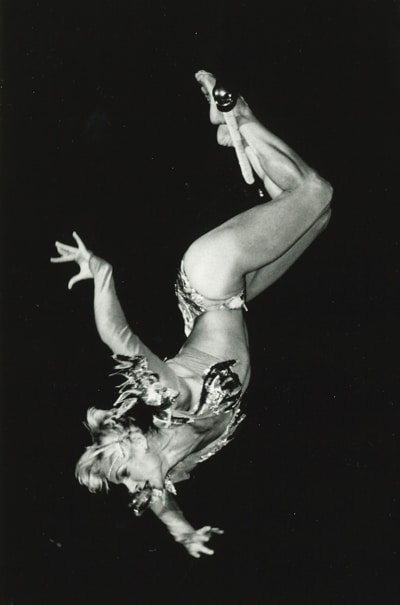
Sylvia in Monte Carlo, performing for Rainier III, Prince of Monaco, completing her famous twisting heel catch – only three other aerialists in the world could do this catch, including her mother, Jacqueline. (Private collection of Sylvia Zerbini)
It was in those early years of the Tarzan Zerbini Circus that Sylvia’s dad owned a herd of young and new horses that wasn’t quite “finished” or ready for performance. He had employed a Frenchman to prepare the equine liberty act, but unexpectedly, the trainer had to leave the United States before the horses were ready to be presented in front of an audience. Suddenly, Sylvia had her first opportunity to produce a liberty team on her own. She began somewhat timidly navigating the inherent challenges of teaching a group of horses to move at the pace you request, in the direction you wish, with the movements you’d like to see at specific marks (spots) in the ring—at first, via numerous international calls to the French trainer for advice. Eventually, though, she gained the confidence she needed to use her own techniques based on animal body language, which she began to develop further as she spent more time with the horses as individuals and as a group, and gained a feel for what worked for them and what did not.
“I don’t think horses are difficult to train,” Sylvia says. “I do believe they have their own language, and it is up to us to pay attention, which many people just don’t do. It is like this with any animal. Each horse also is a different character and should be trained differently. People tend to treat horses like they are all the same. They may be the same animals, but mentally and physically, each one is so completely different. That’s where I feel sometimes we lose something somewhere in equestrian sports, because, yes, that’s a horse, and yes, that’s a person, but they’re each individuals, they’re different from other horses and other people. They think different than another horse or person—they think slower, sometimes they think faster, sometimes they’re a little bit more aggressive, or not.”
That individuality should of course not be surprising, and yet it is a general truth that humans tend to lean into “systems” and techniques that offer broad strokes, rather than specialized consideration. Part of this is born of practicality. Training horses, selling horses, competing horses—these are all forms of business and can provide substantive shares of peoples’ livelihoods. It stands to reason that human beings would strive to find efficiencies and means of training more animals, one way, rather than fewer animals, many ways. (We do this when teaching children, as well.) But the truth of the matter is, while general systems may accomplish basics and reach levels of acceptability, inherent in such an approach is a kind of mediocrity that lacks the “buy-in” you need from another species when attempting to perform together in ways that require connection, composure, and trust in order to be safe and “succeed,” in whatever form that may take.
“Horses are super-sensitive,” Sylvia explained to journalist Liz Ramos in an article in Observer. “You can look at a horse and he can literally tell you what he wants. It’s the emotion and a connection that a horse has with a human being that’s like no other. There were all these subtle cues that as a child I picked up on, and I use a lot of that body language and energy connection with the horses now.”
Dr. Beverley Kane, program director for Stanford Department of Medicine’s equine-assisted learning classes, agrees, emphasizing in Angela Gargano’s 2019 article for Stanford Medicine that horses are “so sensitive, and they reflect our body language and our emotions and even our thoughts, so what we think we’ve hidden they pick up on and what we think we’re putting out they may get confused about…. In this way, they teach us to be very precise in our communication… you have to fine-tune your behavior, your body language and even your emotions around them.”
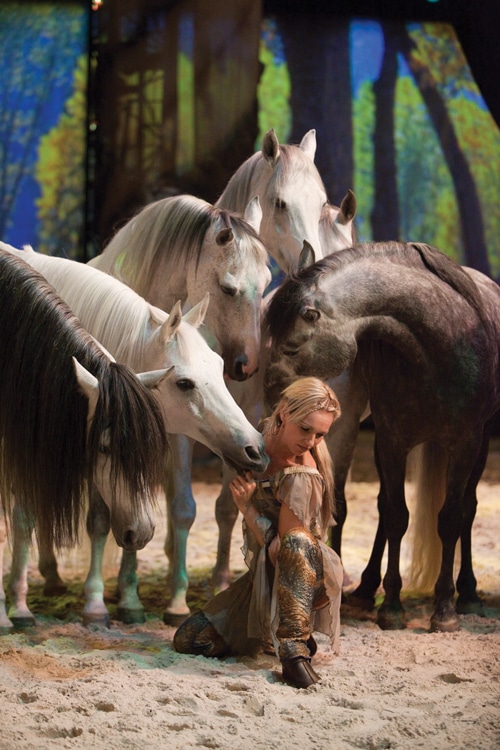
The connection between Sylvia and her horses is palpable on the stage of Cavalia. (© Normand Latourelle/Cavalia)
And the human emotions aren’t the only aspect that must be considered. Animals have “moods” that can be compared to our own—”good days” and “bad days”—and relationships with other animals, and with us, that warm up and cool down at varying rates. Sylvia learned early on that in order to read her horses well enough to determine their emotional state in any particular situation, she had to spend the time—thirty to forty-five minutes, at least—before asking them to work or perform. There were moments when she was with Cavalia (2008 through 2011), when she changed an act’s routine entirely because of her horses’ moods.
Quite simply, Sylvia says it takes a lot of time to learn different horse personalities and train them each according to their temperament and tendencies. In order to listen to horses, we must accept working at a slower pace and acknowledging each moment of understanding a horse might offer. Sylvia would like to help more of us learn to do this. “I want to teach everyone the language of the horse,” she says, “and help more people know them as they know each other. We’re so into the mechanical parts of things that we forget the emotional part.”
This is one element that contributes to why Sylvia feels it is important for her to do demonstrations with large numbers of horses—her Grande Liberté with ten or more in the herd. “Working twelve horses—I feel that it is such an accomplishment to have that many characters and minds and to be able to control all of them at the same time,” she says. “Technically, when a horse is in a pasture with multiple horses and one runs, he runs. They all run. With my team, if one runs, none of the others will follow that horse…they’re going to stay where I tell them. I’m able to show my audience what I have accomplished…that I’ve mastered the communication part with them. Horses will choose me.
“My horses will run out into what is a three-hundred by three-hundred-foot arena—it’s huge, massive, and to them it looks like a big turnout—an open field. You send them out there, and then all of a sudden, I can just look at one and just say his name, and boom, he comes running. And then the other ones are like, ‘Hey, wait! What about us?’ So it shows that what I’m doing with these horses is good because of their response.”
Sylvia describes an act she once did in a standard-size circus ring, which is about forty-two feet in diameter, approximately the size of a three-story building laid on its side, set up in a vast arena that was probably almost three hundred feet long. “I was able to send the horses around the outer perimeter of the ring [in the big arena space] and then I’d go inside the small ring, and I’d call them in. The horses would then all come in at different times, but they’d all come in and start trotting in a circle, and then I’d send four back out; they’d go out, and then I’d call them back in. For me, it was one of the hardest acts to do, but it demonstrated that the horses enjoyed and understood what I was asking of them because it showed they knew I only had two legs and they had four—they could run away at any point in time—but they chose to be with me.”
Horses, like humans, are social creatures. They prefer peace to conflict and company to solitude. But they are also prey animals with a fear instinct that pulsates continuously, even when born into domestication and handled by humans from the beginning of life. They were built to flee predators, and the characteristics that preserved their kind through the evolutionary challenges of time remain recognizable features: hard, flinty hooves for moving quickly over varying terrain; massive hindquarters to propel them forward at speed; eyes set on the sides of a broad forehead to provide almost three hundred and fifty degrees of sight; a keen sense of smell to read markers of danger along the ground and on the wind.
In a space that is three hundred feet long, a horse has the means to get away and stay away from a source of stress or discomfort. When he chooses otherwise, it is an indicator of a pull stronger than his innate urge for self-preservation: curiosity, playfulness, friendship, safety.
“Obviously, in those situations, I am…I don’t want to say ‘in control,’ but I am ‘managing’ the situation,” Sylvia explains. “I am managing it in a way that’s fun for them, but they’re not just being individuals at their discretion. They’re being individuals at my discretion. It is like I am the conductor of their orchestra.”
Sylvia’s methods of reading the horse and taking his individuality into consideration become an interesting question when it comes to mixing in each of the actual characters in her barn and what is safe and appropriate when it comes to allowing them to express themselves and perform in the company of herdmates. Clearly, in liberty performance, and in the kind of liberty performance she prefers, which allows a lot of freedom of movement in the horses, there is room for expression outside a list of prepared tricks or planned choreography. But can it also be possible to embrace equine individuality in other activities we pursue with horses? In competitions over prescribed courses or with established patterns and tests and time constraints? And can the boundaries necessary to ensure human safety in the company of large, powerful animals exist while still supporting a horse’s unique self?
“I think what makes my show so special is watching horses have their own little characters and not just be robotic creatures,” says Sylvia. “Individual characters getting to be ‘horses,’ but still listening and still doing what you’re asking and still wanting to be in your presence…. The more I think about horses and people, the more I think of their movement as a language dance. It isn’t words, it’s the body that is actually talking. I can look at any horse and see how that horse is having a conversation with other horses, with me, that is being presented just by his movement, by where he looks, by the way he breathes, the way he turns his head.
“For me, it’s no big deal,” she goes on. “This is what I’ve been doing my whole life—it’s not like I just decided to ‘be a horse trainer.’ It’s just something in my genes…it’s my passion without me even knowing it, because it is all I know.”
“It is honest work,” she told Sarah E. Coleman for the Kentucky Equestrian Directory in 2021. “Horses are honest—they are not testing you; if something is going wrong, we have to correct ourselves and look at it from a different angle.”
***
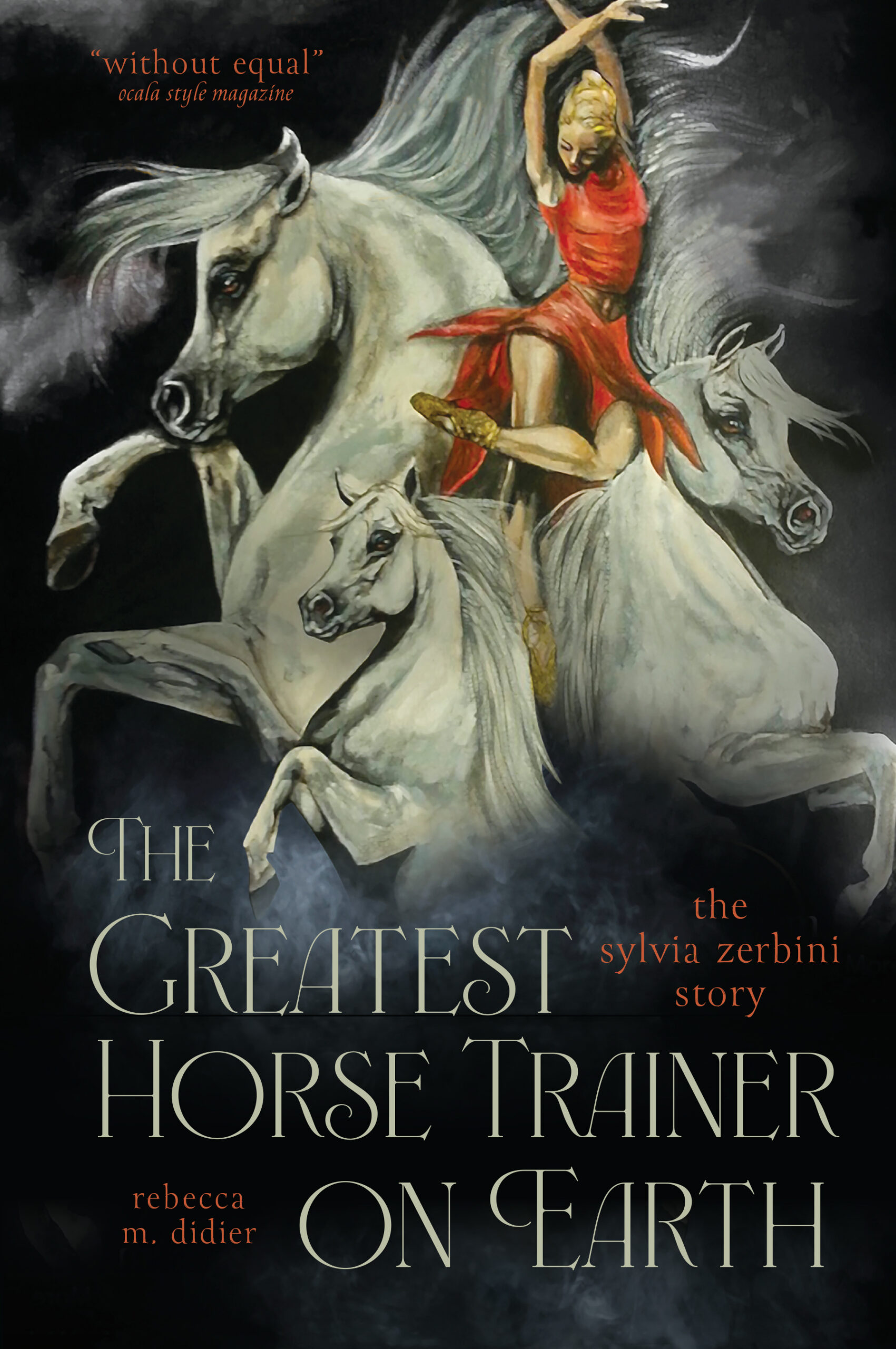
Order your copy of ‘The Greatest Horse Trainer on Earth: The Sylvia Zerbini Story’ from Stable Book Group here.
The Latest