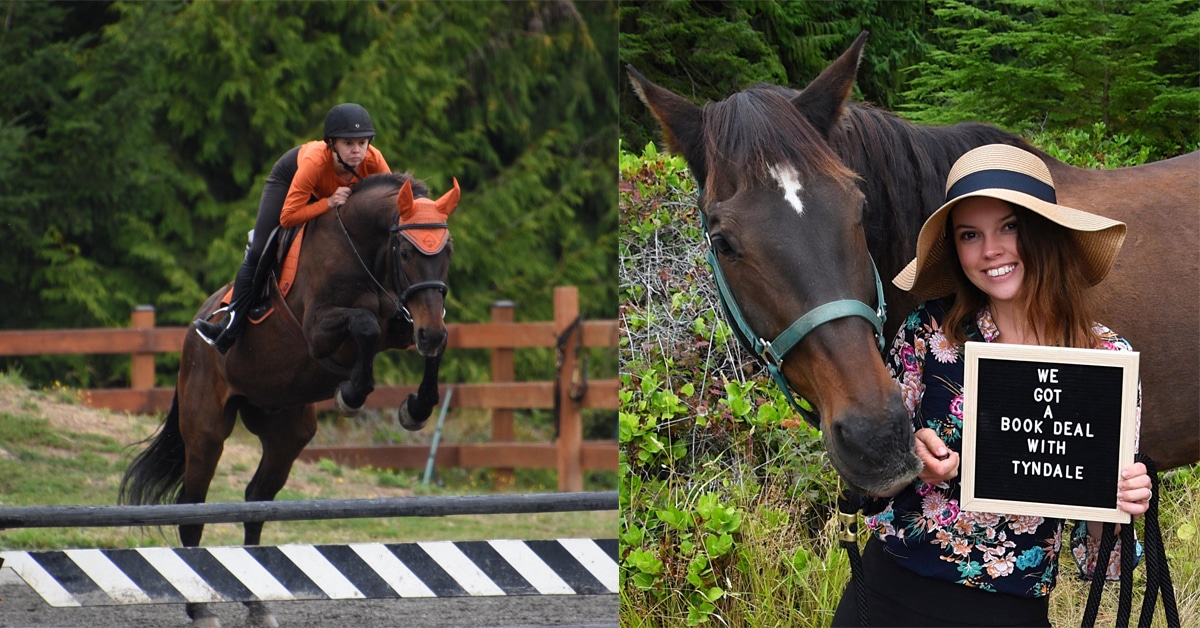
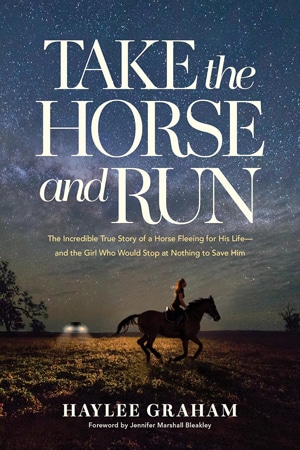
Take the Horse and Run by Haylee Graham is the true story of a girl and her showjumper, Cartier, whose extraordinary bond carried her and her mother through a harrowing legal battle, life on the run, and a dangerous pursuit. Spanning more than a decade, this powerful memoir is a story of courage, resilience, and the unbreakable connection between a girl and her horse—woven with a journey of redemption that ultimately saved them both.
***
Wham!
The fall thundered in my ears, and I felt the jarring crack of my spine on impact. The wind shot out of me, and my chest heaved in the thick, dusty air. Usually, I scrambled up after falling off a horse—bruised but determined. This time, I stayed down. My body ached, my muscles burned, but nothing was broken. I could move if I wanted to.
But the thing was—I didn’t want to move because I had completely and utterly failed. Four jumps into the course, I misjudged a vertical, letting Cartier get too close to the base. He lurched over it, catapulting me from the saddle. I’d missed my distance and now I was on the ground.
In show jumping, there’s this tricky little thing called “finding a distance”— the moment when you and your horse agree on a perfect takeoff spot to clear an obstacle. If you need to slow your horse down, you’ve got only seconds to adjust your thousand-pound animal’s stride. If you need to speed up to meet an accurate launching spot, you’d better act fast and lengthen your horse’s stride. And if you miss the distance completely—or don’t see one at all—then you risk going in blind, and your horse either refusing, knocking over the jump, or causing a serious accident.
There’s almost never a good ending to a catastrophic distance. All the pressure is on the rider to search for that perfect spot—even before they turn for the jump at all—while the horse is moving at full pace. The logistics of competitive horseback riding are intense and meticulous, no matter the discipline. There is a demand for perfection; there is pressure to be the best partner, one your horse can count on and not lose trust in; and there is a thin line between life, injury, and a snapped neck. Falling off a horse isn’t easy. It’s hard on the body and even harder on the mind. When you come crashing to the dirt, rolling in your failure and mistakes, it’s usually in front of a crowd: your best cheerleaders, biggest rivals, and greatest critics.
Eventually, I rolled over, rose to my feet, and gave an apologetic wave to the crowd who responded with pacified claps. I heard my family applauding the loudest and cheering for my resiliency but I couldn’t look at them as tears streamed down my dirty cheeks.
The hardest part of riding isn’t the fall. It’s not even getting back up that’s difficult. It’s getting back on; that’s the problem.
You always get back on.
Chad had caught Cartier near the entrance gate, but his eyes never stopped tracking me. It was his silent way of asking for an explanation. I didn’t have one. To make matters worse, the most dysfunctional entourage at the competition was arrayed along the sidelines and started moving toward me: Mom dragging two of our dogs on leashes, Dad and my stepmom, Becky, with Corbin and Maureena trailing behind.
Dad tried to console me with a hug, but I refused his embrace. Mom tried to wipe the dirt from my back, but I moved her hand away. Becky was concerned and asked if I had hit my head.
“I’m wearing a helmet!” I snapped. Everyone’s worry was overwhelming. They were all talking at the same time and asking the same things.
Chad penetrated the circle. “Let’s go, Haylee. Let’s get back on.”
I shook my head. “No. I’m done.”
Dad interceded. “Honey, what’s wrong?”
“I don’t want to do this anymore. That’s what’s wrong.”
I pushed past everyone and headed to the groom who was holding Cartier. I patted him and he nuzzled me, either wondering where I was going or scolding me for my dumb mistakes.
“I’m so sorry,” I whispered. “I really am. You did great. I just . . . didn’t.”
Then, I walked away. My entourage called after me, but I ignored them, ripping my helmet from my head and tearing off my gloves with my teeth as I drifted back to the barns.
I was about to disappear down a barn aisle when I heard Chad calling my name.
Instinctively, I stopped, then I turned to face him. Chad stood a few feet away, his arms folded across his chest.
“You fell off, kiddo,” he said, his voice calm, but firm. “That doesn’t mean you quit.”
“Shouldn’t you be yelling at me?”
“Probably,” he conceded, taking a couple steps closer. “But that’s only because I know you and that horse can be champions—”
“Champions don’t fall.”
“Come on, Hay-dee, you know that’s not true.” He gave me a gentle nudge. My body swayed slightly, but I kept my gaze locked on my boots.
“They’re not champions because they never fall,” he continued. “They’re champions because when they do fall, they swing back on when everyone else stays down in the dirt.”
Silence hung between us aside from a few of my sniffles.
“Don’t give up on yourself now, kiddo,” he said softly. “And don’t give up on your horse. You have one more round. It wouldn’t be fair to take that from him.”
I hated that thought. Clenching my jaw, I took a few slow breaths. I knew he was right. Giving up now wasn’t just about me. If I quit, Cartier had to quit too. We were a team, and I needed to act like it. Without a word, I slowly began to wrap my hair in my hair net, and I put my sand-crusted helmet back on my head.
Chad and I silently walked back to the arena. As I drew closer, Mom and Dad challenged each other for my ear.
“Haylee, what do you want to do?” Mom asked.
“Do you think you need to get checked out?” Dad was frowning.
“Are you ready to get back on?” Mom pressed.
“You can stop if you want to,” Dad countered.
“No, she’ll get back on if she’s not hurt. You always get back on after a fall. You should know that by now, Gary.”
I pushed through them to get to Cartier. I embraced his head. “Let’s try this again,” I whispered. I rubbed the F on his head—as if for good luck—and swung back on.
***
In the blink of an eye, the arena gate opened and we entered the course. My stomach was twisted in knots and tears threatened to blur my vision. This was our final round, and I knew I needed to finish it.
The buzzer sounded, and we began to navigate the course. I opened Cartier up when I needed to and collected him just enough to find the right distance. We were seamless, we were perfect, we were clearing every jump with ease. We can actually win this thing. I landed on the other side of a jump, and I looked for the next as we rounded the far corner of the arena. I sat up in the saddle, stiffening, and Cartier responded by falling on his haunches and shortening his stride. I faced obstacles that we had already cleared. My mind went blank, and I didn’t know where we were going. Did I mention I was also being timed?
Then I saw that we were about to pass right by a massive jump with an even larger spread. How did I miss this? At the very last moment, I yanked on the reins, hoping Cartier would respond. The turn was off, the approach all wrong; we were taking off at an angle that could lead to disaster. Cartier had every reason to run out or refuse the jump, and I wouldn’t have blamed him. But instead, he saw where my eyes were, dropped his left shoulder, and did something incredible: He jumped and twisted midair, his knees tucking tightly to his chest. A few gasps rippled through the stands.
 We landed softly on the other side, and there was no thunderous crash of poles. I immediately urged Cartier into a gallop toward the timer, leaning over the crest of his neck and throwing my arms forward.
“Let’s go!” I shouted into his ears. Cartier responded, his stride lengthening as we powered forward. We flew past the timer, and my family erupted to their feet, cheering in unison.
I eased Cartier into a walk, and my eyes flicked to the timer display, the glowing red numbers confirming we’d done it. We had the fastest time of the day, outracing dozens of riders. The announcement boomed across the stadium, but I didn’t need to hear it. I already knew.
I threw my arms around Cartier’s neck, burying my face in his sleek, sweat-damp coat. We were champions.
***
For more details on the book, please visit:
Barnes & Noble
Amazon
The Latest