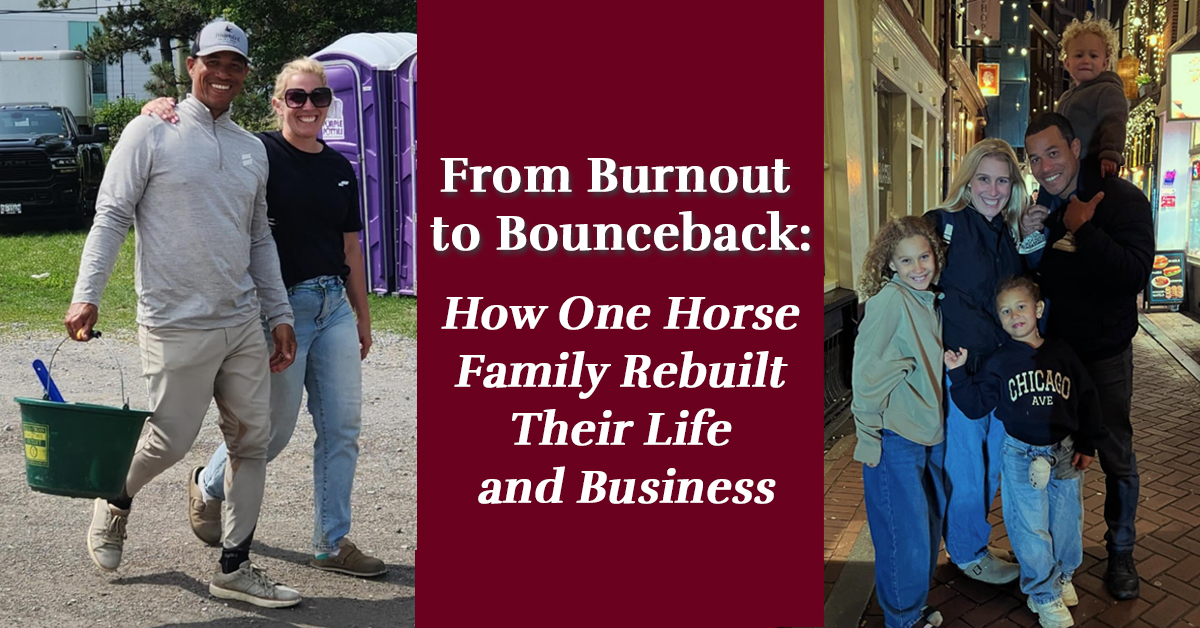
There is a quiet but growing conversation happening across the horse industry, one that surfaces in late-night social posts, in conversations at the in-gate, and barns across the country. The theme is consistent. Trainers operating boarding barns are exhausted, stretched thin, and often not making enough to justify the grind. Ray Butterfield and his wife Scarlett know that story well because they lived it, and what makes their experience different is not that they burned out, but that they chose to step away at the breaking point and rebuild in a way that works for them.
At the height of their operation, Ray and Scarlett were running Hazel Crest, a boarding and training business out of Someday Farm in Erin, Ontario that, from the outside, looked viable. The barn had horses, the client list was active, and they were present on the show circuit. But beneath that surface, both the numbers and the lifestyle were telling a different story. “We could not charge enough,” Ray says. “Even if we raised prices, it still wouldn’t have been enough. The business model was making no sense. We were borrowing from the month ahead to pay for the month behind.” Like many in the industry, they struggled with pricing realistically. Charging what it truly cost to run the business felt uncomfortable, and charging what it needed to be sustainable felt out of reach in a competitive market where everyone seemed to be undercutting each other.
At the same time, the personal cost was becoming harder to ignore, not because the lifestyle was wrong, but because it was no longer the right fit for their family at that stage of life. Running a full-service barn meant long days, constant client demands, and very little separation between work and family life, something many horse families embrace and make work in their own way. For Ray and Scarlett, however, it began to feel out of sync with what they wanted for their young children, who were growing up in the aisles of the barn and at horse shows, often out of necessity rather than choice. Ray reflected on that dawning realization. “We were putting customers before our children. At some point, we had to ask ourselves, what about our family?” It was not a single incident that forced the decision, but rather the accumulation of years of imbalance, where the business consistently came first and everything else had to fit around it.
When they announced they were leaving their farm, many assumed they were exiting the industry altogether. In reality, they were stepping away from a model that was no longer sustainable. “At the end of show season we will be leaving Someday Farm… we are excited for this new adventure with our young family and also confident that this is the right decision,” they shared in a Facebook post last July. It was both a professional pivot and a personal reset. When the final horse left the farm, the weight of that decision became real. “Nothing has gone like planned, yet everything has fallen into place perfectly,” they shared later in August. It was not a carefully orchestrated transition. It was a leap forward without a clearly defined landing.
Instead of immediately rebuilding, they chose to pause, something that is rare in an industry that rarely stops moving. The family travelled to Europe for six weeks, not to chase business opportunities or expand contacts, but to decompress and reconnect. Horses were still part of the experience, but the context had shifted. “We just spent time with horses. Not as a job but just to enjoy them.” That distinction mattered more than they expected. For the first time in years, horses were not tied to invoices, overhead, or client expectations. They were simply part of a lifestyle they loved. More importantly, the time allowed them to reconnect as a family. Scarlett reflected that what they were really searching for was not a different business model, but a different life. “I feel like ‘better way’ for us is just having time… time to invest into our most important ministry, our family,” said Scarlett in a Facebook post after their adventure.
Starting Over, Without a Safety Net
When they returned, the reality of starting over set in quickly. There was no barn, no roster of clients, and no guaranteed income. “We were scared,” Ray admits. “We had to ride it out. We had nothing coming in.” What they did have was a reputation built over years, a network of contacts, and a willingness to approach the business differently. They shifted their focus toward sales and training on a smaller, more controlled scale. Instead of taking on volume, they prioritized quality, carefully selecting the horses they represented and the people they worked with. Ray is clear about why that matters. “Your name is the most precious thing you have in this business. One wrong deal and you’re done.”
They began reaching out, sourcing horses, calling contacts, and piecing together a string of opportunities that would allow them to head to Florida. It was not guaranteed, and it required a level of persistence and risk that many would hesitate to take. Before the winter circuit had fully ramped up, they had already sold two horses, a critical early win that provided both financial relief and confidence. By the end of the season, they had sold eight of their charges.
What has emerged since is a business that looks very different from the one they left behind. They intentionally limit the number of horses they take on, choosing to focus on doing fewer things well rather than trying to do everything. “I don’t want to look after more than eight horses,” Ray says. “We can’t do a good job otherwise.”
They have also diversified their income streams, incorporating clinics, specialized services like clipping and braiding, and selective training projects alongside sales. This approach not only reduces overhead but also creates flexibility, allowing them to adapt to opportunities without becoming overextended.
Perhaps the most significant change is not operational but personal. The constant pressure that once defined their daily life has lifted. “She doesn’t have that tight feeling in her chest anymore,” Ray says of Scarlett. That shift is difficult to quantify, but it speaks directly to the underlying issue facing many in the industry. Burnout is not just about long hours. It is about a sustained imbalance where the demands of the business can outweigh the rewards, both financially and personally.
Ray is clear that their story is not unique, and that is precisely the problem. Industry professionals continue to struggle with chronic underpricing, high overhead in a labour intensive business, and a reluctance to approach operations with the same discipline seen in other sectors. At the same time, there is a culture that often discourages collaboration between professionals and creates a more defensive mindset. Fear plays a significant role in that dynamic, whether it is fear of losing clients, fear of charging appropriately, or fear of trying something different. That fear can keep professionals locked into models that are no longer viable.
“Most trainers aren’t failing because they don’t know how to do the job,” Ray noted. “They’re stuck because they’re afraid to charge what it actually costs and risk losing clients. That constant high stress creates huge tension so that instead of working together professionals end up protecting their own turf.”
For those feeling the same pressure, Ray’s advice is both simple and challenging to implement. Be willing to change, even when it feels risky. Be honest about what your business actually costs and charge accordingly. Look for alternative ways to generate income that work with your strengths rather than defaulting to traditional models. Most importantly, do not be afraid to put yourself out there. “Post something online. Be present at horse shows. Tell people what you do,” he says. “There are so many different ways to make money in this industry. You don’t have to be a Grand Prix rider to have a successful business.” The path forward is no longer linear, and those who are willing to adapt are more likely to find sustainability.
Ray and Scarlett’s story is still unfolding. The financial recovery is ongoing, and the business continues to evolve as they refine what works and what does not. There are still decisions to be made about how much to grow and where to focus their energy. What has changed is the foundation on which those decisions are made. The family is stable, the work is aligned with their values, and the pressure is manageable. In an industry where burnout has become increasingly common, that may be the most meaningful definition of success.
The Latest