There has been a substantial increase in cases of blood on the horse sanctioned in jumping classes at FEI shows, following the introduction of a warning system to replace elimination on January 1.
In the first 20 weeks of this year, 186 Jumping Recorded Warnings for blood have been issued at CSIs around the world, equivalent to nine a week. Last year a total of 116 jumping riders were eliminated for blood on the flanks, equivalent to 2.2 a week, and in 2024 there were 83, i.e. an average of 1.6 a week.
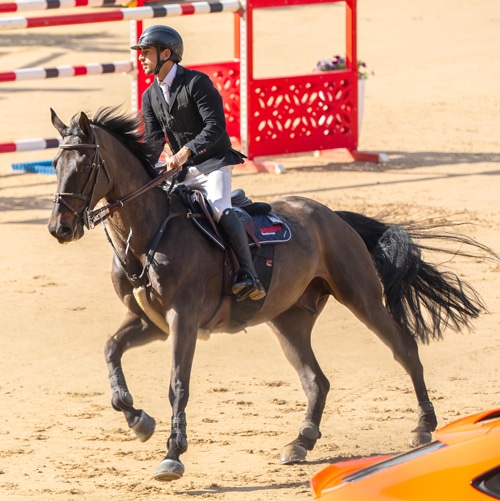
Egypt’s Ismail Osama El Borai, shown riding Incredible Z during the Doha Equestrian Tour, was the first to receive two Jumping Recorded Warnings with the same horse and became the first rider suspended for blood under the new rules. (DET/Lukasz Kowalski)
Under the new system the scope of sanctions has widened to include blood in the mouth – unlike dressage, up to the end of 2025 in FEI jumping elimination for blood in the mouth was discretionary and not applied if it was determined the horse had bitten lip or tongue accidentally. No direct, like-for-like comparison is therefore available. However, while the percentage of warnings is still minimal in the context of close to nearly half a million FEI jumping starts each year, the figures do pose questions: are riders becoming more careless because a warning card for “athlete induced blood” is more palatable to them than elimination? Are officials now more comfortable with handing down a card now that they are not obliged to eliminate, with the inference that some may have felt pressured not to act over borderline cases in the past?
The new style Jumping Recorded Warning is applied for blood anywhere on the horse, under Jumping Regulations Art 259. Elimination no longer occurs – this change being the main source of controversy last year. (Riders can still be eliminated for excessive spur marks under a separate, extant rule.) All horses must also be vet-checked in order to continue in the show (the only discipline to do this in cases of blood.)
If a rider receives two recorded warnings within 12 months, they are immediately suspended for a month and fined 1000 Swiss francs.
Are riders becoming more careless because a warning card for “athlete induced blood” is more palatable to them than elimination?
Within days of Art 259 coming into force, Egypt’s Ismail Osama El Borai received two Jumping Recorded Warnings during the Doha CSI5* with the same horse and so became the first rider suspended for blood under the new regimen. Earlier this month, Venezuela’s Luis Fernando Larrazabal received two recorded warnings a week apart in Lexington.
HorseSport.com contacted the FEI for comment earlier this year, after noticing that 47 blood warnings had been handed down by February 12. A spokesman said at that time: “Given the small sample size of events in 2026 so far, we would caution against making any generalisations in relation to trends and comparisons with 2025 numbers at this stage. The FEI is monitoring the data closely.”
Earlier this month HorseSport.com asked the FEI if it had now enough data to draw some conclusions, but there was no response.
Jumping stakeholders initiated the change, triggered by Pedro Veniss’s elimination during the Paris Olympic Games because a “micro lesion” was found on the flanks of Nimrod de Muze. This had the effect of removing Brazil from the team competition because there is no longer a drop score.
Pushback to Art 259 last fall appeared to catch the FEI by surprise, with FEI executive direct of Sport and Games Aine Power later agreeing that the matter could have been handled better. She commented: “There are learnings to take forward from this, that people looking in at the sport are not coming from the same place we are.”
More News