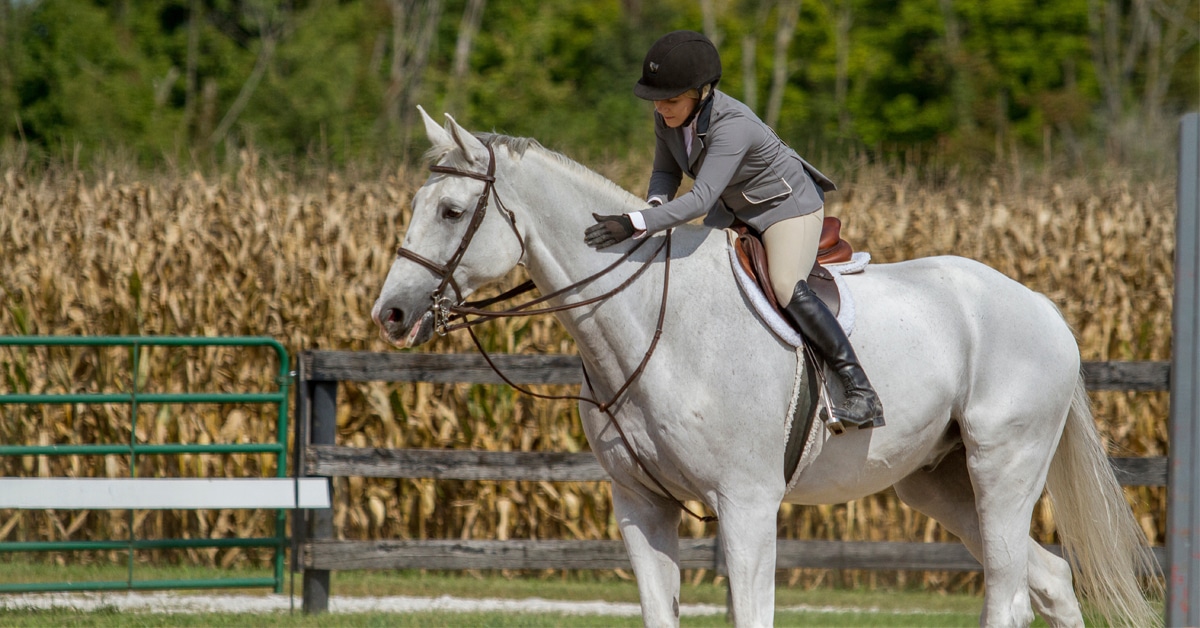
No horse competes forever – but recognizing when it’s time to step back isn’t always simple.
Some horses go out on top. Others slow down gradually, their needs and comfort changing with each season. Between the two lies a grey area where signs of physical strain or mental fatigue are easy to miss … or misread.
We’ll look at what those signs really are, why they matter, and how to make retirement a compassionate, informed decision. Because when the time comes, every horse deserves a transition that puts their well-being first.
Physical Indicators
For many competition horses, retirement doesn’t necessarily arrive with a single catastrophic injury. Instead, it unfolds gradually, through small physical changes that accumulate gradually over time. These are the horses who still show up willing, still pass the jog, and may even deliver the occasional standout performance, but whose bodies are quietly working harder to deliver the same performance they once handled with ease.
Arthritis
Arthritis is one of the most common factors that eventually limits a horse’s ability to compete at the upper levels. In the words of equine veterinarian and senior horse care professor at the University of Guelph, Dr. Bettina Bobsien, it represents “the end of the useful lifespan of an athletic body.”
While early or mild arthritis can often be managed, particularly at lower levels, at a certain point, continued high-impact work becomes less about conditioning and more about compensation.
Owners may first notice this shift through increasing maintenance needs. A horse who once required minimal support may now depend on joint injections, corrective shoeing, longer warm-ups, or extended recovery time between competitions. None of these interventions is inherently wrong, but when they stack up, they can signal that the horse’s margin for error is narrowing.
Declining Performance
Equine performance consultant Dr. Tim Worden, who works primarily with jumping horses, notes that some of the most telling physical warning signs appear before overt lameness.
Riders might notice their horse struggling to jump out of combinations or tight lines, relying more on speed than strength, or taking longer to organize before fences.
In his experience, early declines in energy availability, power generation, and recovery capacity are common, especially in aging equines. “For aging athletes, the first physical abilities to decline are those that require producing large forces in short periods of time,” he explains. These include generating power at takeoff, balance through combinations, and the ability to quickly recover between jumping efforts.
Riders might notice their horse struggling to jump out of combinations or tight lines, relying more on speed than strength, or taking longer to organize before fences. Some horses may begin to adopt inefficient or uncharacteristic movement strategies, such as twisting through the body, pushing off the ground for too long during takeoff, or over-relying on either the front or hind end to generate lift. They may not look like classic lameness, but they’re red flags that the horse is working harder to sustain performance.
Medication Exclusions from Competition
Medication rules can also influence retirement decisions. Dr. Bobsien notes that PPID (Cushing’s disease) is extremely common in aging horses, yet the medication used to manage it, pergolide, is prohibited under FEI regulations, despite not being performance-enhancing. Older horses, such as those commonly seen in vaulting or para-disciplines, may have cases of PPID that are manageable with proper medication, but owners must make the arduous decision to either temporarily take a horse off medication to allow it to compete, or retire an otherwise sound, capable athlete so it can stay on its medication.
Similarly, anti-inflammatory drugs allowed in some national competitions are banned at the international level. In these cases, a horse may be physically capable of continuing, but unable to do so comfortably within the rules of their discipline, depending on the governing body of the specific competition.
Slower Recovery Time
Slower recovery is another important indicator. Horses who once felt fresh after a day off may now need multiple light days following competition. Fatigue may linger longer, and form may fluctuate more dramatically from week to week. While occasional off days are normal, a consistent downward trend suggests the body is struggling to meet the demands being placed on it.
But how can owners tell when the demands really are too much when it comes to a prey animal that’s evolved to hide pain?
Assessing Physical Lameness in the Aging Horse
Dr. Bobsien points out that traditional lameness exams can often miss these subtle issues. “The only real soundness exam is the horse doing its job,” she says. “I want to see the horse under tack, with its regular rider, doing its regular job.” Watching a horse trot in-hand on a straight line may look clean, but watching them land off a jump on both leads, or enter a dressage arena under pressure, can reveal discomfort that would otherwise go undetected.
When maintaining form depends on constant intervention, or when a horse’s movement and recovery no longer resemble their former baseline, it may be time to step back and reassess. Often, a lower level or different job allows these horses to remain sound, engaged, comfortable, and still in use, without pushing an aging body past its limits.
But what if the first sign of trouble doesn’t seem to appear in the body first? In many cases, the first signs that retirement – whatever that may look like – is on the horizon aren’t immediate physical cues, they’re behavioural.
Mental & Behavioural Indicators
There’s a persistent myth in the horse world that some horses become “bratty”, “lazy,” or “difficult”. But when it comes to seasoned competition horses, sudden shifts in behaviour should never be dismissed as personality flaws or “bad attitude”. In most cases, these changes are a red flag for pain.
“After a certain point, it’s not the horse’s character that’s the problem. It’s pain,” says Dr. Bobsien. “By the time a good horse starts behaving badly, you need to ask ‘how long have they already been hurting?’”
Veterinary science is clear: horses are prey animals, and they’re hardwired to hide signs of pain, vulnerability and weakness. That makes them remarkably stoic and good at coping – until they can’t. As a result, many of the earliest signs of discomfort show up not in how a horse moves, but in how they behave.
Common Warning Signs
Dr. Bobsien offers a range of examples: the jumper who starts refusing fences or getting “sticky” in combinations. The dressage horse who suddenly resists entering the ring, is unwilling to pass the judge’s booth they’ve passed a hundred times, or shows tension and anxiety during tests. Despite their discomfort, these horses are often still performing, just not like themselves.
Even routine interactions can reveal underlying issues. Changes in a horse’s attitude during farrier appointments, for example, can be one of the earliest indicators of growing discomfort. “Lifting a hind leg is essentially a flexion test,” Bobsien notes. “If a horse suddenly can’t tolerate having their leg pulled laterally or held up, that’s not ‘being difficult.’ That’s a clue something’s wrong.”
Key Performance Indicators
Performance consultant Dr. Tim Worden has observed similar patterns from a data-driven perspective. He points out that many riders only recognize decline when results falter, but horses often give quieter signals much earlier. “Often people delay retirement because the horse still has the occasional standout round,” he says. “But if you look at performance trends over time, there’s a clear downward trajectory.”
If a horse is showing signs of struggle, even subtle ones, consulting a sport-focused vet early on can be a smart move – before spending thousands on new saddles, alternative treatments, or changing trainers.
That trajectory may include reluctance to work, inconsistent focus, or a slow erosion of precision and power. Especially in highly-trained horses, these changes might look psychological, but they often reflect mounting discomfort or fatigue that riders must take seriously.
When to Act
Both Bobsien and Worden emphasize the value of early, specialized evaluation. Not all veterinarians have access to advanced diagnostic tools, and performance-related lameness is not always easy to identify. If a horse is showing signs of struggle, even subtle ones, consulting a sport-focused vet early on can be a smart move – before spending thousands on new saddles, alternative treatments, or changing trainers. A good veterinary performance exam can often identify the issue faster and more accurately from the start.
What Retirement Can (and Should) Look Like
Retirement doesn’t have to mean standing in a field, forgotten. Just like people, horses benefit from individualized retirement plans that suit their personality, physical condition, and preferences. For some, that might mean full turnout with a herd. For others, it might mean a new role entirely.
Working Retirement
Many horses benefit from staying in some kind of work, provided that work is suited to their abilities and condition. “Some horses can actually do worse in full retirement,” say Dr. Bobsien. They can stiffen up, lose condition and generally decline without the stimulation of routine and interaction.
In this case, retirement from competition could be a change of rider, a different program, a new environment, a lighter job, or more variety in training. It might mean stepping down from 1.30m to 0.90m, or transitioning from high-level dressage into working equitation. As long as the horse remains physically comfortable and mentally willing, these roles can offer continued purpose and joy for the right horse.
A Change of Scenery
A competitive job comes with a competitive horse’s lifestyle, too. Frequent stalling, limited turnout, high-concentrate diets, constant shipping and exposure to new and stressful environments can all take their toll on a horse. No matter their background, all horses thrive on ‘the 3 Fs’: freedom, forage, and friends.
Whether retirement looks like an amateur rider on a schooling circuit, the occasional trail ride, or just time with horses unencumbered by human expectation, leaving the competition world can come with full turnout and a herd – an ideal environment for any horse. This is especially true of horses who suffer from ulcers. Reduced stress and unlimited forage can help buffer stomach acid, support more natural digestive function, and allow the gut to heal in ways that are difficult to achieve in a stalled, high‑stress competition environment.
Rehoming older, unsound horses as “free to a good home” often puts vulnerable horses at risk.
A Moral Obligation
Designing a thoughtful transition is only part of the responsibility. There’s also the ethical obligation to ensure a horse’s retirement is safe, supported, and humane. That means taking financial and logistical responsibility for what comes next – even when it’s hard.
“The worst thing you can do is wash your hands of them,” says Bobsien. She cautions against the all-too-common approach of passing the bill for retirement off to a rescue, or rehoming older, unsound horses as “free to a good home”, a tactic that often passes the burden to others and puts vulnerable horses at risk.
And sometimes, the kindest retirement isn’t a new job or a pasture. Sometimes, it’s letting go. It’s not a failure to choose euthanasia when pain can’t be managed. It’s a form of care.
That’s not a decision anyone makes lightly. But it is one that should be made early, with a clear head, and ideally before the horse is in crisis. Planning for end-of-life care while the horse is still healthy is one of the most generous acts an owner can offer. It ensures the decision is made out of love and responsibility. Not panic, guilt, or desperation.
Listen, Plan, and Honour the Horse
Retirement is not the end of a horse’s story; it’s the start of a new chapter.
The signs that a horse is ready for change may be obvious–a chronic injury that won’t heal, or the slow grind of arthritis making everyday work harder than it should be. But the signs may also be subtle: resistance to routines they once enjoyed, behavioural shifts, or performance that fluctuates without a clear cause. These aren’t attitude problems; they’re feedback, and behind them is a horse asking for something different.
As riders, owners, and caretakers, we ask a lot of our horses. We ask them to compete, to travel, to perform. To partner with us through fear, fatigue, and the everyday stressors of sport. What we owe them in return is not just care in their prime, but dignity in their later years. That means asking the hard questions, making thoughtful plans, and acting with the horse’s best interest at heart – even when it’s not convenient or easy.
For everything they give us – the ribbons, the lessons, the loyalty – we owe them more than just gratitude. We owe them a soft landing.
The Latest