American Association of Equine Veterinary Technicians (AAEVT) made history this spring with its first-ever Canadian conference, hosted at King Animal Hospital in King, Ontario. This was a milestone event which helped to address the long-standing gap in equine veterinary education in Canada and show that this country can play a larger role in closing it.
The AAEVT provides continuing education for equine health care professionals, but for decades these events have been held in the US. This has led equine veterinary technicians and assistants across Canada to face a simple but costly reality: to access meaningful, hands-on continuing education, they had to leave the country, often using their own money and vacation time to do it.
“This is the very first event that the AAEVT has ever hosted in Canada,” noted Jennifer Lorimer, Lead Equine RVT at King Animal Hospital. “This is a very big deal.”
A System Under Pressure
The need for change is not theoretical. Across Canada, veterinary practices are grappling with a shortage of veterinarians and increasing demand for care.
For Dr. Darryl Bonder, Chief Medical Officer of the Equine Division at King Animal Hospital, the solution lies in better utilizing the professionals already in the system.
“If we’re talking about the horse world in general, horse people are very traditional. They don’t accept change readily,” he said. “But our technicians are highly trained. They’ve got a lot of expertise, and we encourage them to rise to the next level.”
He draws a comparison familiar to anyone who has visited a doctor or dentist. “When you’re in the hospital, you see the nurse 75% of the time and the doctor walks in, the doctor walks out,” he explained. “Things like blood draws and vaccinations, these are tasks that our VTs can do every bit as well as a vet.”
Yet, in equine practice, those skills are often underused. “If you never give them the opportunity and they are just driving the vet around and holding horses, well, what a waste of an education.”
For event attendees like Kayleigh McDonald, who travelled from British Columbia, the opportunity for change is clear.
“There’s a lot of under-utilization of assistants and technicians, especially out in BC,” she commented. “A lot of the practices out there don’t actually have technicians working for them.”
That reality persists even as demand for veterinary care grows. “Pretty much across Canada, there’s a vet shortage,” McDonald added. The solution, she believes, is already in place.
“There’s so much more that I can do that the vets don’t need to do,” she said. “There’s a lot that I can help take off the vet’s plate so that they can focus on something else that may require more attention.”
The Education Gap
That underutilization is closely tied to a lack of accessible, high-quality training in Canada.
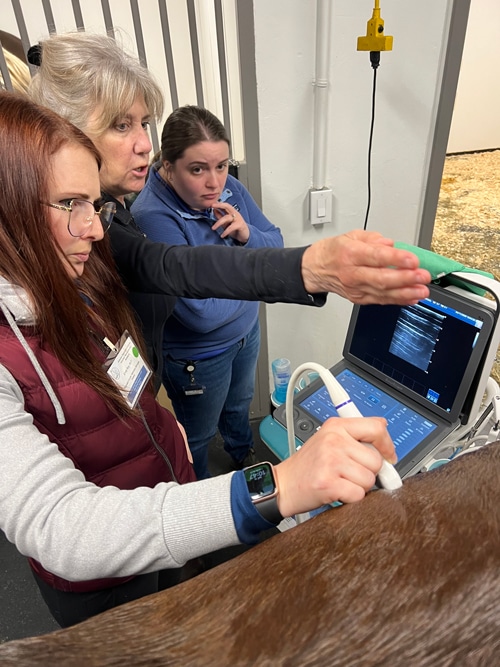
Veterinary assistants and technicians are often under-utilized, when they could take on more tasks to ease the burden on vets.
Canadian veterinary technicians are required to complete 20 hours of continuing education every two years to maintain their credentials. While a number of conferences offer opportunities to earn those hours, most are held in the United States and provide limited equine-specific content, often just one or two sessions worth a few hours of credit.
There is one major annual event dedicated to equine health, but for busy equine practices, allowing an entire team to attend can be logistically difficult, leaving many technicians without access to the hands-on learning they need.
“These guys have to go to two or three different conferences throughout the year to get the number of hours that they need,” explained Mara Anderson, the RVT Manager at King Animal Hospital. She continued on to explain the significant extra workload to required for technicians who would like to specialize in equine medicine, requiring 40 additional hours of continuing education a year.
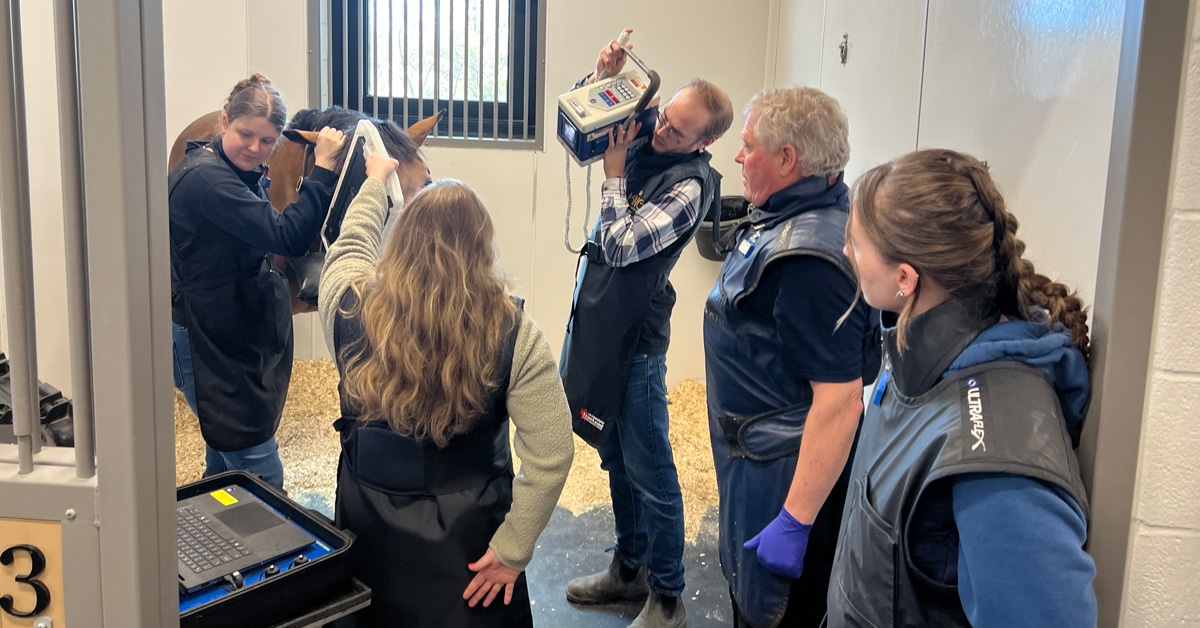
Even more challenging is the nature of equine training itself. The event at King Animal Hospital featured lectures led by hospital surgeons Dr. Bonder, Dr. Albert Torrent and Dr. Natalie Cote who also oversaw ‘wet labs’ where technicians got hands-on experience working with thoracic ultrasounds and dental x-rays.
“You can do online learning any day, but to be able to do wet labs and to have surgeons talk to you, that’s unheard of,” added Chantal Dube, an Equine RVT at King Animal Hospital.
Why King and Why Now
The decision to host the event at King Animal Hospital was not accidental.
“It’s an amazing facility,” said Lexie Conrow, President of AAEVT. “And everyone was so excited it sold out immediately.”
The hospital’s model, which is built around education, collaboration, and expanded roles for technicians, made it an ideal partner. “We have to look at how we can empower our nursing team,” said Tracy Jones, CEO of King Animal Hospital. “They’re smart individuals, and they want to do more.”
Jones comes from the human health sector sees the evolution of veterinary technicians following a familiar path. “I think it’s going to follow along what human health did. They’re going to increase their scope of practice because the doctors need to focus on that higher scope,” she said.
That shift is not just about efficiency, it’s about access.
“What scares me is that animal owners can’t access the care that is needed,” Jones added. “Or the care that you do access is subpar.”
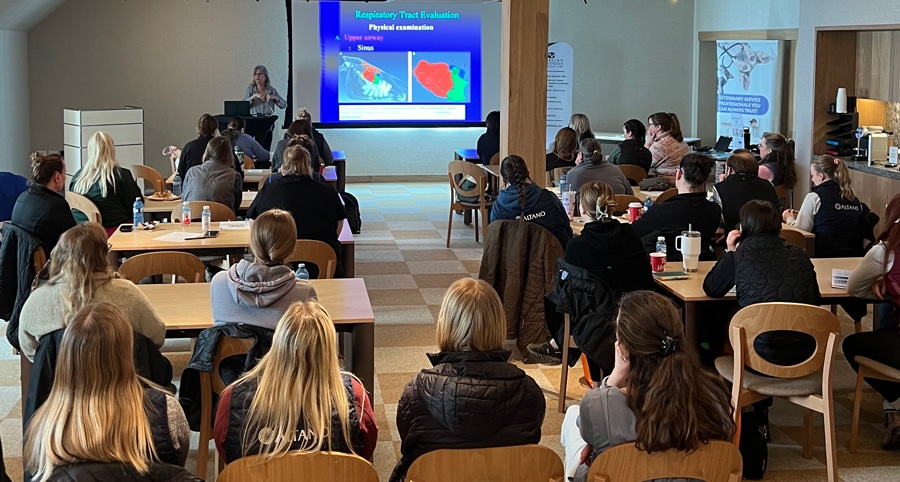
Equine surgeon Dr. Nathalie Côté, DVM, DVSc, DACVS led a lecture during the conference.
At its core, the event was not just about professional development – it was about improving outcomes for horses. Better-trained technicians can identify issues earlier, support more advanced procedures, allow veterinarians to focus on complex cases, and expand access to care in underserved regions.
“There’s been a huge push to actually utilize technicians more,” said Conrow. “They’re underutilized for a wide variety of reasons, but we’re working to bridge that gap.”
For years, Canadian equine technicians have travelled abroad to build their skills. This event signals a shift: the education is beginning to come to them. And perhaps more importantly, the mindset is beginning to change. “There has to be a paradigm shift,” said Dr. Bonder.
At King Animal Hospital, and through partnerships with organizations like AAEVT, that shift is already underway – one that could redefine not only how veterinary teams work together, but how horses across Canada are cared for.
The Latest