A lot of riders are already receiving good coaching. They hear things like, “Sit taller,” “Soften your hand,” “Lengthen your leg,” “Move the hind end over,” or “Straighten your horse.” They understand what the coach means, and yet when it’s time to apply it, it’s just not there.
That’s where so many riders and coaches get frustrated ‒ and not always just frustrated with themselves, sometimes with the horse, too.
When things aren’t working, it’s easy to feel like you’re trying hard, listening carefully, and still somehow not getting the result. You can start wondering if you’re not strong enough, not coordinated enough, or just not good enough. Most of the time, that’s not the issue; the missing piece is awareness.
Not just awareness of your own body, but awareness of what your nervous system is doing unconsciously, and then adding what the horse is doing underneath you. If you’re bracing, holding your breath, gripping, collapsing through one side, or simply trying so hard to “do it right,” it gets a lot harder to feel the horse clearly so that adjustments can be made.
This is something I started paying close attention to through years riding competitively and professionally in the hunter-jumper arenas, catch riding, and entering medal classes where equitation and accuracy really mattered. I wanted to better understand biomechanics because I was getting feedback from so many different horses and I wanted to make sure I wasn’t getting in their way.
After a motor vehicle accident in 2023 that caused a vestibular concussion, I entered into traumatic brain injury protocols and extensive vision therapy. That made me even more aware of how easily the body compensates, shuts things down, or misses important information without us even realizing it.
Here are three awareness ‘screens’ (tools to improve mindfulness and situational alertness) I use often myself, as well as to help riders notice the hidden patterns that often get in the way of balance, feel, symmetry, and follow-through.
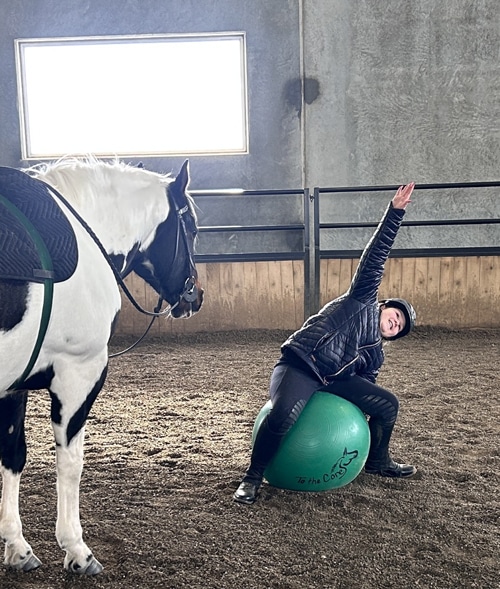
Simply sitting on an exercise ball can make a rider more aware of where centre is (and can provide a great ribcage stretch as well.) (Amy Mawson photo)
1. Centering on the Ball
At first glance, this one doesn’t look very glamorous, but it tells the truth quickly.
When a rider sits on the ball with real attention, they can start to feel how pressure moves through their feet, seat bones, and torso. Can they stay centred, or do they drift more easily to one side? Can they keep the ball quiet, or does it start wobbling the second one leg changes? Can they rock side-to-side or do big stretches evenly, or does one direction feel much harder?
That’s useful; now you’re no longer just “working on balance” ‒ you’re getting information. You can start to feel whether one foot pushes more than the other, whether one side of your ribcage braces, your jaw tightens, or you stop breathing the moment your body feels challenged. None of that means you’re doing it badly. It just means your body is telling you something.
The point isn’t to look perfect. The point is to notice the pattern. If you can’t feel where centre is off the horse, it gets a whole lot harder to organize it on the horse.
2. Pre-Ride Lunge with Ribcage Reach
Before getting on your horse, step into a lunge and reach one arm overhead. This opens the hip flexors, quads, and hamstrings, but more importantly, it gives you a chance to feel whether one side is tighter, shorter, or harder to organize than the other. This is not just a stretch, it’s a screen.
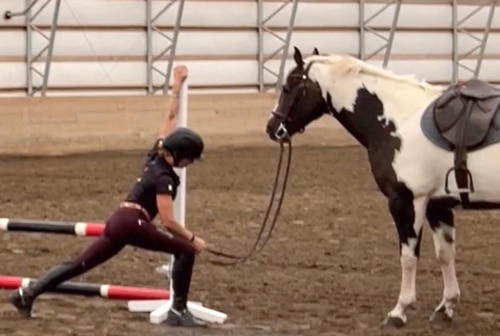
The lunge can provide a nice pre-ride warmup, and identify tightness in the hip flexors, quads and hamstrings. (Amy Mawson photo)
Can you lengthen through the ribcage without tipping or bracing? Can you stay balanced without curling your toes into the dirt for dear life? Does one hip open nicely, while the other side feels like it absolutely did not agree to participate?
Those little differences matter. They often show up in the saddle as a dropped hip, a shortened side, a tighter rein, or that ongoing feeling of, “Why is one direction always harder for me?”
This is also a great place to bring in breath and a mental rehearsal. Before you do the movement, picture it. Then do it slowly and stay present.
A lot of riders go straight into doing, fixing, or trying harder, but the body often organizes better when it has a moment to feel the movement first. A simple pre-ride check-in like will make a real difference.
3. Mounted Awareness with Video Feedback
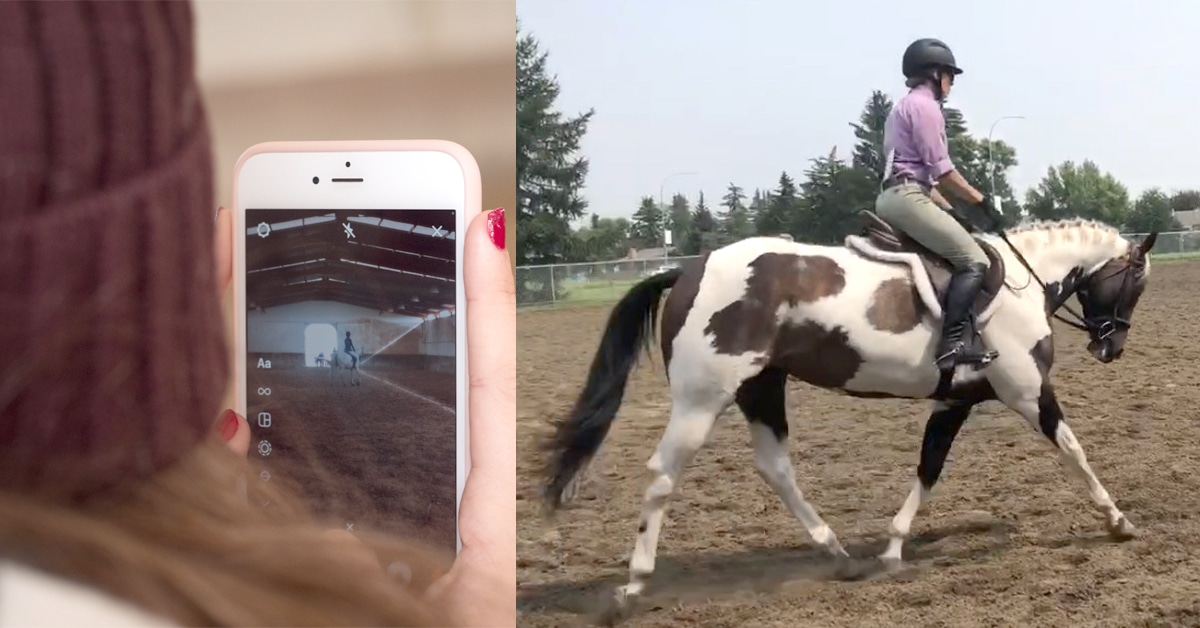
This is where many riders discover that what they feel and what they’re actually doing are not always the same thing. One of the easiest ways to expose this is with simple mounted work and video from directly behind or directly in front. It doesn’t need to be fancy; even a short clip can show a dropped shoulder, a hip shift, twisting through the torso, gripping through one thigh, or a leg that doesn’t hang the same on both sides.
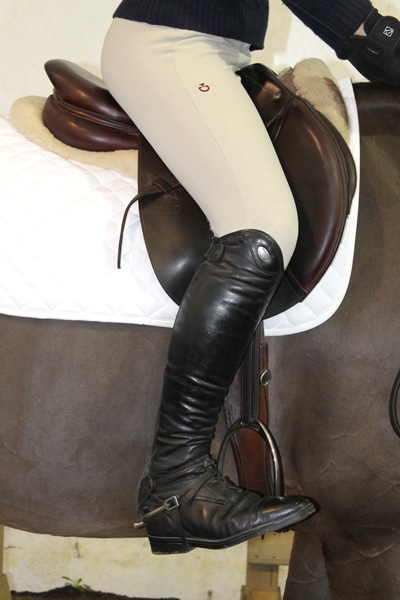
Dreaded no-stirrup work is especially helpful caught on video because it makes asymmetry and other patterns easier to see. (Jessica Lefroy photo)
No-stirrup work is especially helpful while on camera. Not because it’s meant to be punishing, and not because everyone needs to prove they can suffer nobly through it. It helps because it removes one layer of support and makes patterns easier to see. This can reveal where a rider braces, rhythm changes, and where tension starts interrupting the motion. If a rider holds their breath, narrows their focus, or starts mentally rushing, asymmetry shows up almost immediately.
For riders coming back after injury, this can be especially helpful. Even when the body is technically ready to do more, it can still hang onto old protective habits. Awareness helps bring those habits into the light instead of letting them quietly ride along in the background.
The real heart of this work is getting to the core patterns happening subconsciously in your body. A rider’s progress often starts with noticing more, not doing more. Success and confidence will be the by-product of this awareness, not something we all have to “try much harder” for!
The Latest