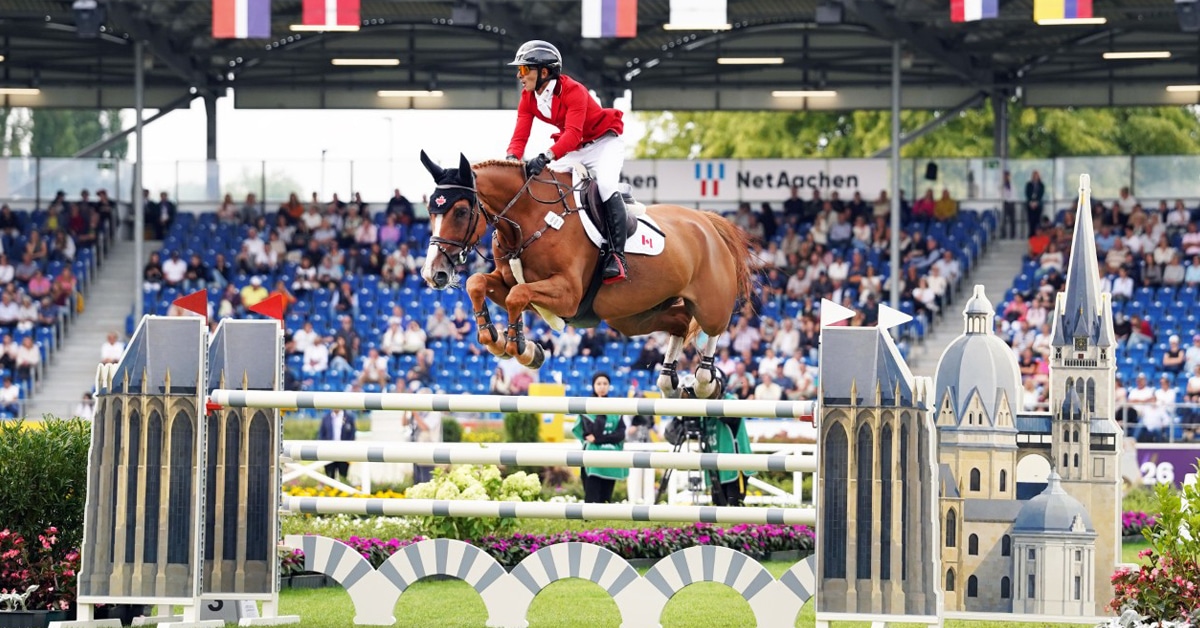
Another championship year is upon us, with Canada fielding teams to take on the world at the FEI World Championships in Aachen in August. Held every four years between Olympic Games and formerly called the World Equestrian Games (WEG), the event in Aachen hosts jumping, dressage, driving, eventing, para-dressage and vaulting.
With any championship year comes increased scrutiny on team selection, and in this article series we will be diving into the criteria set forth by Equestrian Canada (EC) to choose dressage, jumping, and eventing teams.
The 2026 FEI World Championships Canadian Dressage Team was announced on July 8 and includes Brittany Fraser-Beaulieu aboard Jaccardo, Camille Carier Bergeron riding Finnlanderin, Chris von Martels and Londoncrown, and Denielle Gallagher-Legriffon aboard Come Back de Massa.
It’s a team that shouldn’t surprise anyone who follows the sport. Notably, there is no reserve rider heading to Aachen ‒ a decision that the EC says is a budgetary one.
Following the controversy that arose after the dressage team selection for the Paris Olympic Games in 2024, Equestrian Canada (EC) entered the 2026 FEI World Championships in Aachen with renewed attention on how national teams are chosen. While the basic selection model remains mostly intact, EC has strengthened its governance and refined several elements of the process in an effort to instill greater confidence among athletes.
Canada’s Selection Model
EC’s published selection policy is designed around a single central objective: selecting the athlete-and-horse combinations most capable of producing a top-10 team finish at the World Championships.
There are four stages in the process:
- Athletes must first declare their intention to compete before achieving the FEI’s Minimum Eligibility Requirement, requiring two Grand Prix scores of at least 66 percent at two different CDI3* or higher competitions.
- During the qualification period from January through late June, combinations must compete in at least four Grand Prix tests and three Grand Prix Specials. Importantly, at least one Grand Prix and one Grand Prix Special score must be earned after May 13, ensuring the selection committee can evaluate the most current competitive form rather than relying solely on performances from early in the season.
- The highest-ranked combination earns automatic nomination.
- The remaining team members are selected by EC’s High Performance Advisory Group (HPAG). While scores remain the primary foundation, the committee may also consider factors including consistency, improvement over time, horse soundness, veterinary status, international experience, quality of competition and the horse and rider’s ability to contribute to the strongest possible Canadian team.
That balance between objective scoring and limited discretion lies at the heart of Canada’s philosophy.
“The scores are the primary foundation for selection,” explains Christine Peters, Senior Manager of EC’s Olympic and Paralympic Dressage Program. “Unless there’s a scenario that would sway otherwise, that’s the only time the discretionary piece would come in.”
When emailed questions about the selection process for dressage, team riders Fraser-Beaulieu and Gallagher-Legriffon, along with athlete representative Pia Fortmuller, chose to respond jointly. “The selection process feels fair, because athletes understand the criteria, and EC has made a large effort to maintain clear channels of communication,” their email statement read.
Learning from Paris
The controversy ‒ or some might say scandal ‒ following the 2024 nominations involved athlete Ariana Chia, who was chosen as the second reserve rider and who appealed the selection process to the Sport Dispute Resolution Centre of Canada (SDRCC), alleging conflicts of interest within the High Performance Advisory Group. Specifically, the issue was that HPAG members Lisa von Martel was the spouse of team rider Chris von Martels, who was the first alternate named for Paris, and Denielle Gallagher-Legriffon was herself a declared athlete. Both Chris von Martels and Gallagher-Legriffon are competing in Aachen this summer.
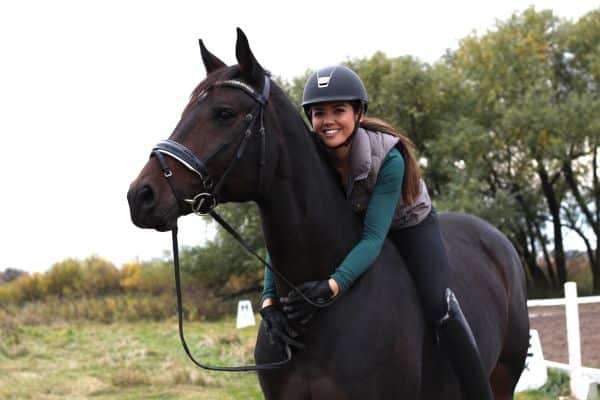
Ariana Chia and Fantasia (Fidertanz x Dream of Glory).
Of this conflict of interest in 2024, Chia says plainly, “I don’t think an actively declared rider, or the spouse of a declared rider, should ever be part of the selection committee or discussions.”
SDRCC arbitrator Richard McLaren agreed and determined that the two named HPAG members had either real or perceived conflicts and ordered the committee to reconvene without them.
After reconsideration, however, the same athletes were selected for the Olympic team.
Gallagher-Legriffon was also asked via email for her thoughts on the dispute and its resolution, her response came via the same joint email sent by Fortmuller, which read simply, “The appeal was solved in a very professional manner.”
For Chia, the appeal was never primarily about who made the team. “Top sport is incredibly competitive, and every athlete understands that not every decision will go their way,” she says. “What was difficult was feeling that the selection criteria and governance policies weren’t followed consistently.”
She says athletes invest years of work and considerable personal sacrifice pursuing championship opportunities and deserve confidence that the published process will be followed as written.
Ultimately, the SDRCC decision wasn’t about whether the right riders had been chosen. Instead, it focused on whether EC had properly followed its own published procedures.
James Hood, EC’s Director of High Performance, acknowledges that managing conflicts is particularly challenging in equestrian sport.
“The Sport Dispute Resolution Centre recognizes that there’s always conflict-of-interest potential because sports are small,” Hood says. “[Especially in equestrian sports where] everybody knows each other. Somebody’s coached somebody, sold a horse to somebody, ridden for somebody or is married to somebody.”
Despite the experience, Chia believes the appeal accomplished something important. “Having the SDRCC review everything independently and ultimately rule in my favour was very validating,” she says. “I hope it leads to a future where riders can have complete confidence that selection processes will be fair, transparent and applied the same way for everyone.”
Rather than rewriting the entire selection system, EC has strengthened how conflicts are managed before selection discussions begin.
Stronger Governance
Perhaps the most significant change since Paris is the expansion of the HPAG from five members to seven.
According to Peters, the larger committee provides greater flexibility when members must recuse themselves because of conflicts of interest. “We added seven members for the sake of some of these conflicts of interest, so that when somebody has to recuse themselves, we still have enough voting members on the group,” she says.
Athlete representation has also been reinforced. National Team Program athletes elect their own representatives to the advisory group, who consult regularly with athletes before criteria are finalized and before selection discussions begin. EC has also introduced the ability to appoint temporary replacement members whenever multiple conflicts arise, ensuring both quorum and impartiality.
“We do have mechanisms built into place now to effectively replace them for the selection period as needed,” Hood says. “That ensures both voting quorum and that equitable fairness piece.”
Those changes appear to have addressed at least some of the concerns raised during the Paris dispute and has reassured athletes including Chia. “From my perspective, Equestrian Canada has made a greater effort to strengthen its governance processes and ensure better compliance with its own criteria,” she says. “No system is ever perfect, but I do believe there has been positive progress.”
Why “Recency” Matters
Another noticeable bit of fine-turning for 2026 is EC’s increased emphasis on recent performances.
Rather than simply rewarding athletes for strong results accumulated early in the year, selectors require evidence that horse-and-rider combinations are still performing at a championship level just weeks before Aachen.
An athlete averaging 71 percent in January, but slipping into the mid-60s by June, presents a different competitive picture than one steadily improving toward 71 or 72 percent at the end of the qualification period.
By requiring late-season scores, EC attempts to identify combinations peaking at precisely the right time.
How Canada Compares Internationally
Equestrian Canada’s approach to team selection has some big differences from several of the world’s top performing dressage nations.
Great Britain
British Equestrian relies far more heavily on expert selector judgement. Unlike Canada, Britain offers no automatic selection based purely on competition results. Its published criteria specifically state that various selection factors are not listed in order of importance and may receive different weight — or even be disregarded — to achieve overall performance objectives.
Selectors may consider qualities such as an athlete’s ability to perform under pressure, contribute to team culture, owner commitment and even future championship development.
Such flexibility reflects Britain’s exceptional depth of international combinations, but it also gives selectors considerably greater discretion than Canada’s more structured approach.
Germany
Dressage powerhouse Germany works within a major events framework, such as the German Championships and other competitions in Europe leading up to team selection, which serve as key evaluation opportunities before the national coach and Dressage Committee nominate the championship team.
Similar to Great Britain, Germany places major trust in experienced coaches and selectors who evaluate performances over time and not purely relying on rankings.
The Netherlands
The Dutch system also emphasizes national squad pathways, observation opportunities and long-term high-performance planning. Using athlete development programs, federation members and election committees evaluate combinations throughout the season against championship objectives. Like Germany, the Netherlands places greater emphasis on subjective expert judgement than on automatic ranking systems.
Where Canada’s Approach Fits Globally
Compared with these European powers and top dressage performers, Canada’s selection system sits somewhere in the middle. Its very specific qualification requirements, weighted scoring averages, and automatic selection provide athletes with a high degree of transparency and predictability. Riders generally know exactly what scores they need to produce and how those scores will be evaluated.
At the same time, EC retains enough flexibility to account for situations that raw percentages cannot fully capture, such as declining form, horse fitness, or exceptional international experience.
That balance reflects Canada’s competitive reality. Without the overwhelming depth of horses and rider combos that are the bedrock of winning nations such as Britain, Germany, and the Netherlands, Canada has chosen a process that is objective enough to withstand appeals while still allowing experienced selectors to assemble the strongest possible team.
The Role of Jordi Domingo Coll
Perhaps the most significant factor since Paris is the appointment of Spanish Olympian Jordi Domingo Coll as EC’s Technical Advisor. He joined EC in this role in May of this year, and because of that his influence on the Aachen selections was intentionally limited.
“The criteria were already developed,” Peters explains. “There wasn’t much of a discretionary discussion surrounding the selection. He definitely voiced his opinions on the selection call, but really there wasn’t a lot of influence in that.”
The addition of Coll to the selection process is one that Chia also believes is an important step forward.
“Jordi is bringing a wealth of international experience and technical expertise,” she says. “I’ve also been encouraged to see more investment in athlete development… Those kinds of initiatives create learning opportunities, strengthen the program and help develop riders and horses throughout the high-performance pathway.”
Looking ahead, however, EC expects the technical advisor’s role to expand.
“I don’t think we’ll ever traditionally move to what you see some of the European countries doing, where it’s very much a discretionary selection, because I don’t think our athletes have that appetite, shall we say, at this point to have the experts in place for the dedicated time and the background that they’d like to see in those roles,” Peters says. “But it definitely is something we’re looking at going forward in terms of how the technical advisor can have more of a role in final team decision-making.”
Moving Forward
The reality of selecting championship or Olympic teams in any sport is that no selection system will eliminate disappointment or controversy from time to time. The blunt truth is that all championship teams have limited spots, and that means that there will always be deserving combinations that don’t make the final cut.
The real challenge is building a process that athletes trust, even when they disagree with the outcome.
In the case of Canada’s 2026 dressage selection criteria, EC responded to lessons gleaned from Paris, not by abandoning an objective, score-driven model, but by strengthening governance, improving conflict-of-interest procedures, and reinforcing transparency around discretionary decisions.
Whether that approach prevents future appeals remains to be seen. But in a sport where relationships often overlap and margins between athletes can be measured in fractions of a percentage point, a clear and consistent process is not only required, but valued by all.
The Latest