Senior international hunter judge, course designer, coach, and author Randy Roy sticks to the rules when he’s judging. But what happens when no rules exist for what he witnesses in the ring, such as a missing jump rail or tack breaking?
In this third part of an occasional series on hunter judging mishaps, Roy shares what he did, or would do. He has to react quickly while being mindful of what’s in the best interests of the show management team, the competitor, and the horse. Roy says his split-second decisions on mishaps aren’t written in stone – another judge might call it a different way, and that judge would also be correct.
Wonky rails
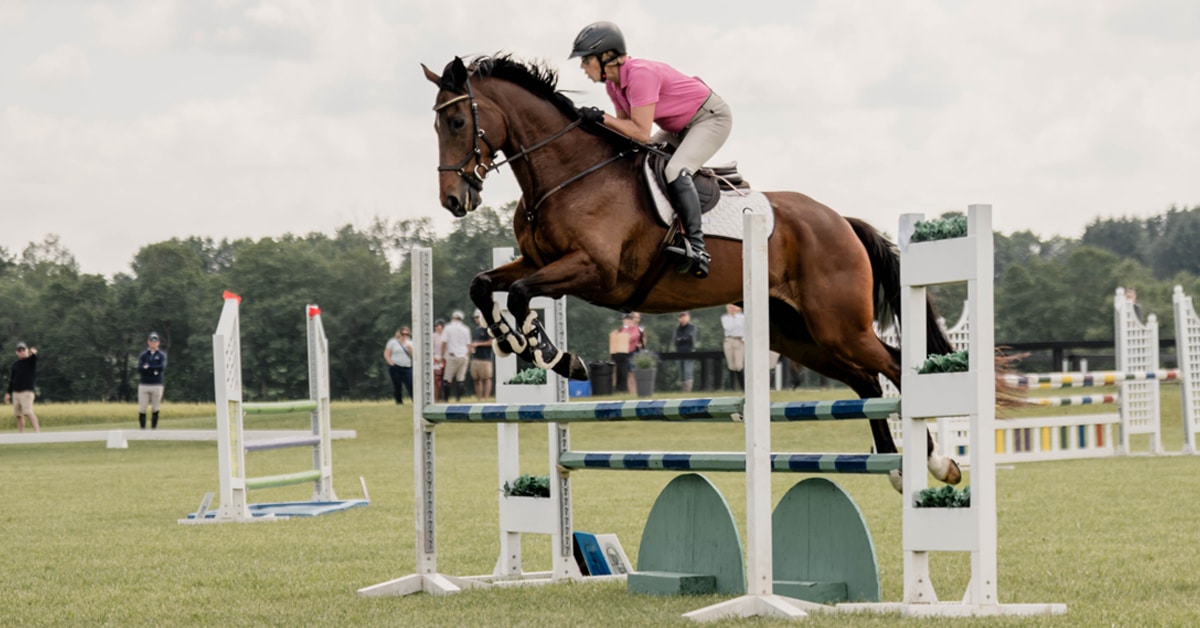
The jump crew forgets to place or re-place a rail on a jump. Roy may not be able to see the missing rail, for example, if the pillars of another jump are in the way. He will reward the rider with a free good jump and make sure the rail gets put up for the next competitor. He may request a spotter to inform him of a rail down when he can’t get a clear view of a jump.
Which one?
This is a tip for judges. There may be two jumps side-by-side on a course, and in a big class, it can be easy to miss which one is to be jumped first. Roy marks the colour of the first fence to be jumped on his card when two are in close proximity, so he knows which one is first. A rider cantering down a line may jump the wrong one, and that’s an easy mistake to make, he says.
Wrong way!
Another issue that can be easily missed is a jump set up facing the wrong way. Roy always tries to check that all fences are set up in the right direction before a class starts, but if that error is missed and a rider jumps the jump well (even if it’s backwards), Roy allows them to continue if they want to, or the rider can elect to have a re-ride. The mistake is on Roy, the jump crew, and the course designer, and needs to be fixed before the next horse enters the ring.
Not a lead line class
Some horses are hesitant to enter the ring and need a little encouragement. A helper may step in and lead the reluctant horse forward, but how far is too far? Roy says people really push the envelope on this one, and he says if the person leading the horse passes the in-gate, it’s a major fault and will be reflected in the rider’s score. It’s okay to guide a horse a bit – but don’t step into the ring.
No turn signal
After the last jump on course, a rider has to turn right or left. But if rider turns wrong way after the final jump to avoid a lead change, it won’t escape Roy’s eye. He’ll note it on the judge’s card. He knows the rider is doing it to avoid the change, and while it’s not marked as a refusal, it will be marked as a cross-canter and a score that was 80 will drop to the low 70s.
Losing contact
In an equitation class, a rider may have to drop a rein when asked to shift his or her number. That’s fine with Roy, and he doesn’t penalize that. At end of a round, a lot of riders drop their reins and pat their horse for a job well done. Roy doesn’t penalize that either, although some judges do if rider doesn’t hold the reins until he or she leaves the ring. But Roy’s view is that the rider held the reins when it counted, and he doesn’t mind if a rider decides to reward their mount with a well-deserved pat.
Too dark
When the sun is setting and Roy is having trouble seeing horses at the end of the ring, he’ll stop the class and resume it the next day when it’s light. If he can’t see the horse and riders (especially dark horses), he can’t judge them. Roy will assert himself and make the call to stop the class, even if others want to keep going. It’s not just a matter of being able to see well enough to judge, but also a matter of safety.
Tack break
A rider’s rein, a girth, martingale, breastplate or another piece of tack breaks or comes undone in the ring. The rider may pull up and look to Roy, and while he understands, the rider needs to leave the ring and get the tack repaired. The ride won’t count in that class, but the rider can come back for the second round. Riders should make sure their tack is in good condition before they enter the ring, he adds.
Just for kicks
In an under-saddle class, one horse tries to kick another. The rider on the horse that’s the target pulls up to avoid contact. If Roy sees this happen and if he knows which horse kicked out, he’ll immediately tell all competitors to walk, excuse the kicker, then resume the class. The rider of the kicking horse has the option to line up in the centre of the ring or leave. The horse that was the target and its rider won’t be penalized for pulling up.
Timber!
Often trees are set up beside jumps as part of the course decoration. If one of the trees falls when a horse is on course and near that obstacle, Roy allows a re-ride from that jump forward.
No dramatic releases
No doubt you’ve seen riders in hunter classes who have an exaggerated release and fling themselves forward on the horse’s neck over each jump. This is Roy’s advice for judges who might be distracted by a rider’s style: bring your vision to the horse’s level and regardless of the rider’s position, focus on the horse alone and how it’s jumping. The rider needs to be ignored unless he or she gets left behind.
In an equitation class, it’s a whole other matter, says Roy. Those riders with such exaggerated releases “are toast” and out of the ribbons.
The Latest