To be the best, you have to work with the best. That simple reason has led Canadian dressage rider Shannon Dueck to train with the legendary Carl Hester for more than a decade. And while Dueck has built a successful career competing internationally at the highest levels, she believes every horse and rider at every level can benefit from Carl’s training philosophy.
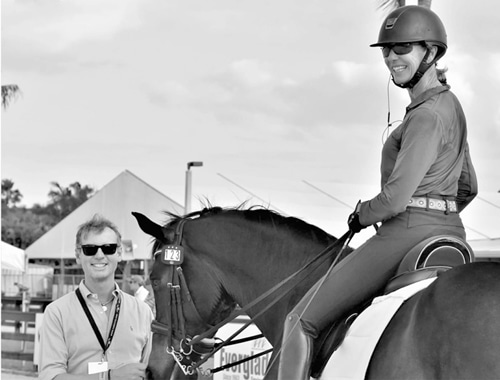
Carl Hester and Shannon Dueck. (Queca Franco photo)
“Carl has an ability to make everything so clear, and simple. He’s so correct and always fair, which creates such confidence in the horse. When the horse really understands what’s being asked, step by step, it’s easy for them to progress,” she says. “It’s important they learn to react to a light aid without being punished for responding too much. For example, riders often ask the horse to go forward from the leg, but immediately pull back on the reins if the horse goes too forward, which just creates confusion. Reward the try. Establish that forward is the correct response to the leg and once the horse truly understands, you can begin to refine how much of an aid you need and how much the horse should react.”
Dueck incorporates many of Carl’s techniques in her daily training, including one exercise he calls his favourite: the canter leg yield. Although this simple movement isn’t found in any dressage test, she says it is essential to creating a supple, straight horse.
Why canter leg yield?
“Canter leg yield is so important in both suppling and straightening the horse,” Dueck says. “When you yield away from the inside leg, you’re creating bend and also engaging the inside hind. And in yielding away from your inside leg to create bend, you’re filling up the outside rein. That inside-leg-to-outside-rein connection, which is foundational in dressage, then develops into the ability to ride your horse in a correct shoulder-fore.
“Once you have a correct shoulder-fore, you can develop more suppleness with shoulder-in, haunches-in, half-pass, and more, step by step. But before introducing any of those movements, you must be able to free the shoulders and move them. In canter leg yield, the horse learns to move away from the inside leg into the outside rein ‒ again without being punished for their response if it’s too much at first.
“When teaching a horse to yield from inside leg at walk, trot, and canter, at first it will move too much through the outside shoulder and lose balance with the outside rein. That’s okay! Allow it to happen while the horse is still learning, and don’t confuse the horse by putting too much constraint on outside rein. Of course, the ultimate goal is a really good leg yield where the horse is parallel, but the exercise must be adapted to the horse’s level of training. Once the horse clearly understands how to move laterally, you’ll be to ride in shoulder-fore without stress. Once sideways is established, then you can work on balance.”
Supple and straight
“Leg yield away from the inside leg ‒ for example, you turn up the centre line in left lead canter, then leg yield to the right back towards the wall ‒ creates suppleness. But leg yield the opposite way ‒ away from the outside leg from the wall towards the middle of the ring ‒ is as important, because it develops the ability to correctly ride the horse straight and upright. The shoulder has to be mobile from the outside rein and you must be able to move the shoulder in front of the haunches in canter, keeping it upright as you move his body around. And guess what? That’s how you develop a nice pirouette, or straight flying changes that are on the aids, and really good lateral work.
“When you can easily do canter leg yield in both directions, you can decide if you want bend to the inside, bend to the outside, or straightness. That’s a problem for many horses, because as soon as you change the bend, they do a flying change. I want to move the horse’s body around in canter left and in canter right. And when I can move the body around easily, I can put it in exactly the right place to do a beautiful upright line of flying changes, or a canter zig-zag.”
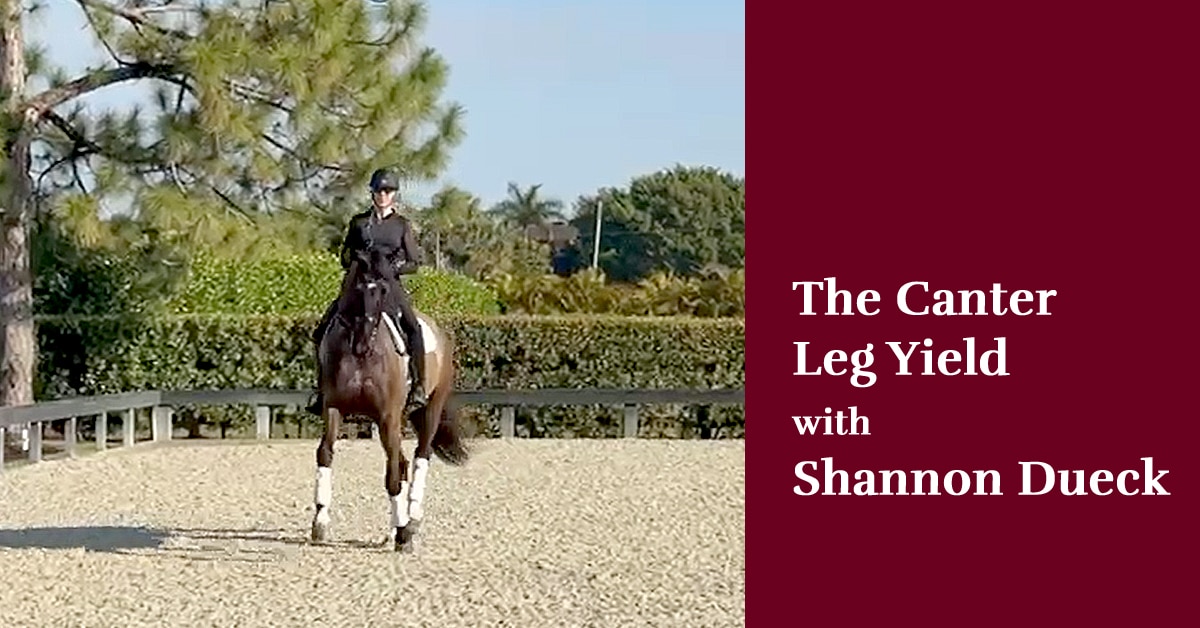
Shannon demonstrates this effective training technique aboard Alchemist, owned by Braeburn Farm of Collingwood, ON:
Canter Leg Yield away from inside leg
Canter Leg Yield away from outside leg
Try this at home – Lower levels
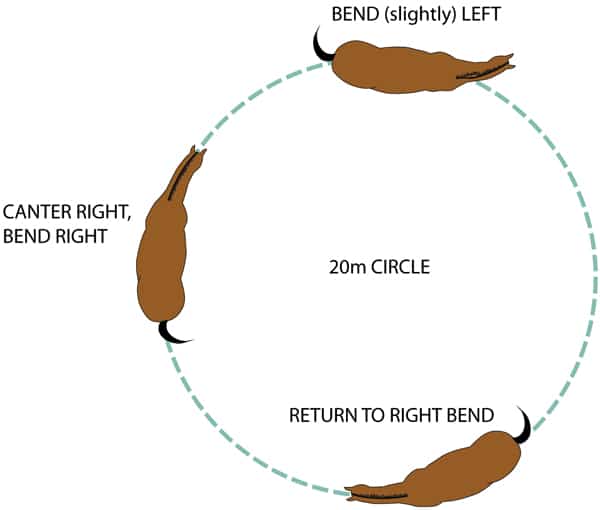
Dueck recommends introducing this simple leg yield exercise (see diagram below) as soon as the horse is consistent, confident, and showing a basic level of balance at the canter.
- On a 20-metre circle, canter right and bend right
- Maintain the right lead and slowly bend to the outside a little bit
- When you counterflex, you want to feel the shoulders move to the inside slightly with every moment of suspension
- It’s not just about turning the head to the outside, but where you’re placing the shoulders
- Slowly change the bend back to the inside and move the shoulders back in line
- Reward the horse with a pat when it yields the shoulders correctly
When the 20m exercise feels easy, try shallow leg yields on the long side from the 3/4 line to the wall, and from the wall to the quarter line.
Try this at home – Upper levels
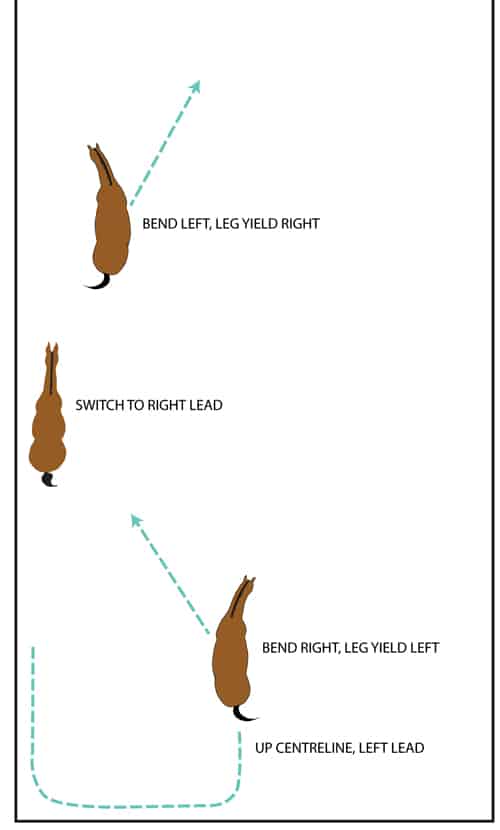
The canter half-pass zigzag is one of the more challenging movements in the FEI tests. Dueck finds schooling it in leg yield instead of half-pass really allows the rider’s outside rein to do its job, creates upright flying changes and keeps the horse from anticipating a flying change every time the bend changes.
- In left lead canter, turn up the centre line
- Bend to right, while leg yielding left
- As you approach the wall, straighten, flying change to right lead, using left rein and left leg
- Now leg yield to the right, away from the wall, bending left from the new outside aids
- Think about not just “leg” yield, but “shoulder yield” as well.
Troubleshooting – avoid these common mistakes
- Maintain your correct seat alignment in the leg yield. If you are in left lead canter, your seat needs to communicate that to horse, even when changing the bend to the right
- Don’t expect perfection on the first try. Begin with a few steps at a time and reward the correct effort to build confidence
- Clarify each reaction. Make sure the horse truly understands how to move laterally from just the leg before introducing a more complex set of aids. When horses get confused, they shut down or misbehave
- Go back to an easier exercise when struggling. Re-establish the ability to easily change flexion and bend while on the inside lead, to move the shoulders in and out on a 20m circle, until you feel the horse understands
- Reward the effort with lots of pats and praise.
The Latest