Development and Causes of Riding Fear
Do you sometimes wonder how you got to a point where you are afraid of riding, or even afraid of being around your horse? It’s not a comfortable feeling, but you should know that you are not alone. Many riders, even professionals, have felt fear at some point in their lives while riding or interacting with horses. Maybe you know other riders who have managed to overcome these fears. Trust me when I tell you that you can do it, too!
Perhaps you have heard that you should ride through your fear. Maybe you have also heard that you should not let your horse feel your fear. You have probably tried both, and neither worked for you. As far as not letting your horse feel your fear is concerned, the issue with that so-called solution is straightforward—you cannot lie to horses. Horses are emotional seismographs and will pick up on emotions we think we have buried.
 However, the first piece of advice, riding through the fear, can actually work. If you know how. The truth is that those who give this advice usually have no idea how to leave fear behind—both because they have not experienced your type of fear, and, importantly, because they are not trained in psychotherapy. When you hear that you should just ride through it, with the advice to, “Just canter already, you will see that you won’t fall,” it probably won’t make you approach the next canter with more courage. Instead, you are more likely to ask yourself whether you are even a good rider.
This kind of well-meaning advice can unfortunately cause even more fear, if it comes from someone who doesn’t really know what they are talking about. A recent client told me that a former trainer forced her to go on a two-hour trail ride, telling her, “After that, you’ll know you don’t need to be afraid.” In behavioral therapy, this approach can indeed be used. However, in order for it to work, these kinds of confrontations with the fear-inducing moment or activity are mindfully set up by the behavioral therapist, who usually accompanies their client through that controlled scenario. This careful preparation means the most important result is achieved: no further terrible things happen.
Unfortunately, in this case, during this ride my client was forced to take, her horse was frightened and bolted. The trainer had no influence over the frightened horse, and ultimately my client fell off the bolting animal. Since that time, my client had not even mounted her horse again. She said that this ride had retraumatized her, and that she had lost all trust in her trainer. I can certainly understand.
I believe that if you want to help people with problems like this, you should at least have a basic knowledge of psychology. You should also know how to solve these problems, and you should have successfully done so many times before. In my opinion, it is irresponsible for riding instructors to use their students as guinea pigs, as in the case described above, as it can have detrimental consequences.
Riders who have never been afraid of riding sometimes think fear is related to a lack of skill, and I have often heard fearful riders being told this is why they are afraid. However, fear has nothing to do with level of skill.
Nobody is immune to fear. Whether you get back on the horse after a fall does not depend on your degree of riding ability. It depends on how you process this fall, and on what kind of foundation this experience rests. If you’re a mother, for example, you probably have your children in the back of your mind, and you know you need to stay safe so you can take care of them. Nature has cleverly arranged it so you will be more cautious as a result.
Even top professional riders who compete internationally can develop chronic fear. It’s probably not something you’ve heard about, but believe me, it’s not because it doesn’t happen. There are a number of reasons why chronic fear within the ranks of professional riders isn’t widely discussed. These may include:
- the person is reluctant to admit they are afraid because they are in the spotlight and are a sports role model;
- high-profile people are often quickly and unjustly criticized;
- less successful riders might take advantage of a well-known rider’s fear to raise their own position and self-esteem.
Given these reasons (among others), it’s easy to understand why big-name trainers or professional riders don’t reveal that they’ve experienced riding-related fear, or that they have sought help because they couldn’t free themselves from that fear on their own. It could definitely tarnish their image. I have worked with many professional riders and trainers, but they don’t advertise this fact. Instead, this clientele shares my name discreetly amongst themselves, letting each other know I can help. So, while it is not advertised by professional equestrians, I think it is essential for you to know that you are not alone in your fear. On the contrary, you are in the good company of fantastic, talented, sensitive riders, and empathetic trainers. What connects you with these horse people who faced their fear are exactly these qualities, which I know you have, too.
It is because you are sensitive and empathetic that you developed chronic fear; and it is because you are sensitive and empathetic that you have the ability to become a wonderful partner to your horse again.
As I alluded to above, people who experience chronic fear are often ridiculed by those without fear. In my eyes, this reveals a lack of sensitivity and empathy. I frequently observe that when I announce a workshop on social media, for example, there are always negative comments, and people who try to make themselves look better than others. In my opinion, this behavior just shows how little these people know about the subject of fear and how to overcome it. But it’s also because of the way many riding schools still teach today. Many riding instructors simply don’t know how to deal with students who are afraid—after all, it wasn’t part of the trainer’s training.
Ultimately, it doesn’t matter why you have developed a riding-related fear. Maybe you were once a very brave rider and rode the wildest horses, and now you can’t understand what has changed. Or perhaps you have always felt somewhat anxious, and have never seen yourself as a courageous rider. Whatever the case, it’s crucial to understand that being anxious isn’t innate, it’s learned, and it often stems from a fear of losing control. Working with a horse accentuates this feeling, because we’re partnering with a large, powerful creature with natural flight instincts that may act on his own feelings and judgments. This dynamic can make these situations especially challenging, compared to other contexts where chronic fears occur. Yet it’s possible to learn to remain calm and poised in this kind of tense scenario, which can positively influence both the situation and the horse.
What Fear Wants to Tell You
At its core, fear has two components. The first is the cause, which has given rise to the fear, and the second is the maintenance of that fear. Let’s look at both. You may be familiar with this scenario: You’re thinking about going to the barn later. Your horse really should be ridden again, though you’ve been avoiding that lately. You look out the window and realize it’s windy. The thought crosses your mind that your horse is more prone to spooking in the wind. You recall that recently, on another windy day, a blanket flew off the fence. You were passing by the arena door at that moment, and saw a horse in the arena jump to the side because of the blowing blanket. The rider stayed on and briefly scolded her horse, and you were relieved that it wasn’t you and your horse involved. Currently, you prefer riding in the arena, out of the elements, rather than the outdoor riding area. But now you’re wondering if it might be better to skip riding entirely today, especially since thinking about it is making you feel so uneasy.
What this scenario shows is that you have a fear of fear itself, and your thoughts have only increased your fears and worries. When we ponder these kinds of things, we quickly fall into a kind of fear spiral, and these spiraling thoughts sustain our fears. By doing this, we basically train our fear, making it more readily available and more pronounced—the exact opposite of what we want.
This whirlwind of thoughts, in which we vividly imagine what could potentially happen, is essentially a form of negative self-hypnosis. When we visualize something with great clarity and intensity, we enter a type of trance. In this state, we’re especially receptive, our brains are at their most malleable, and we learn more quickly. That’s usually a good thing—but not when it comes to fear.
I want you to know that, because of your vivid imagination and sensitivity, you easily enter into a trance and are also highly suggestible. Together, this strong suggestibility and easy ability to enter a trance is both a blessing and a curse. I’ve already explained the way in which these characteristics are a curse: With your imagination and the power of your visualizations about your fear, you ensure that you can feel fear more quickly and intensely. It’s like negative self-hypnosis, by which you train yourself to get better at becoming afraid. The blessing is that your suggestibility also makes it easy for you to leave your fears behind, through the same process. You just have to find a way to use your powers of imagination to your advantage. I’ll show you how in the next chapters. Moreover, afterward you’ll be able to harness this powerful imaginative ability for all other goals in your life.
Physical Symptoms
Fear is an emotion designed to ensure our survival. Physically, fear mobilizes all our energy reserves to activate the “fight or flight” response, as our systems flood with stress hormones such as adrenaline, norepinephrine, and cortisol, which keep us alert and attentive. These hormones also ensure we don’t immediately perceive pain if something harms us. Our breathing rate accelerates to provide our muscles with more oxygen. Our heart rate significantly increases so more blood can be pumped to the large muscle groups and internal organs; to allow for this increased blood flow, the blood vessels in our legs expand, which is why you might feel like you have shaky legs. The overall increase in muscle tension can make your hands tremble, too.
There’s often a queasy feeling in our midsections, pressure in our chests, sweating, and altered skin coloration. In addition to all that, we might feel dizzy, hear ringing in our ears, or urgently need to use the restroom.
The physical symptoms of fear are diverse, and may or may not include those described above. Moreover, they don’t all necessarily occur simultaneously, and you might experience symptoms other than the ones I’ve listed. Each person is unique, and will respond to fear in slightly different ways.
How Does Your Fear Manifest?
What are the three or four main symptoms you experience when you feel fear? Please write them down. For each symptom, think about where you would rate it on a scale from 1-10 (1 = the symptom is very mild, 10 = it couldn’t be more intense). Also, assign an overall value to your riding fear on this scale.
Keep this note handy, as you’ll need it later to assess how your fear has changed.
Emotional And Behavioral Symptoms
Besides the physical symptoms, fear also induces changes in our emotional state and behavior. We become easily irritable and tense, because fear causes stress, especially if it has become chronic, and stress produces these behaviors. When we are in a state of fear, our ability to focus is impaired significantly, and we do not act rationally. For instance, every rider knows they shouldn’t shout while riding. If you are intensely afraid, however, this knowledge is forgotten, and you might scream, even though under other circumstances you are aware it might worsen the situation. Over time, fear develops into a spiral of anxiety during which we constantly think about what triggers our fear.
Because this kind of thought spiral can make it difficult to sleep, chronic fear can also affect our rest. You might lie awake longer, wake up in the middle of the night and feel unable to fall back asleep, or find yourself waking up very early in the morning. Your thoughts may go in circles, and you might almost feel as if you’re going mad. None of this seems normal to you, but you try to cope on your own because you wonder what others would think of you if you told them how you are feeling.
Gradually, you start avoiding what scares you. You might have firmly decided to go trail riding today to prove to yourself that you still can. You’re not exactly comfortable with the thought, however, so you decide that a brief ride around the property at a walk will suffice. As you leave the house, however, you notice that it’s drizzling. During the drive to the stable, you wonder whether the drizzle will intensify and turn to rain. You don’t like rain, but worse, rain makes your horse jittery. Lately, too, you tell yourself, your horse has started to object to even the sound of rain on the arena roof. You decide you should postpone the ride outside for a nicer day. So, upon arriving at the stable, you take the cavesson, lunge line, and whip from the tack locker, instead of your saddle. Better safe than sorry, you tell yourself.
The added difficulty with any fear is that it becomes chronic if it isn’t addressed promptly. The longer a fear persists, the less likely it is to resolve on its own, and instead it may require treatment. Fear may also spread to different areas of your life. Many of my patients have gone through an “anxiety career,” starting, for instance, with a fear of heights, and then gradually accumulating other fears—related fears, at first, and then unrelated fears. If you suffer from multiple phobias, you might have experience with this. Fear sends us into a spiral of anxiety. We eventually fear the onset of fear itself, which only amplifies our anxiety.
Falling Is Not the Cause of Your Fear
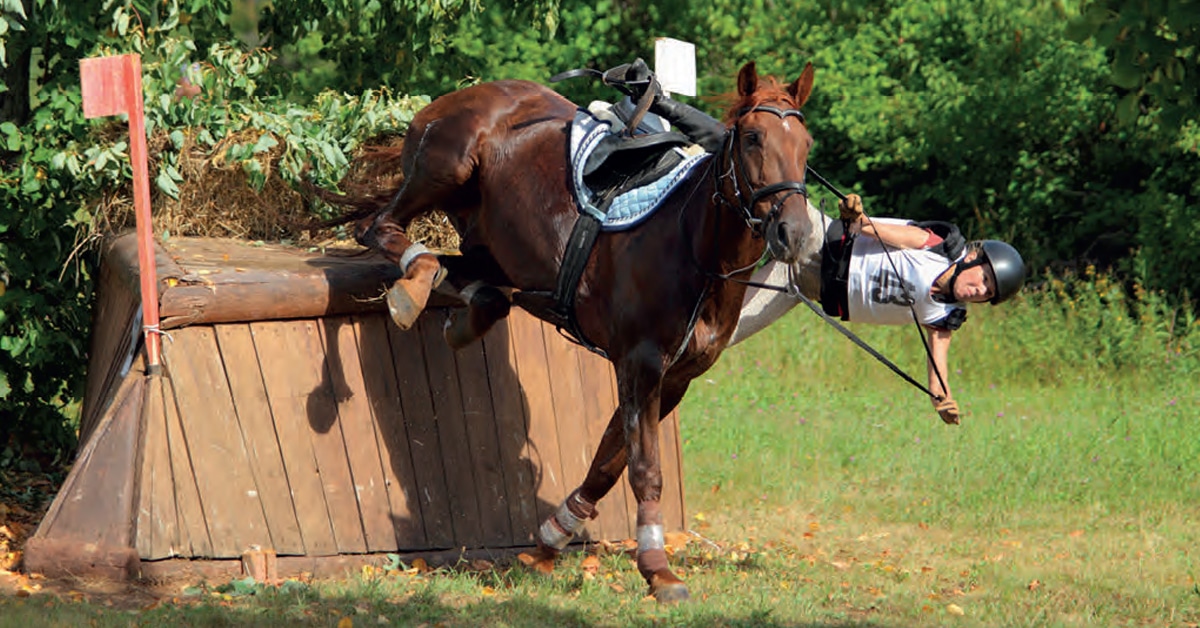
Diana reports: “Three years ago, I had a nasty fall during a trail ride. I was out riding with a friend when our horses got spooked by a combine harvester and bolted. After some time, we managed to slow the horses down, but then a tractor approached us. I thought my horse would bolt again, so I tried to hold him back. That’s when he lowered his head and began to buck. He had never behaved like that before, which caught me off guard. At first, I could manage the bucks, but then my horse really started acting like a rodeo bronco. At least that’s what my friend says—I Most riders who develop chronic fear believe they can pinpoint the exact cause of their anxiety. can’t recall the details. At some point, I know, I just couldn’t hold on anymore, and I fell off. After a hospital stay, rehabilitation, and several months of recovery, I was allowed to ride again.”
Diana goes on to say, “Since the fall, I’ve been afraid of going on trail rides. Over the past few months, even cantering in an arena has become difficult. The thing is, I have two horses—the gelding I fell from, and a mare—and strangely, I am much more afraid of the mare than of the gelding, even though nothing bad ever happened with her.”
In this example with Diana, you might assume that the fall led directly to her fear. But if that was the case, why would she feel more fear of the mare, with whom she never had a traumatic experience, than the gelding from whom she had actually fallen? Something doesn’t add up, and that demonstrates that there are other factors influencing her reaction.
It could be that, due to other experiences or beliefs about her abilities or about the nature of horses in general, Diana became insecure. Maybe she picked up somewhere, or developed the conviction herself, that mares are more temperamental than geldings. Or perhaps, early on, the mare exhibited behavior that Diana interpreted as unpredictable, even if it wasn’t dangerous at the time, and now she subconsciously remembers that, and the context of her new fear makes it much more frightening. Fear is not always logical. It’s entirely possible that Diana’s fear, through a combination of physical memories of the fall and psychological factors, was transferred from the gelding to the mare.
We tend to want to make causal connections between certain events and our reactions to them. In doing so, we often forget that our feelings, reactions, and beliefs are the result of a multitude of influences—not just a single experience. So it is essential to recognize that while traumatic events like falling off a horse and becoming severely injured can definitely lead to fear, they often serve as triggers, while the underlying causes are usually much deeper and more complex, and very often have nothing to do with horses whatsoever. Conclusion: A fall can be a trigger that “sets off” fear, but in most cases, it’s not the root cause.
The Function Of Fear
Fear is fundamentally a very meaningful and necessary response to danger. We are born with the ability to feel fear, and every animal and human is hardwired to experience it. We need this ability, because fear activates the alarm system of our bodies when we are in danger. Only when it is triggered are we able to flee, fight, or freeze. Fear is meant to ensure our survival, so we need it to respond appropriately and swiftly in dangerous situations. Fear is not something you should despise. In genuinely dangerous situations, fear is your ally.
It can happen, however, that fear becomes misplaced, and we start to feel fear in situations that are not actually dangerous. The body’s alarm system doesn’t always respond correctly. Maybe we fear something in the future, or even the past. Maybe we start to fear everyday activities that most people find unproblematic. There’s also a heightened sense of fear that can escalate to panic, which can strike seemingly without warning. Panic manifests mainly physically, and it can make us feel as if we are dying.
A life full of fear is not desirable, but neither is a life without fear. You should feel fear in dangerous situations, in order to keep yourself safe. On the other hand, when no part of you is actually at risk, you should not feel unwarranted fear. Paradoxically, we live in a society where fear is part of everyday life, especially because most of us live in safe places. Sociologists call it the “security paradox.” Because we have security, we subconsciously fear losing it, which is why, in the countries that are safest to live in worldwide, people tend to be particularly fearful. This doesn’t mean you can’t do anything about your fears.
***
Order your copy of EquiHypnosis, Essential Techniques for Managing Riding Fear from Trafalgar Square Books here.
The Latest