Fans of thriller and mystery novels know the name Shari Lapena. The Canadian bestselling author is a global sensation with numerous New York Times bestsellers. beginning with The Couple Next Door. Lapena has earned a reputation as a writer of propulsive novels that also dive deep into the anxieties of modern life; less known, even among her fervent fans, is that behind the suspense and plot twists is a women with a lifelong love of horses and a creative process that thrives as much in the barn as it does behind the desk.
“The secret for me is getting right inside the heads of my characters,” she says. “I write very emotionally… and I’m very good at thinking of the worst possible thing that might happen, which seems to be the best thing for a thriller writer.”
Yet for someone who spends so much time imagining worst-case scenarios, Lapena has the ideal counterbalance: horses.
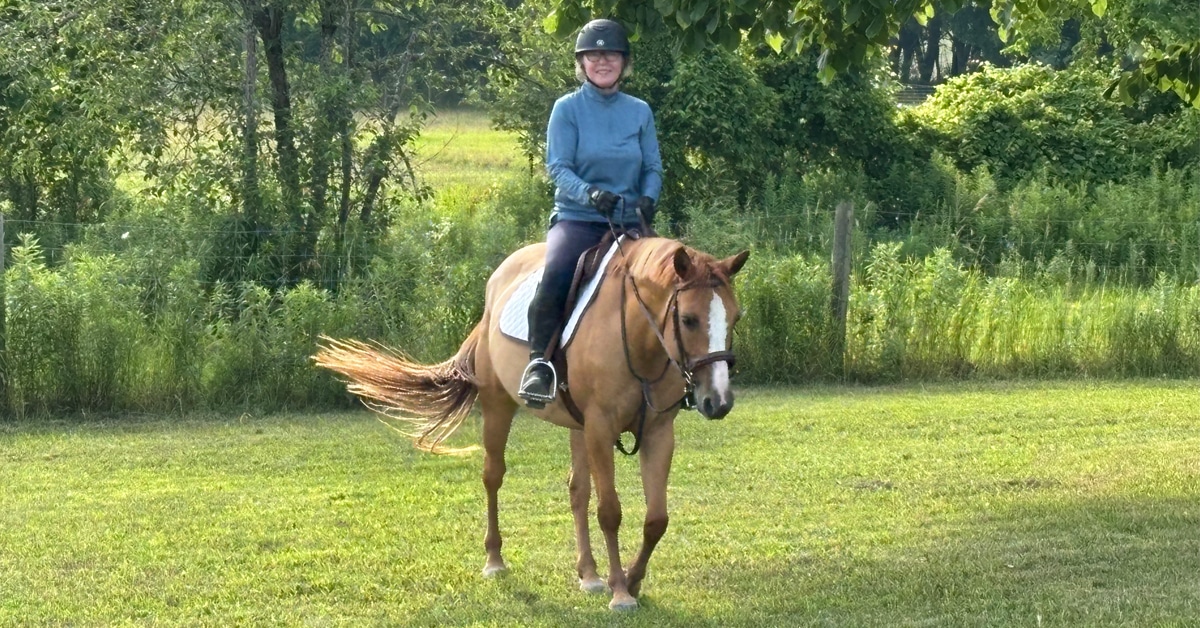
Her love of riding began in childhood. “I started when I was about 12,” she says, recalling her time in Pony Club in Ontario. Like many young riders, life eventually took her out of the saddle, but she didn’t completely leave the stable behind. When Lapena had a daughter of her own who inherited the horsey gene, she drove countless kilometers taking her daughter to various show barns outside of Toronto, until she stopped riding when she went away to university. But decades later, Lapena decided it was time to mount up again herself. “I came back to it when I was around sixty,” she says. The author started taking lessons again, including jumping cross-rails. “A couple of years ago, I bought my own Quarter Horse ‘pony’, her name is Nutmeg.”
Nutmeg is an eleven-year-old 14.1-hand red dun mare who has become part of the Lapena family. “She’s just too cute,” Lapena says. “I’ll keep her forever.”
Aboard Nutmeg, the author enjoyed taking lessons, including jumping. But the mare developed a bad case of heaves and needed almost a year off. Thankfully, allergy shots and switching to steamed hay solved that problem. Then Lapena found she had issues with her hip and had to stop riding in recent months.
But nothing stops her from bonding with her mare. Nutmeg is boarded a short drive from the eastern Ontario farm that Lapena and her husband call home, along with a beloved cat named Ginger. Even without riding, the connection between Lapena and Nutmeg remains as strong as ever.
“You get an emotional attachment to them,” she says. “They’re very soothing to be around… I’ll groom her and tell her about my books and my plot problems.”
It’s a striking image: a bestselling thriller author talking through fictional murders with a patient, non-judgmental mare. And like all horsewomen, Lapena also appreciates the emotional and physical well-being benefits that horses provide. “It’s very grounding,” she says. “When you’re living in your head all the time as a writer, it’s helpful to go outside, to be in nature. At the barn, you’re busy with your hands, brushing, and your mind is free.”
That freedom, she adds, is vital for someone whose work requires sustained creative intensity. “If you have to spend a lot of time imagining the worst possible thing that can happen, it’s kind of nice to just go hang out and groom.”
While Lapena has yet to set a novel in the horse world, the idea is something she’s considered. “I’ve thought about setting one in a horse sanctuary,” she says. “It would certainly appeal to me.”
For now, though, her equestrian life remains a personal refuge rather than a fictional setting. In fact, her connection to Nutmeg has become so meaningful that it has found its way into her work in another way.
“I’m dedicating my next book, Getting Away with Murder, to Nutmeg and our cat, Ginger,” she shares.
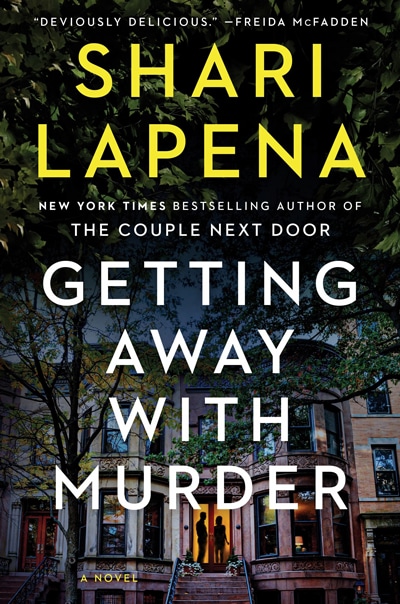 In Getting Away with Murder, Lapena serves up a new take on the genre. The plot follows Jill and Ted, a couple who adore their New York brownstone the way others adore their children. They have carefully, expensively, made every inch of it their own. It reflects who they are, their status and tastes. With the grand mahogany staircase and state-of-the-art kitchen, it is the stuff of glossy magazines and real-estate dreams. It is their sanctuary. So when Ted’s inheritance runs out and he makes a bad investment, they panic. How can they protect their beloved home and enviable lifestyle? The answer is obvious. Or at least, it is obvious to Jill and Ted. The death of one wealthy family member — from whom they stand to inherit millions — could solve all their problems. Together, they will get away with murder.
“Getting Away with Murder is a bit of a different kind of book for me,” Lapena explains. “It’s still very twisty and fast-paced, but instead of being a whodunit we know right from the very beginning that Jill and Ted have murdered Ted’s brother for his money. The question is, are they going to get away with it? I’m always trying to think of the perfect murder. It could be the perfect murder, but we don’t know until the end of the book.”
The novel also explores deeper themes — class, greed, and the mutability of status. “How far would they go to get money to save their lifestyle?” she asks. “I’m exploring the growing inequality in the U.S.”
As her readers eagerly await Getting Away with Murder, one thing is certain: whether in the pages of her novels or the peaceful aisles of a barn, Lapena knows exactly how to hold our attention, and when to let us breathe.
The Latest