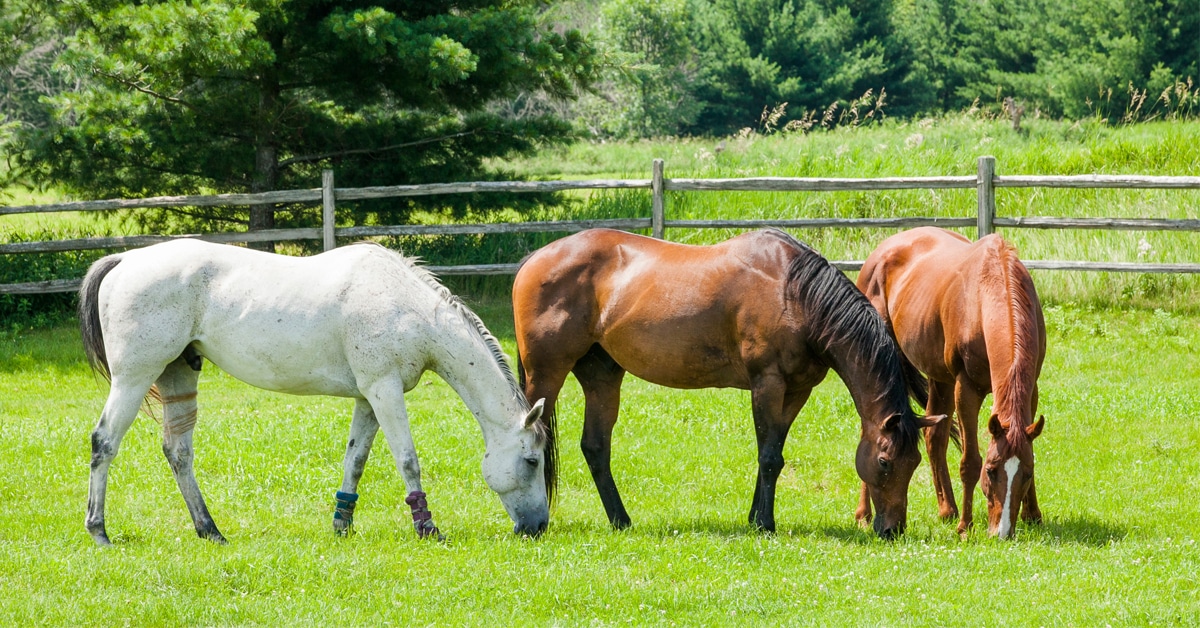
Every farm owner dreams of lush grazing pastures, but few know that ideal pasture maintenance starts from the ground up. When it comes to troubleshooting common pasture problems like sparse grass, weeds, nutrient deficiency, compaction, erosion, drainage – and yes, mud – solutions can often be found at the level of the soil. There are no quick and easy fixes, but long-term planning and diligent maintenance of pasture soils can make a world of difference for pasture health, and better pastures mean healthier, happier horses.

Dr. Kimberley Schneider.
Dr. Kimberley Schneider, a soil scientist and assistant professor in forage and service crops at the University of Guelph, believes healthy pastures can help save money on forage while also having excellent benefits for the environment.
Dr. Schneider has spent 20 years as an agronomist, and the last six years researching forage quality for livestock, focusing on the environmental benefits of perennial forages and cover crops, including efficient nutrient use, carbon sequestration, and soil health.
“We have evidence that pastures are good for soil health and sequestering carbon into the ground. Pastures are generally better than annual crops in terms of having higher soil organic matter and health scores,” Dr. Schneider told Horse Sport.
Here she offers some insights and basic tips for maintaining pastures to ensure soil health and high-quality forage.
Protecting the Plants: Rotational Grazing and Rest Periods
Dr. Schneider said the biggest detriment to pasture health is overgrazing, which occurs when grasses and legumes are cropped down below two or three inches, or ripped out of the ground entirely, damaging root systems. Destroying root systems reduces plant nutrients, productivity, and longevity.
“Horses gnaw the plant again and again when it grows back, before it’s ready to graze,” said Dr. Schneider. “Over time, this depletes the root reserves, and draws nutrients from the roots… and the roots don’t have enough energy to keep growing. Even though the plant is drawing nutrients, it’s invested in growing the above-ground biomass and not putting resources into the below-ground.”
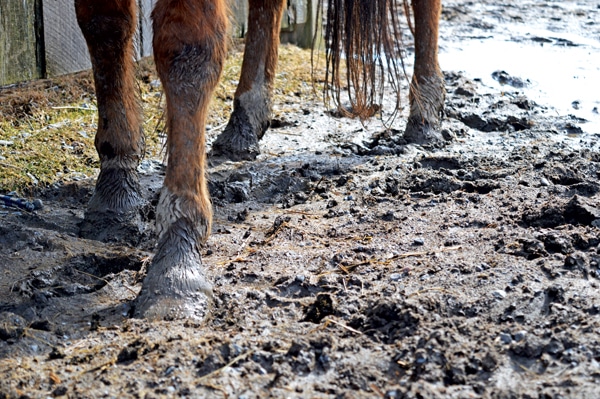
While mud in the spring and fall is inevitable, it can be managed, and the soil protected, by rotating pastures or relocating trough and feeding stations in paddocks regularly. (Amy Harris photo)
Grazing too early or too late in the plant’s lifecycle can also cause problems, warned Dr. Schneider. Grazing too early can prevent plants from reaching maturity, whereas grazing too late, when the mature plant has gone to head, forming flowers and seeds in the reproductive stage, might cause horses to avoid it.
To prevent overgrazing, Dr. Schneider suggests rotational grazing, a management practice that gives grazed pastures a period of rest and recovery. In addition to promoting forage productivity and pasture longevity, rotational grazing can drastically reduce compaction and destruction of pasture soil due to foot traffic.
Rotational grazing can be difficult for a number of reasons, however, especially on smaller properties where there is limited acreage available to create additional pasture spaces. It can also be tricky to develop a system that serves the dietary needs of each individual herd member.
Dr. Schneider suggests starting small, with a rotation of four paddocks large enough to accommodate the number of horses inside, keeping in mind that each horse requires about one acre to meet dietary needs if their nutrient intake depends solely on grazing. Safe, temporary fencing such as high-visibility electric fencing can be used to separate large paddocks.
Rotational grazing can also help with problems caused by too much foot traffic, such as soil compaction and mud. “If you put them out when it’s wet, and you have clay in the soil, it’s more prone to compaction,” said Dr. Schneider.
“Managing horse pasture” guidelines from the Ontario Ministry of Agriculture, Food, and Rural Affairs (OMAFA) recommend rotating horses to a different paddock every five to six days to prevent plants from being grazed below two or three inches. Resting pastures should be allowed to regrow to 8-10″ high before reintroducing horses.
Dr. Schneider recommends having a stress or ‘sacrifice paddock’ in addition to the regular grazing rotation that can be used for turnout when the ground is wet in the spring and fall, or after heavy rains. The stress paddock might be a winter holding area close to the barn, where horses can be fed hay while resting pastures or waiting for better weather.
In addition to promoting forage productivity and pasture longevity, rotational grazing can drastically reduce compaction and destruction of pasture soil due to foot traffic.
Horses can be turned out on pastures when the ground is dry enough to walk on without compacting it or causing damage, usually from early to mid-May until sometime in September. But even within this window of time, horses will sometimes have to be moved back to the stress paddock after heavy rainfalls, Dr. Schneider said.
In both stress paddocks and pastures, the best solution for preventing mud build-up is to reduce usage of high-traffic areas by rotating water troughs, hay nets, or round bales to different positions.
For more information on how to develop a rotational grazing plan that works for you, Dr. Schneider recommends this fact sheet from Dr. Amy Burk, a horse pasture scientist from the University of Maryland, and these suggestions from Dr. Krishona Martinson from the University of Minnesota.
Protecting the Soil: Mowing and Dragging
Horses are picky eaters, resulting in pastures typically being overgrazed down below an inch in some places, while other vegetation is left to grow unchecked.
Routine mowing helps to keep all plants in a similar state of maturity, and it prevents weeds from growing to maturity and propagating, said Dr. Schneider. The practice helps plants maintain healthy root systems, thereby aiding carbon sequestration, one of the most important parts of pasture soil health.
Carbon sequestration occurs when plants absorb CO2 during photosynthesis and transfer carbon into the soil via their roots and decomposed biomass. Carbon-rich soil is one of the biggest building blocks of nutrient-rich and structurally sound pasture soil. In addition to providing nutrients for microbes, carbon sequestration creates healthy soil aggregates, which allow for water retention and drainage.
Soil aggregates create the structure of the soil. When soil is compacted, the aggregates are cemented together, making it more difficult for grass roots to penetrate and slowing water drainage. An ideal soil structure for pastures is composed of pea-sized granules that can be penetrated by grass roots.
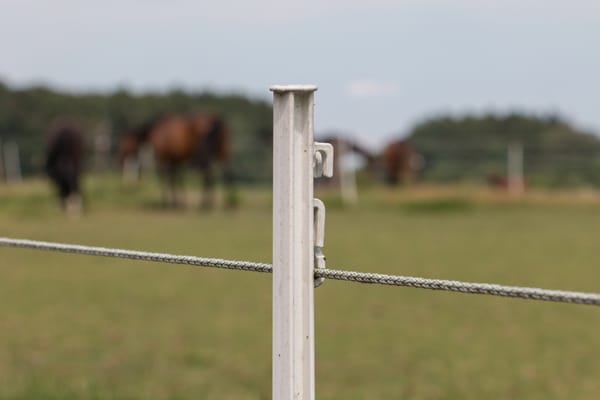
Rotational grazing is possible even on smaller acreages, utilizing easily transportible electic fencing. (StudioLaMagica – stock.adobe.com)
When healthy roots are able to put carbon compounds into the soil, microbes feed off the carbon compounds, die and mix with the mineral material in the soil, making stabler organic matter. The organic matter is protected by the soil aggregates, and the carbon is prevented from oxidizing and being released back into the air.
“The more microbes, the more stable carbon we have in the soil,” said Dr. Schnieder.
Soil texture – the particle size of the sand, silt, or clay that comprises it – cannot be changed, but the structure, which is composed of how the aggregates are held together and how large they are, can be changed by increasing organic matter with healthy plant roots. Changing the structure can help with drainage as well as forage growth.
To help encourage the healthiest plant roots, mowing should be done each time horses leave a pasture during rotation, and should be followed by a rest period where plants can regrow. After mowing, fields can be lightly harrowed or dragged to break up and spread around clumps of manure. This helps prevent uneven regrowth around manure clusters.
“You want to go in after they’ve grazed over an area and mow down whatever they haven’t eaten to about four inches, so everything can regrow in a uniform manner,” said Dr. Schneider.
Dr. Schneider recommends dragging once or twice per year during hot temperatures in order to remove parasite infestations. Harrowing or dragging on cool, wet days can actually spread parasite infestations.
According to the University of Guelph’s The Horse Portal, parasites found in pastures can cause motility disturbances, inflammation, and lesions and blood clots in the intestinal tract, sometimes leading to colic. Fecal egg counts done by a veterinarian during pasture grazing months can help to assess the parasite content in your pastures.
Plant Types, Fertilizer and Testing
The fertility, nutrient content, and protein content of soils depends on the kinds of plants growing in the pasture. Most horse pastures are a combination of grasses, most commonly Kentucky bluegrass, and legumes.
Legumes, including alfalfa, white clover, trefoil, and red clover, have a taproot and can bring nutrients up from deeper in the soil. They can increase soil microbe populations and fix nitrogen in a way that shallow grass roots cannot. Useable nitrogen is a vital part chlorophyll production and plant growth.
“Legumes are plants that fix nitrogen from the atmosphere, and they have a symbiotic relationship [with soil microbes] that can convert nitrogen gas into useable nitrogen,” explained Dr. Schneider.
Healthy soil within a pasture means a diversity of root structures. Pastures with mostly grasses can be nitrogen deficient, whereas legume-heavy pastures consisting of more than around 30% legumes will be rich in nitrogen and will likely not need additional fertilizers.
According to OMAFA’s “Managing Horse Pastures” guidelines, unlike legumes, grasses may require up to 300 kg of nitrogen/hectare for best growth results, with a minimum of 75 kg of nitrogen required to see results. Yearly nitrogen application should be split into one half during the early spring, one quarter in late June, and one quarter in early September. Larger horse pastures might require bulk fertilizers to be spread, but on smaller acreages without access to tractors, small fertilizer spreaders will work well.
Nitrogen testing can be difficult, said Dr. Schneider. One way to determine whether your pastures need nitrogen is checking to see if there is better and greener growth around urine and manure spots. For a more comprehensive guide to determining if fertilizer needs to be applied and how to apply it, Dr. Schnieder recommends consulting OMAFA’s “Guide to Forage Production,” edited by OMAFA Forage Specialist Christine O’Reilly.
Ideally, pasture soils will be tested at least once every three years to determine organic matter levels, pH, and nutrients such as phosphorus and potassium. To get more information on soil testing, contact your local OMAFA office or fertilizer supplier.
Nutrient testing on pasture forage can be done in the same way hay nutrients are tested, by taking samples for lab analysis. In conjunction with lab analysis, Dr. Schneider recommends a visual assessment of at least ten different places throughout the pasture to get an idea of the kinds of forage growing there.
The contents of pasture forage can be changed over time to suit specific needs. For example, despite their benefit to soil nitrogen content, a heavy-legume pasture might not be suitable for all horses because legumes are higher in protein and energy content.
“Legumes… have a symbiotic relationship with soil microbes that can convert nitrogen gas into useable nitrogen.”
“It comes down to what types of horses you have and what you’re doing with them,” said. Dr. Schneider. “You don’t always want a high-protein or high-energy feed. Some [farms] might want all-grass pastures and some can get away with having more legumes in the pasture.”
Lastly, too many weeds, too much mud, or the wrong grass-to-legume ratio might be an indication that the pasture needs a complete re-seeding. Dr. Schnieder stressed that it’s important to choose forage seeds after testing pasture soils, to ensure the kind of forage you choose is a good match for your soil nutrients, pH profile, and drainage. “For example, alfalfa shouldn’t be planted on soils with low pH; a better legume would be clover.”
When incorporating these tips, expect to take things slowly and learn from trial-and-error. Dr. Schneider said finding the right rotation schedule, maintenance schedule, and nutrient profile can be “…challenging, but not impossible.”
The Latest