Feeding. Watering. Mucking. Blanketing. Turnout. Biosecurity. Health. Horsemanship.
There are so many considerations to running a horse barn. But are you the only person who knows which horse gets what feed, where its health records are kept, and in which paddock it lives? Is there a backup plan if you’re away or ill? Can stable hands or volunteers run things in a pinch?
Robyn Freer at Foxwood Farm in Gilford, ON, has developed a system based on meticulous organization: tack rooms are fitted with roomy individual cupboards, saddle racks and bridle hooks; the feed room has white boards charting the day’s meals, which are doled out from labelled and colour-coordinated bins and feed pails matched to horse and paddock; and a wall of cubbies holds clean, folded blankets for the 25 equine residents – all of which live outdoors, all year round.
Pony Club roots
Freer started riding at age seven in Peterborough, moved to Toronto at age 12 and rode with the Eglinton Equestrian Club, taking public transit every day to the stable after school until she learned to drive. Pony Club helped her learn horsemanship, something she strives to replicate at Foxwood. “Most people just come, ride and leave and do not understand what goes into the care of a horse, above and beyond riding,” she bemoans of what happens at a lot of stables.
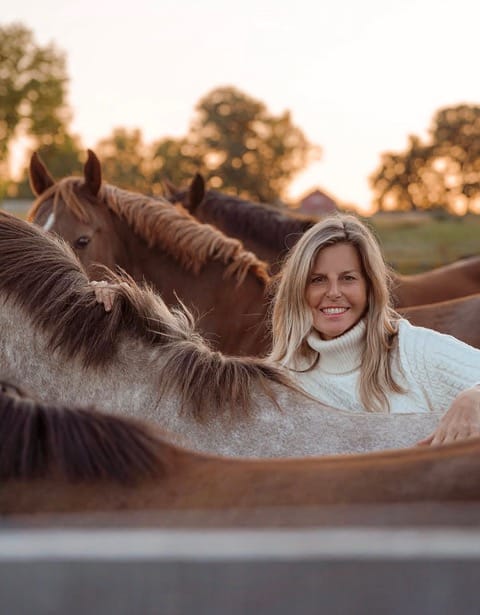
Robyn Freer. (Studio 4 Collective/Emily Buchinger)
Freer graduated from Western University with an English degree, minoring in French and German, and thinking she might become a translator. Eventually, now the owner of a horse, Freer decided to do something very different, and in 1984 she opened a tack store in King City. Founding Foxwood in 1998 with two horses, she boarded retired horses, giving lessons, then kids camps, “and then it just snowballed.” Daughter Emily Buchinger, 24, has ridden competitively on the gold circuit and operates her own videography/photography business, taking care of Foxwood’s social media presence.
“Over the years you learn what works and what doesn’t work,” Freer notes of the details, training and knowledge acquisition, feeding, blanketing, and other management practices that have to function optimally for the barn manager, and especially the horses.
24/7 Outside Living – It Is Possible!
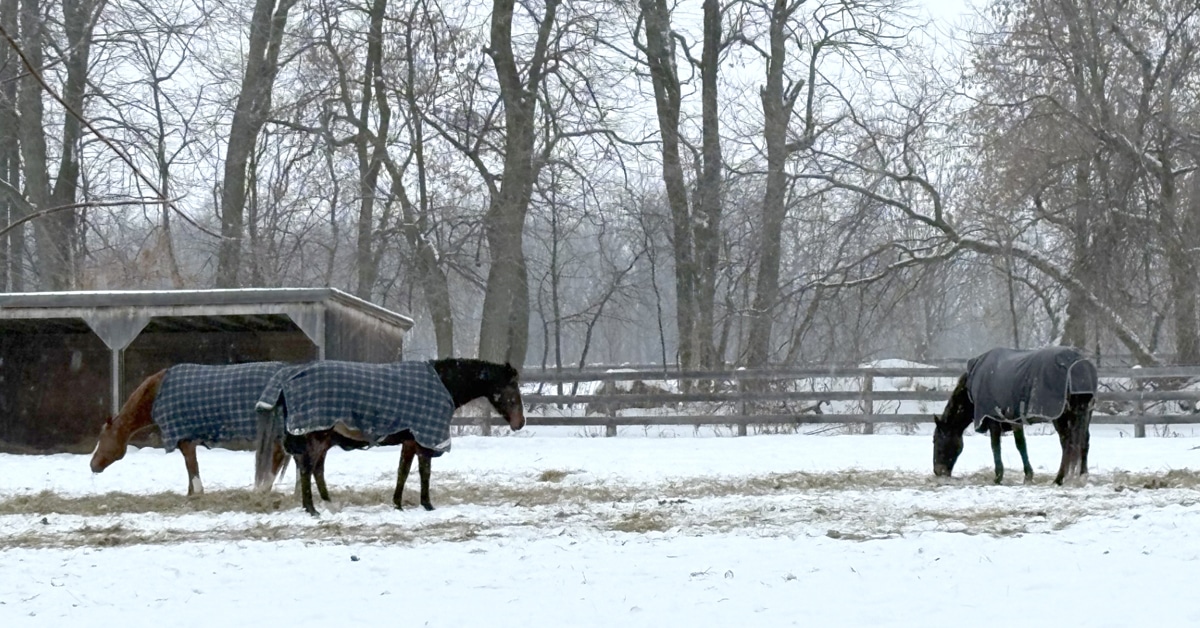
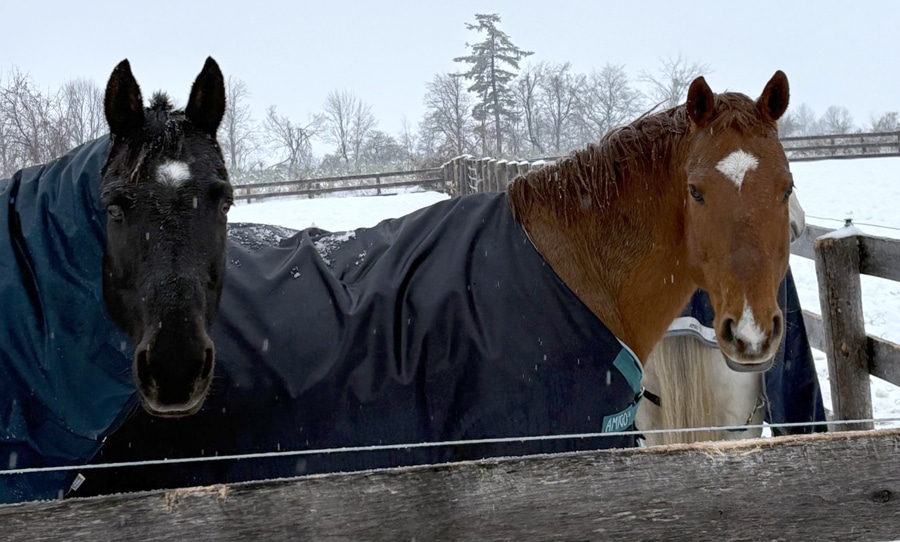
Every horse at Foxwood lives out 24/7 – and loves it. “My show horses (none are ever clipped in the winter) all live outside. Once they get a taste of living outside, they do not want to be inside,” says Freer. One particularly cold night this past December, she brought all the horses in – only to find they whinnied and kicked constantly. “They just wanted to go back outside to their paddocks.” Freer believes horses are healthier and happier in the paddock, although outside living is not a cost-saving measure.
(Leslie Smith photo)
All run-in sheds are bedded deeply with straw. Hay is placed in front of the sheds so the horses only have to stick their necks out to eat. Freer notes that most horses just don’t care about the weather. Even during the worst snowstorms, most of her geldings are out in their paddocks, by choice, rather than sheltering in their sheds.
 Robyn Freer says her main concern regarding her horses wintering outside are freezing rain and frigid conditions, so “Basically, we just monitor them.” All horses are brought inside for daily checks whether they are ridden that day or not. Freezing rain is a concern, because paddocks become icy. If horses cannot stay warm even wearing a variety of blankets, they will come in, especially older horses. The barn has 17 indoor stalls and horses can be put in the riding arena in very extreme conditions; however, she has only had to do this twice in 27 years.
Tack & Blankets Blankets Blankets
Most show team horses and riders have a own locker where blankets, show gear, regular and show tack is kept. School horses have assigned saddle racks and bridle hooks for tack. A saddle fitter comes annually to check saddle fit; saddles and bridles are always fitted to the horse. Biosecurity is important, so grooming equipment is shared only within the horse group.
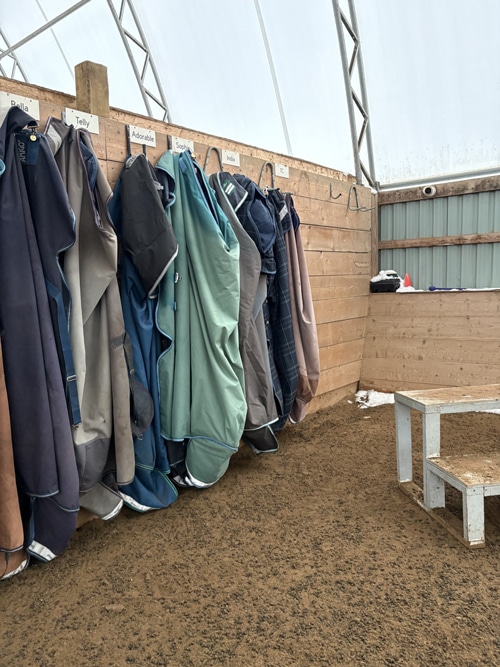
Blankets hanging in the arena, labelled by horse. (Leslie Smith photo)
With all horses living outdoors, blanket organization is paramount. A large blanket shelf in the tractor barn features a wall of cubicles for each horse, containing a variety of blankets of various weights and types, washed and folded in clear plastic bags. Labelled hooks in the riding arena hold blankets which are drying out or which will be put back on horses being ridden. Horses generally have a rain sheet, a 100-gram and 200-gram blanket liner, and a 250-gram and 400-gram turnout blanket. Some horses may have 300-g and 400-g and 450-g liners, and so on. A 400-g liner might be paired with a 200-g blanket on an extra-cold day for some horses.
But Freer cautions, “Horses do not like to be overheated. What we may think is cold might be okay for a horse. We have to monitor the individual horse. Some horses do not grow much of a coat, and we are always checking blankets. We put a hand underneath and check for warmth and dampness.” Plastic totes, labelled by size and the horse’s name, are used to store extra winter blankets and liners when not in use.
Various white boards chart what feed horses receive, their blanket size, their supplements, when vaccines were given, when the farrier trimmed their hooves, and when deworming was done.
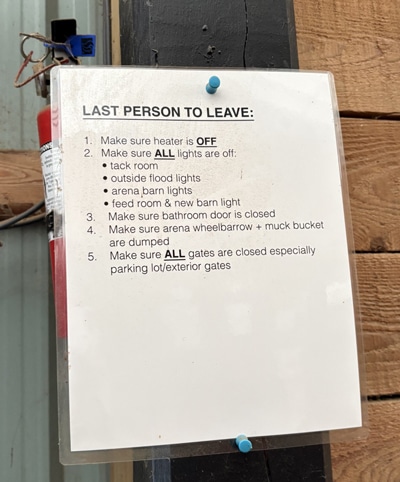
“We always have a checklist on the board of what to do when you are here,” says Freer of how the staff are informed of the day’s tasks. This may include bringing in horses, filling grain bins, distributing hay and shavings, checking waterers and fence lines, feeding the cats, soaking feed, and making up beet pulp, “so they know what to do if they come in for a two-hour shift.”
Freer suggests documenting each horse’s baseline vital signs: heart rate, temperature and respiration, as if a horse gets sick or colics, it is important to know what is normal for each animal. “It is good to have as much information as possible.”
Paddock Patrol: Hay, Feed and Water
Freer incorporates an intuitive system of colour-coordinated buckets with horses’ names on them for her 12 paddocks as well as individual name tags for ease of identification and feeding. Geldings have blue name tags with named blue feed buckets and reside in the gelding-only blue paddock. The different shades of buckets denote different paddocks and a white board chart shows which horses live in which paddocks.
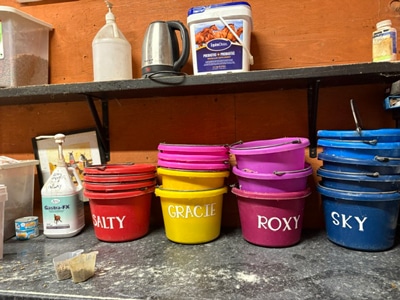
The feed room contains labelled bins featuring supplements, feed and colour-coded feed buckets. (Leslie Smith photo)
“I always oversee the feeding,” Freer says. “If a horse is off their feed, then what is the reason? Horses are grazers, so you want them to always be eating. I take out a round bale to the paddock, drop it, cut the strings, and we roll it out.” This ‘pathway’ can be picked up and relocated or divided up and put in different areas so horses do not fight over hay or trample it excessively, wasting fodder.
She also uses square bales, conscious that round-bale hay and square-bale hay can be of different nutritional quality. “They constantly have hay. I never let my horses have an empty paddock.”
Horses all get a scoop of salt; some get extra vitamins and minerals. Others are on supplements or special feeding programs.
Freer emphasizes the importance of water, winter and summer. “They cannot eat snow!”
Each paddock is equipped with automatic drinking posts which she describes as “amazing.” When a horse pushes on a paddle, fresh water is forced up from below the frost line, filling a bowl. When the horse finishes drinking, excess water drains away. The system uses electricity only to pump water up, not to heat it. Waterers are checked twice a day to ensure they are working.
“As we feed, we rinse out the feed bucket and use something yummy” like a sweet feed, “then we add a scoop of electrolytes and warm water after the horse finishes their grain, and give them what we call ‘sweet water.'” The horses love it and it increases their desire to drink, crucial in winter when their water intake typically drops.
Lessons, Show Teams, Mentors, Volunteers and Staff
Coordinating and keeping track of about 75 riders (about 75% of them under 18) in spring, summer and fall, plus another 50-odd riders in winter is a challenge, but Freer’s organizational methods prevail.
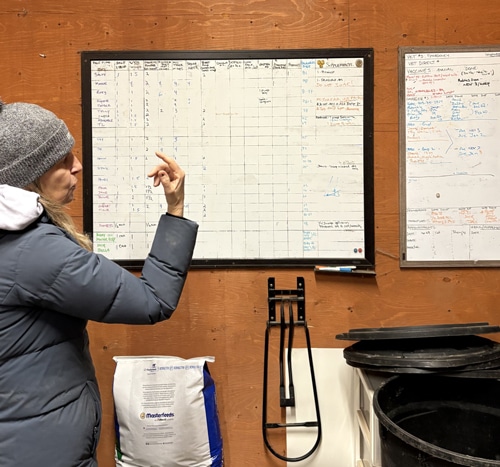
Robyn Freer explains her white board chart system. (Leslie Smith photo)
Foxwood has a 12-member junior and 10-member Silver show team aged 10-adult. Silver shows last four days, five times per season (end of April-early September). The Junior team attends three shows, learning competition, grooming, horsemanship and riding skills. A team braider and day care staff braid and feed, bandage and check on horses competing on show weekends.
The barn has three paid staff plus several instructors, including Freer. She matches experienced horse people with volunteers, offering encouragement and hands-on experience. “If you volunteer first and learn, by the time you are going to work and get paid, you are already trained.”
The results is a barn full of friendly, knowledgeable riders, young and old. Volunteers can take CPR and first aid courses on site. Riders can participate in summer camps, and practise and test for Ontario Equestrian rider levels.
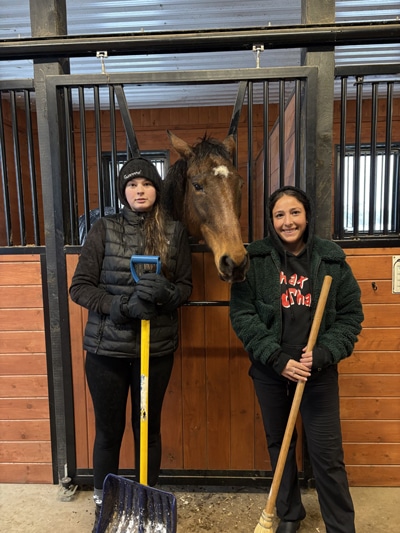
Kaitlyn Fosberg, 19, left, and Julia Ceccarelli, 25, right. (Leslie Smith photo)
One of the staff members, Julia Ceccarelli, 25, began volunteering at Foxwood last spring as a stable hand. In March, 2026, she departs for a four-year veterinary program in Melbourne, Australia. “I was originally going to school to be a nurse and I ended up switching career paths. I did my undergrad in biomedical science at York. I did one year of an accelerated nursing program, but I knew I always wanted to be a vet. I switched back to (University of) Guelph and applied for vet school.”
Staffer Kaitlyn Fosberg, 19, began volunteering at Foxwood at age 12. After studying to be a social services worker, she decided to be a farrier, running her own business and specializing in barefoot trims. “It is going to be a challenge right now since I don’t have enough muscle built up, but that is the only thing that worries me. I think being a woman in this profession will be perfectly fine.” Notes Freer, “it is a dying trade. There are not a lot of barefoot trimming specialists.”
and don’t forget the donkeys…
Freer fosters two donkeys from the Donkey Sanctuary of Canada in Puslinch. Her reason? “I just always wanted donkeys.” She sells horse treats and cookies, individually or by subscription, to raise money for the sanctuary, which houses 100+ donkeys and relies on donations to provide ongoing care for their residents.
The Latest