For Canadian riders looking to expand their competition calendar without sacrificing quality, atmosphere, or family appeal, Traverse City has quietly become one of North America’s most strategic summer destinations.
Held at Flintfields Horse Park in Williamsburg, Michigan, just minutes from downtown Traverse City, the 13-week series blends top-level sport with thoughtful infrastructure and a setting that feels more like a summer retreat than a traditional show circuit.
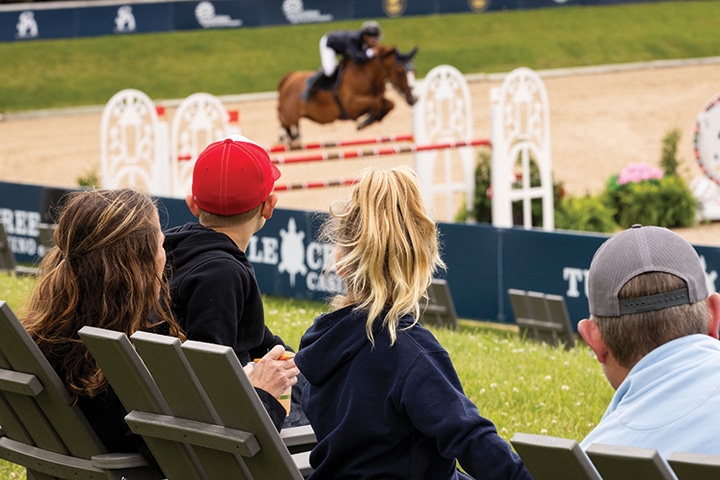
The circuit features Major League Show Jumping, a World Cup qualifier, the American Gold Cup, and the NAYC, among other major events.
Over the past several years, Traverse City Horse Shows has steadily increased its prize money, now exceeding $7 million per season. For Canadian professionals and ambitious juniors, that scale matters. The circuit features FEI 5-star Major League Show Jumping, a 5-star World Cup qualifier, and the 5-star American Gold Cup, currently the longest running Grand Prix in the United States. The schedule also includes the $100,000 Dudley & Barb Smith 3’6” Equitation Championship, the $50,000 Traverse City 3’3” Equitation Championship, plus the USHJA International Hunter Derby regional championships and USHJA North Central Championship Green Hunter Incentive Championships, and of course, the FEI North American Youth Championships for Dressage and Jumping.
In addition to top sport, each year management makes considerable investments in the facility to offer competitors something new each season.
When Morrissey Management Group acquired the property in 2019, one of the first major initiatives was to overhaul footing across the facility.
“The first priority was footing,” said Matt Morrissey, the Managing Partner of Traverse City Horse Show. “We rebuilt the rings from the ground up to ensure consistency and safety. We didn’t want to be constrained to the existing layout.”
Morrissey partnered with GGT to install premium fibre footing, and some rings also have underground watering for consistency and safety. “If it rains, it drains well. We believe in good footing and a safe environment for horses to compete,” Morrissey noted. “We’ve actually had people tell us their horses feel better showing after two weeks here than at home.”
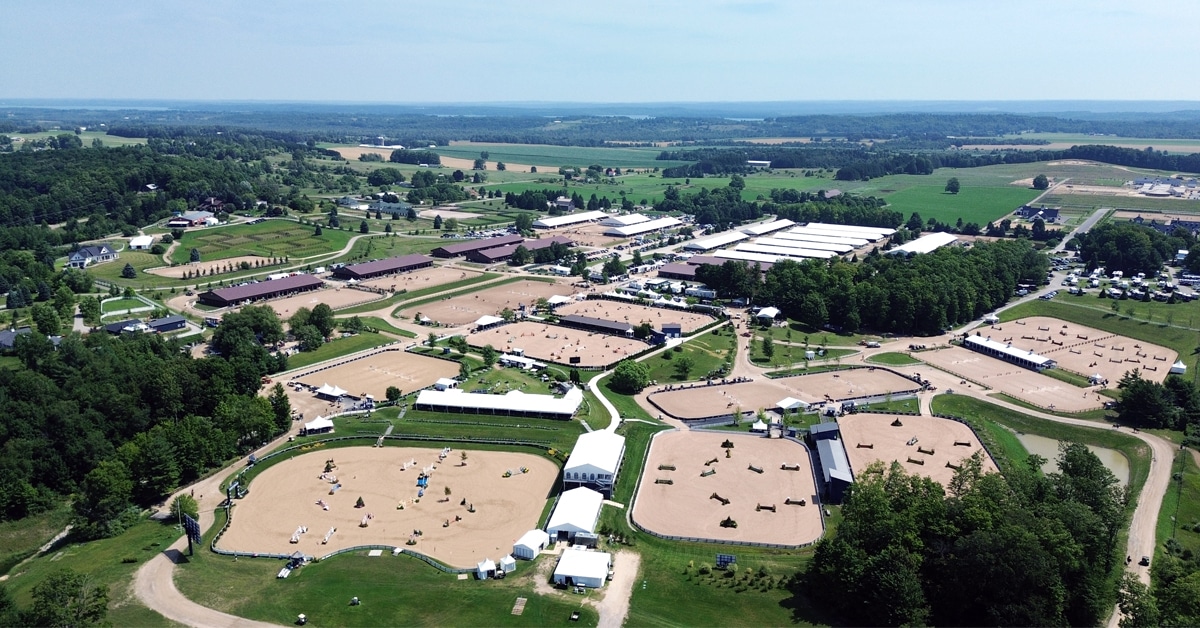
Today the park includes seven competition rings, seven warm-up rings, and additional riding and lunging areas, for a total of 19 ring spaces.
In every off-season, show management is busy adding new upgrades to the facility.
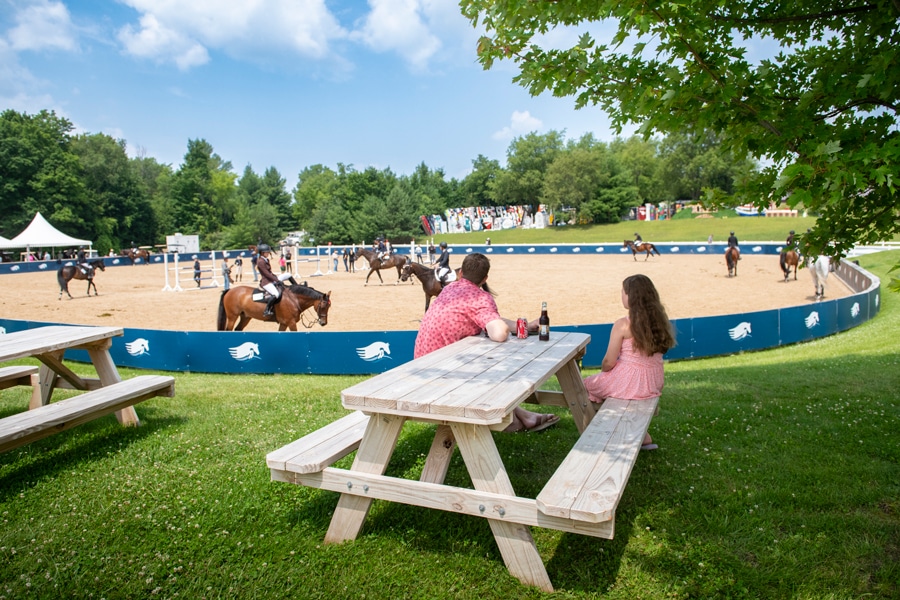
The park includes seven competition rings, seven warm-up rings, and additional riding and lunging areas.
“Every year our regulars see major improvements that were done over the winter,” said Morrissey. “Over the last four years we’ve added 850 permanent stalls, permanent bathrooms, and a large speedy Wi-Fi network — we’re one of the largest fibre networks in the county. Every year, I think people look forward to coming and seeing the upgrades that we do to keep the venue unique.”
One of the most distinctive features of the venue is its 80-acre trail system, created through a partnership with a local First Nation, the Grand Traverse Band of Ottawa and Chippewa Indians, that lease adjacent land for equestrian use. The trails were an immediate hit with exhibitors. “That was the big hit with the venue last year,” Morrissey said, referring to the ability to hack out on expansive, purpose-built paths. There are plans to develop a cross-country course, opening the door to expanded eventing opportunities.
The venue intentionally maintains green space and works with the natural topography rather than imposing a uniform layout. “It’s not your typical cookie cutter shaped horse show,” Morrissey explained. “We use the topography of the grounds and build into it.”
The result feels organic and expansive, yet remains highly functional with short, efficient access between barns and rings.
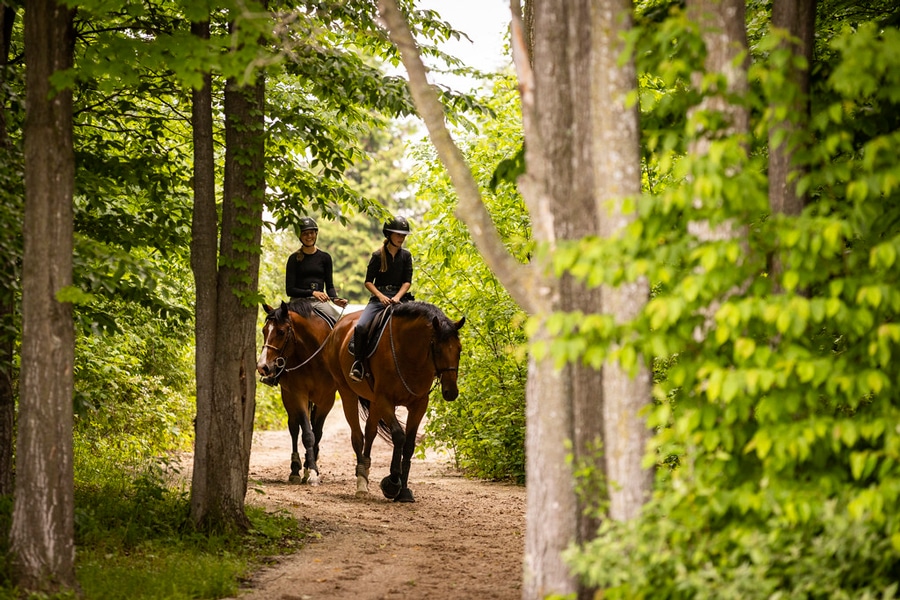
The 80-acre trail system has been a big hit with exhibitors.
Over the course of 13 weeks, the calendar shifts and builds, keeping competition fresh.
“The venue has lots of extracurricular activities like cornhole tournaments, bingo, trivia, kids’ days and even special celebrity chef dinners,” explained Morrissey. “Pony Palooza at the pony ring offers snacks and drinks for the kids and includes different activities including interactive photo booths, arts and crafts and other activities at the pony ring to keep them entertained when they aren’t showing.”
Traverse City has hosted the North American Youth Championships since 2021, reinforcing its status as a championship venue and underscoring its appeal for Canadian young riders targeting team competition. Morrissey believes bringing disciplines together is part of the long-term vision. “There’s a big push to have all three disciplines together,” he said. “We enjoy hosting championships like the North American (NAYC), and we want to be able to accommodate all three disciplines.”
Beyond the sport, the location itself is a key draw. June and September weeks offer flexibility and a slightly quieter rhythm.
“June is one of our best-kept secrets,” Morrissey said. “The schedule is manageable, the weather is comfortable, and riders have time to get out and enjoy the town a little bit more.”
To help with that balance, an on-site concierge helps exhibitors book restaurants, fishing trips, golf, spa visits, and other local experiences before they even arrive. “We wanted to make sure our clients had the opportunity to experience everything there is in Traverse City,” Morrissey added.
Located roughly at the same latitude as Tobermory and further north than Toronto, Traverse City offers a cooler alternative to many southern summer circuits. It has also emerged as one of the Midwest’s most respected culinary destinations, anchored by a thriving wine region and a strong farm-to-table culture. The area is home to multiple James Beard-recognized chefs, and Modern Bird recently earned a place on The New York Times’ list of the 50 best restaurants in America.
Exhibitors are just minutes away from Grand Traverse Resort & Spa, Turtle Creek Casino & Hotel, championship golf, waterfront dining, and Lake Michigan beaches. This makes it easy to enjoy both top-level sport and a relaxing summer lifestyle.
Perhaps most compelling is what has happened beyond the rings. Over the past three years, exhibitors have begun investing in the area by purchasing farms, building barns, and creating a year-round equestrian footprint. Morrissey describes it as something akin to “a mini-Lexington, Kentucky,” with character and equestrian culture growing around the showgrounds.
For Canadians who winter in Wellington or Ocala, Traverse City presents a northern complement, a summer home that combines elite sport with space and lifestyle appeal. Logistically, it is within driving distance for many Ontario riders and accessible by short regional flights. Strategically, it offers international calibre sport, significant prize money, championship opportunities, modern infrastructure, and a family friendly environment. With a strong and growing Ontario presence, Traverse City has become a familiar and accessible summer extension for many Canadian barns.
As Canadian equestrian sport continues to globalize and riders look to broaden their competitive exposure, adding Traverse City to the calendar is less about replacing domestic shows and more about complementing them. It offers a chance to compete at the highest levels, develop young horses, expose juniors to championship atmospheres, and still enjoy summer in a setting that feels both elevated and welcoming.
The Latest