Resolving Lack of Impulsion Through Memory Reconsolidation
Lack of impulsion, characterized by resistance or refusal to increase pace in response to the rider’s aids, is a common problem for riders. Conventional training methods offer limited options, and often no physical cause is found. Various methods to condition and train the horse are typically used in these cases; however, if the problem persists and no medical cause is identified, it is necessary to search for an alternative solution.
Recent advances in the neuroscience of learning offer this innovative alternative: memory reconsolidation (MR). Lack of impulsion, being a learned behaviour, can be unlearned via MR by acting directly on the neural circuits causing its symptoms.
The unlearning process, scientifically validated since 2004, is based on neuroscientific principles that have practical applications in training. Studies have shown that this process has a different impact on the nervous system than conventional training methods.
The MR process follows several key stages, applied in strict compliance with the horse’s tolerance thresholds, with careful monitoring of behavioural markers. First, the target learning is activated by a relevant stimulus, such as a human requesting acceleration. Next, a contradictory experience is introduced, creating a mismatch between what the horse has learned to anticipate (resistance or refusal to accelerate equals stress escalation) and the actual experience during the intervention (stress release). This is repeated 2–3 times, allowing the learning to be rewritten and reconsolidated in a new form, effectively ending the symptoms.
The subject of the study, conducted by Sophie Côté and Sandy Letarte of Equin Communication in Quebec, was an eight-year-old Oldenburg dressage gelding presenting with a lack of impulsion at the trot and canter. Despite tack changes, veterinary assessment, and conditioning training, the problem remained. During liberty sessions lasting 10 minutes, the practitioner encouraged the horse’s natural forward movement. When the horse lacked impulsion, the practitioner ended the session, which contradicted and “unlearned” the horse’s expectation of stress escalation.
This process was successfully replicated in 11 cases, with horses showing full resolution in 4–6 sessions. The horses’ performance and well-being improved, offering trainers and riding schools a quick, effective solution for behavioural issues.
MR targets the horse’s brain, helping it to “unlearn” resistance. By creating new experiences that the horses do not expect, the intervention rewrites the learned lack of impulsion behaviour in memory. This method has shown promising results, with horses becoming more relaxed, responsive, and performing better after just a few sessions, providing a lasting solution to impulsion problems and extending to other equine-related issues.
Abusive Behaviours During Non-Completion of Jumping Rounds
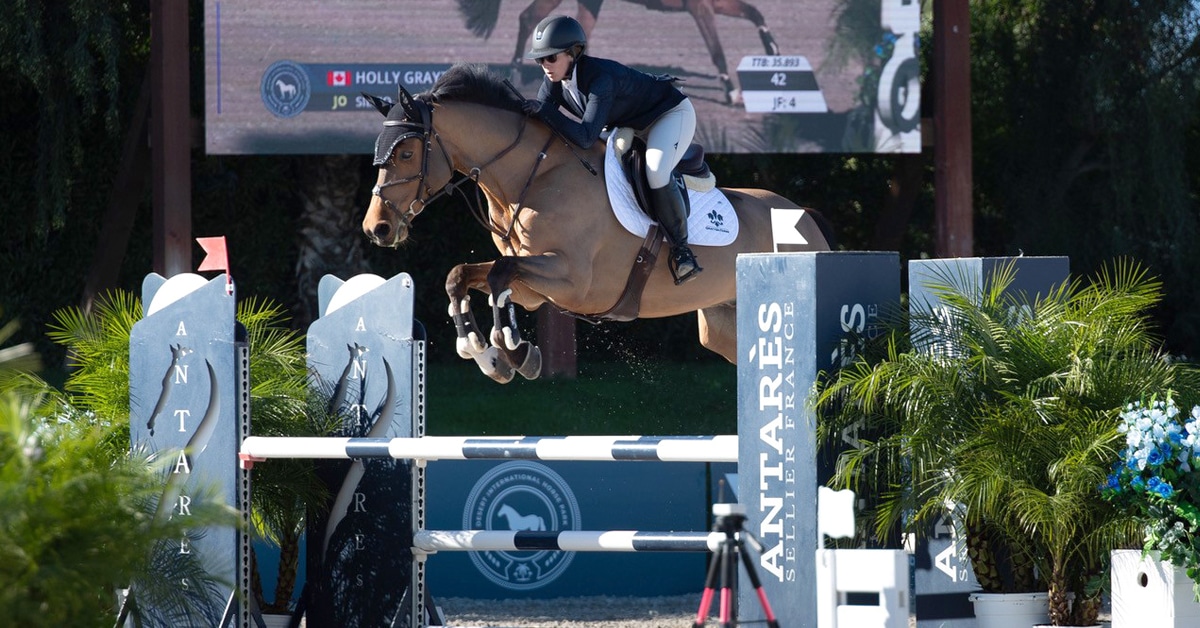
Show jumping performance hinges on effective rider–horse cooperation. Breakdowns in this relationship may lead to non-completion (NC) events—withdrawals, retirements, or eliminations—which are frequently symptomatic of conflict and associated with equine welfare risks.
Applying the Five Domains Model, rider behaviours during NC events in Hungary were investigated by analysing 440 videos from the 2023–2024 Hungarian show jumping seasons in which riders started but did not finish a course. Rider demographic data were matched with video-coded behavioural outcomes by independent, qualified reviewers using FEI standards.
Four rider profiles were identified: Young Advanced (~17 yrs, 111 cm, 4.2 NCs), Intermediates (~26 yrs, 109 cm, 2.8 NCs), Professionals (~31 yrs, 117 cm, 10 NCs), and Amateurs (~16 yrs, 94 cm, 2.3 NCs). Amateurs displayed the highest rate of punitive behaviour, such as rein-pulling or whip use (68.4%), followed by Intermediates (43.1%) and Young Advanced riders (41.9%). Professionals demonstrated the lowest rate of abuse (29.8%) and the highest incidence of remaining calm.
The findings of this study suggest that rider age and experience are inversely related to the occurrence of abusive responses during NC events. Amateur riders, typically younger, may lack the emotional regulation and training required to respond constructively under stress. These results suggest that improved training and awareness could reduce harmful behaviour and improve both horse welfare and competition outcomes.
Stress and Body Language in Emotional Transfer
Emotional contagion in human–horse interactions has been widely studied, yet the role of body language in stress transfer remains underexplored. This study in Romania investigated whether human emotional states, particularly anxiety, affect horses, and whether the mechanism of transfer is primarily nonverbal, via body language.
In the study, 33 human–horse interactions were assessed. Human participants were classified into high-anxiety (HA) and low-anxiety (LA) groups based on State-Trait Anxiety Inventory (STAI-S) scores and heart rate (HR) measurements. Two interaction conditions were tested: (1) Free-Style (FS), where participants moved and expressed emotions naturally; and (2) Constrained-Style (CS), where movement and expression were restricted using sunglasses, a mouth-covering bandana, and metronome-paced steps. Horse responses were evaluated via heart rate variability (HRV) and a validated behavioural ethogram scored at three time points: baseline, contact, and recovery.
Horses exhibited significantly greater physiological and behavioural responses during HA-FS interactions compared to HA-CS, indicating increased reactivity when human anxiety was visibly expressed. In contrast, CS interactions yielded no significant differences between HA and LA groups, suggesting that constrained body language successfully mitigates emotional contagion. Additional comparisons between HA-FS and LA-FS further supported this pattern, while no significant differences were found between LA-FS and LA-CS interactions, likely due to natural emotional regulation by experienced handlers.
These findings imply that horses do not directly perceive human emotional states in the absence of expressive cues, but instead respond to visual and postural indicators. Structured and neutral body language may therefore buffer equine stress responses during interactions with humans.
~ with files from International Society for Equitation Science
The Latest