Wearable technology such as smart watches have been popular for humans for decades – and there’s an increasing number of wearable tech items being developed specifically for horses and riders. They have a range of functionalities from measuring biometrics, alerting when an animal is in distress, or keeping an eye a sick horse. They also have versatile shapes, ranging from smart halters to tail wraps to blankets.
While the technology shouldn’t replace first-hand knowledge or veterinary assessment, they can help provide information to help with decision-making, or even monitoring, with potential applications for tracking health, monitoring exercise and rehabilitation, and providing information for trainers and veterinarians.
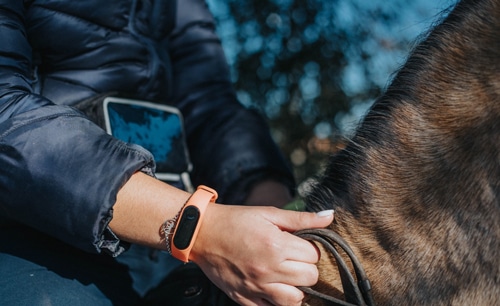
Estride Steady.
Measuring rider impact
One wearable technology for riders is the Estride Steady – a training aid that measures the steadiness of your hands while riding. Worn like a watch, it measures whether you have twisted hands, bouncy hands, or steadiness and consistency, and it can vibrate to let you know when your hands are not in a neutral position.
The company also makes a saddle pressure mat called the Estride Harmony, which fits under the saddle to measure pressure from the saddle and the rider. It be used to check saddle fit, providing data on pressure points from 900 sensors, as well as rider position, by analyzing where the rider is putting pressure on the horse’s back.
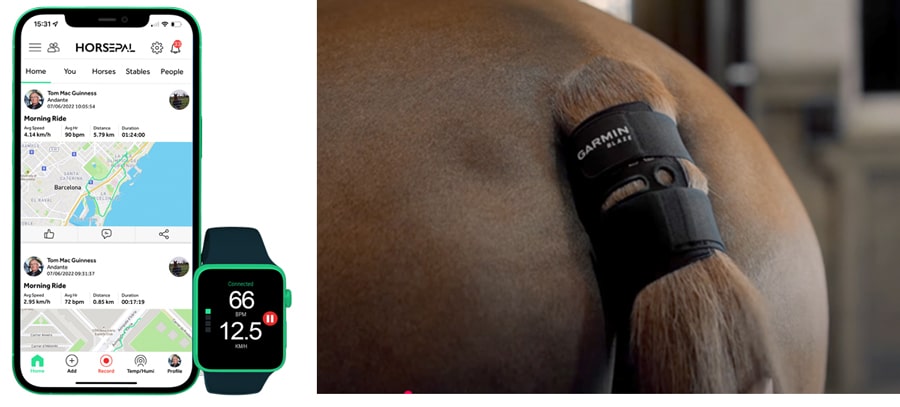
Horsepal and Garmin Blaze.
Biometric sensors
One of the most widespread types of wearable horse technologies are biometric sensors. Most work by attaching a heart rate sensor near the girth area – the Horsepal heart rate monitor, for example, rests behind the middle of the horse’s shoulder, with a belt that goes under the saddle and girth if you’re using it while riding, and Polar makes heart rate monitors for riding horses and Standardbreds. There are also other placement options with devices like the Garmin Blaze, which goes around the base of the tail, and the Equimo tracker, a lightweight device that can be clipped to your saddle pad or carried in a pocket.
They all have different features. Horsepal and Polar’s devices primarily monitor heart rate during exercise, resting and recovery to help optimize training. Equimo tracks your horse’s tempo, jumps, pace, speed, elevation and balance, and the company makes an external heart rate monitor that can also be connected to the device. Garmin Blaze tracks biometric data such as heart rate and changes in skin temperature, kinetic information such as strides and distance, and a heat score based on local weather to help horse owners make blanketing or cooling decisions. All have corresponding apps where you can review tracked data.
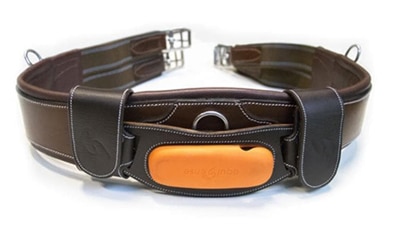
Equisense.
Equisense smart monitor
The Equisense Motion One is a smart monitor that attaches to your horse’s girth to track their movement, jump details, and more. Metrics include a locomotion analysis of symmetry, time spent on left and right lead, and cadence; GPS tracking of distance, speed, and elevation; and analysis of jumping courses, including average rhythm between jumps, strides, and flying phase. Along with the monitor, a paid subscription is required to access your full data history; without a subscription, you can still access your data over a seven-day period.
Gait analysis
Even more technologies are emerging to help with gait analysis and lameness detection, which could be particularly useful for high-performance horses. That includes StrideSAFE, a wearable sensor that’s used to analyse gait and identify musculoskeletal injuries or abnormalities, and Horseteq, another wearable sensor that can measure gait features including step length, strike impact, swing time, heart rate and more (and is compatible with the Polar Equine H3 heart rate sensor),

StrideSafe.
In 2024, the American Association of Equine Practitioners announced funding for a wearable biometric sensor research project. The project, which runs from Jan. 1 – Dec.31, 2025, involves six sensor manufacturers collecting and analysing data from 100 two-year-old Thoroughbreds wearing their sensor. According to an AAEP press release, “these sensors are designed to capture data on a horse’s movement patterns during high-speed events.” The goal of the study is to determine the effectiveness of these sensors in musculoskeletal injury detection.
Chewing halters
The EquiWatch chewing halter is essentially a halter equipped with sensors, which record and store data on time spent eating, the total number of chews, and whether chewing was performed with the head up or head down. It was adapted from the RumiWatch halter, created by a Swiss company to track cattle behaviour including rumination, grazing, and standing.
While not commercially available, researchers at Kentucky Equine Research are using chewing halters to study horse health and behavioural changes during feeding – such as rate of hay intake throughout the night, and differences in chewing and glycemic response among common fibrous feeds.
NightWatch smart halter
The NightWatch smart halter was created in 2013 and branded as an equine distress and wellness monitor. Created by Protequus, the leather breakaway halter with built-in sensors provided data in real time and tracked activity level and biometrics, including heart rate and respiration, through lightweight sensors in the crown piece. Users could be alerted via text, phone, and email if the horse was showing early signs of distress – extremely useful when monitoring a performance horse, a horse recovering from veterinary care, or a pregnant mare getting ready to foal. The original version of the NightWatch smart halter is no longer available, but the company is currently exploring second-generation technology and invites interested horse owners to sign up for email alerts for updates.
Location, location, location
While many types of tech such as Equilab or Steed will provide exact GPS locations of the horse and rider via a wearable device or cell phone, there are also passive tracking devices that horses can wear during turnout to help locate them if they get loose or are stolen.
GPS trackers that attach to a halter provide real-time location data and even geofencing features to allow owners to set virtual boundaries and receive instant alerts if the horse leaves a designated safe zone. Radio-frequency identification (RFID) tags store identification and medical information, which can be read by a scanner to quickly identify lost or stolen horses. It is also becoming more common (and advisable) for owners to microchip their horses.
The future of monitoring blankets
Two students at Western University, Sydney Burns and Julia Piskunowicz, have started a company called StableInsights to bring their smart tech horse blanket to market.
They came up with the idea for a horse blanket that also served as a health monitor during a business course. The blanket will be able to continuously track vitals, including temperature, heart rate, and gut sounds.
They’ve made their own personal prototypes, are working with a textile manufacturer in Toronto for materials for the blankets, and are now looking for a polytechnic institution partner to build the more sophisticated technology and data sets they need. They plan to start beta testing next fall and winter, and are hoping to launch the product in summer 2027, with a goal of getting into equine retail stores nationally and internationally someday.
The Latest