There are certain emergencies that make every equine veterinarian pause before entering the barn. Will this be one of the relatively mild cases that responds quickly to treatment, or are we facing a catastrophic situation that will strain a client’s emotions, time and finances while causing the horse considerable suffering?
Colic, wounds close to a joint and sudden-onset laminitis are among the conditions that raise this concern. Most cases respond well to prompt treatment, but every veterinarian remembers the cases that went terribly wrong despite the best available medical or surgical care.
Recently, we have begun using Canagliflozin that has produced surprisingly encouraging results in horses with a particular type of laminitis. To understand why we are so impressed by its potential, it helps to first look at the three main categories of laminitis.
The Three Main Causes of Laminitis
When examining a horse suspected of having laminitis, veterinarians generally consider three primary causes.
1. Hyperinsulinemia-associated laminitis
Hyperinsulinemia-associated laminitis, or HAL, is now the preferred umbrella term (replacing “endocrinopathic laminitis”) for laminitis driven by chronically elevated insulin.
HAL is most often produced by one of two underlying endocrine diseases, which can occur alone or together in the same horse: Pituitary Pars Intermedia Dysfunction (PPID) or Equine Metabolic Syndrome (EMS).
- PPID is a progressive disease, usually of senior horses, caused by degeneration of dopamine-producing neurons in the hypothalamus that normally restrain the pituitary’s pars intermedia. The resulting loss of inhibition leads to hyperplasia or adenoma of the pars intermedia and oversecretion of ACTH along with other related hormones.
- EMS affects easy keepers and is defined by insulin dysregulation, often alongside obesity.
In both cases it is the resulting hyperinsulinemia, not the underlying disease itself, that drives the laminitis.
2. Systemic inflammation or sepsis
We typically see these cases as a secondary condition related to a severe surgical or medical event. These cases are mainly seen in equine veterinary hospitals following a major colic surgery or horses with colitis. We will see this on the farm following grain overload or with a retained placenta.
3. Excessive weight-bearing on one limb
Finally, laminitis can develop with horses that suffer from excessive weight loading on a limb. For example, horses recovering from a fracture are at risk of laminitis because they are putting more weight on the opposing limb.
For our discussion we will focus on hyperinsulinemia-associated laminitis (HAL), the first cause above, since this is the pathway Canagliflozin targets.
What Happens Inside a Laminitic Hoof?
To understand why Hal is a concern, we need to consider the two underlying forces at play in a horse hoof.
Two opposing forces help maintain stability within the hoof. The deep digital flexor tendon travels down the back of the limb and attaches to the underside of the coffin bone. It applies a constant pulling force to that bone.
Counteracting this pull are the lamellae, the interlocking tissues that suspend the coffin bone inside the hoof capsule. Their structure can be compared to “Velcro,” with the sensitive and insensitive lamellae interlocking to hold the coffin bone securely against the hoof wall.
In a healthy hoof, these forces remain in balance. When the lamellar attachment weakens, however, it may no longer be able to withstand the pull of the deep digital flexor tendon. The coffin bone can then rotate or sink within the hoof capsule.
For many years, it was believed that insulin dysregulation caused laminitis by depriving lamellar cells of glucose. That theory has largely been set aside because lamellar cells don’t appear to rely on insulin to take up glucose in the first place.
The better-supported current theory is that excess insulin cross-reacts with IGF-1 receptors on lamellar cells, driving abnormal cell proliferation and weakening the lamellar attachment. The exact mechanism is still not settled, but the clinical link between controlling insulin and improving laminitis is well documented. Reducing insulin concentrations is therefore a central goal when managing HAL.
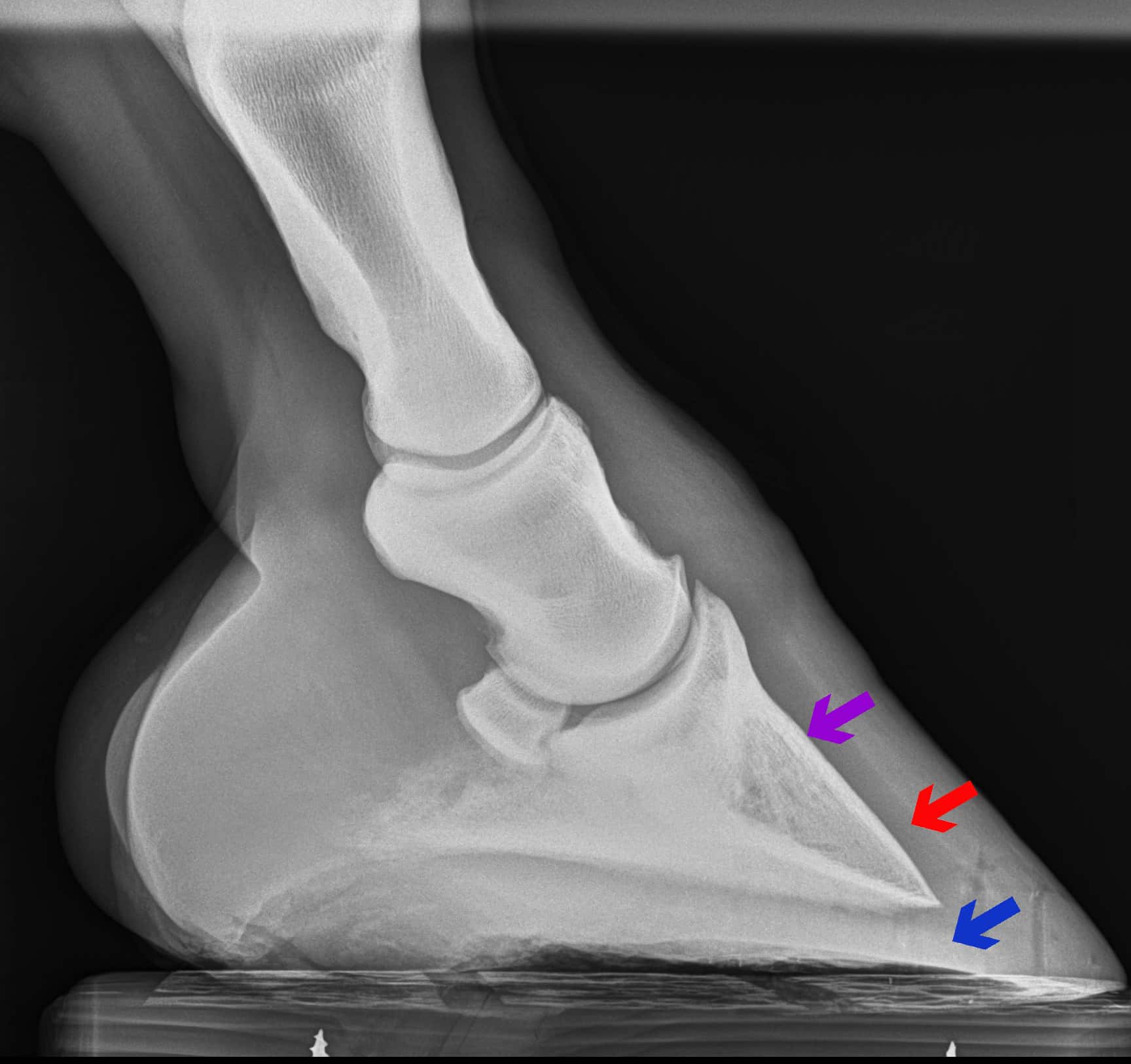
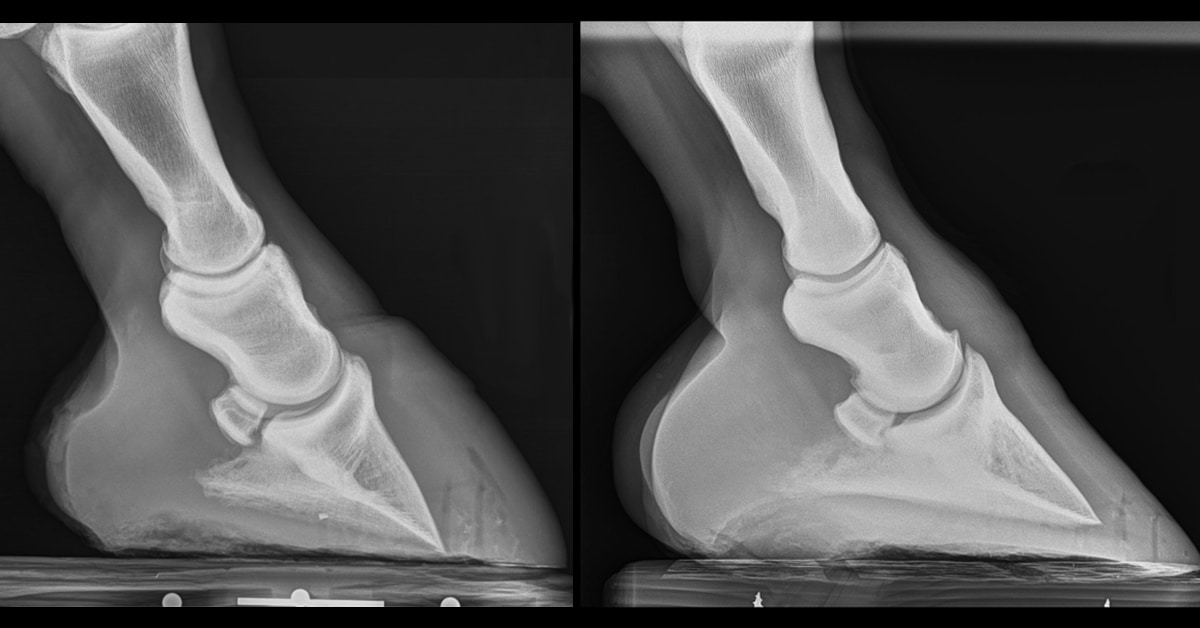
Normal
• Purple arrow: The front of P3 is aligned with the front of P1 and P2.
• Red arrow: Tight junction of the lamellar space at the toe region. Even from the top to the toe.
• Blue arrow: There is approximately 15mm of sole thickness in an adult horse to help protect the sole of the coffin bone.
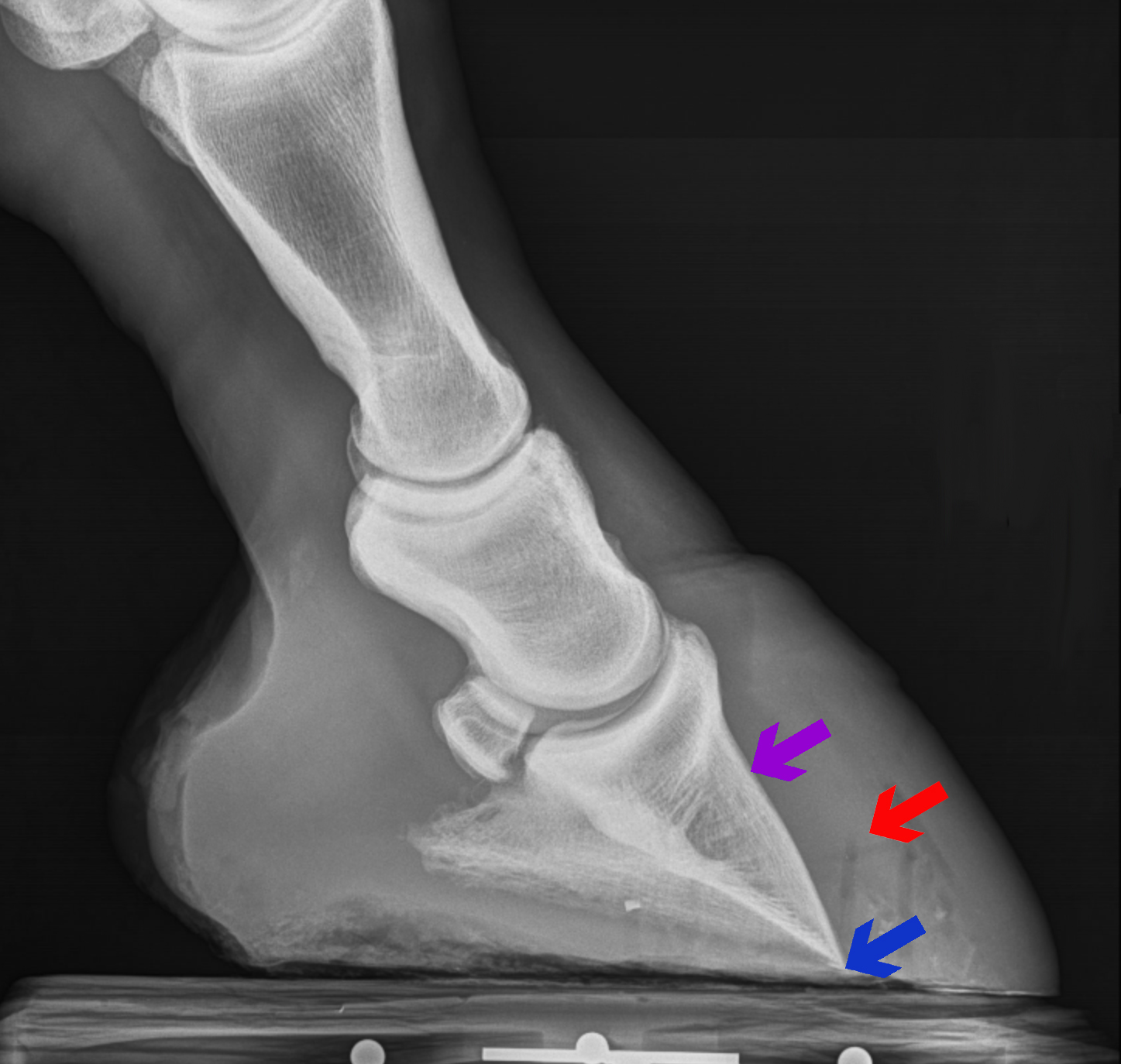
Abnormal
• Purple arrow: P3 is tipped back from the front indicating rotation from the pull of the coffin bone.
• Red arrow: The lamellar space is wide and becomes wider towards the toe.
• Blue arrow: The coffin bone has sunk which we can see because there is no sole thickness, the bone has penetrated the sole. This is an extreme case of a sinker where all of the lamella or “Velcro” has let go.
The Limitations of Existing Treatments
Now we get to the part where we are surprised by the effectiveness of this new medication because so many of the medications and nutritional guidance have variable results.
For example, some horses do well with levothyroxine to support weight loss, while with others it doesn’t seem to do very much. Metformin is another medication that has been increasingly used for insulin regulation, but it appears that after a few months it decreases in efficacy over time. Many horses that suffer from PPID respond to treatment with pergolide. Recent evidence suggests that pergolide helps regulate insulin, but not in all cases.
Because laminitis has several possible causes, veterinarians need a broad toolbox of medical and farriery options. Until recently, however, there have been few medications capable of producing a substantial and rapid reduction in insulin concentrations in horses with severe or refractory insulin dysregulation.
As a result, some owners find themselves trying multiple medications, making major dietary changes and repeatedly adjusting their horse’s hoof care, yet seeing only limited improvement.
How Canagliflozin Works
Canagliflozin is a human diabetes medication that increases excretion of glucose through urine leading to a decrease in circulating insulin levels. It has no approved veterinary formulation, so its use in horses is off-label, but a small but growing body of case series and a placebo-controlled trial support it, and we have seen very encouraging results in laminitic horses in our practice.
We have numerous cases of horses where we have tried many of the common medications, changed their nutrition so they have less non-structural carbohydrates in their diet, modified their shoeing and we have only been able to improve their laminitis consistently by a level or two. Since we have started with Canagliflozin we are seeing remarkable improvements within the first month.
One pony in particular had been extremely frustrating for both us and her owner. Each time we thought we were making progress, she would suddenly regress and become very lame again. By the time we suggested Canagliflozin, her owner was at her wit’s end and willing to try anything that offered a reasonable chance of helping. Within two weeks, the pony was sound. Three months later, she continues to do well. She is not the only case in which we have seen this type of response.
Monitoring for Potential Complications
One possible side effect of Canagliflozin is that horses or ponies can develop high blood levels of tri-glycerides, which in rare cases can progress to hyperlipemia (a potentially serious condition where fat overwhelms the liver). Though uncommon, the risk is higher for overweight ponies and any horse in negative energy balance and with kidney disease. We check baseline kidney function before starting the medication, then monitor with periodic blood tests, and manage it by reducing the dose.
One Part of a Larger Management Plan
Canagliflozin has been one of the most effective options we have found for treating horses with hyperinsulinemia-associated laminitis, whether driven by EMS, PPID, or both. Nutritional management is still required as are other medications required to treat other associated conditions like the use of pergolide to treat PPID.
Laminitis is one of the more frustrating conditions veterinarians, farriers and horse owners need to manage. There isn’t just one way to treat it so being open to new medications, or shoeing approaches is essential.
Time will tell if Canagliflozin fulfills its current promise, but for now it is one of the most promising new tools we have seen in the treatment of laminitis. Of course, consulting with your veterinarian is recommended to see if Canagliflozin is right for your horse.
***
McKee Pownall Equine Services offers equine veterinary care with a focus on Lameness, Sport Horse Medicine, Pre-Purchase Exams, Reproduction, Dentistry, and Wellness. They provide in-clinic and on-farm diagnostic services to horse owners utilizing a range of technology and have three Ontario locations: Campbellville (519-856-8225), King (905-898-9010), and Uxbridge (905-898-0370). info@mpequine.com • www.mckeepownall.ca
The Latest