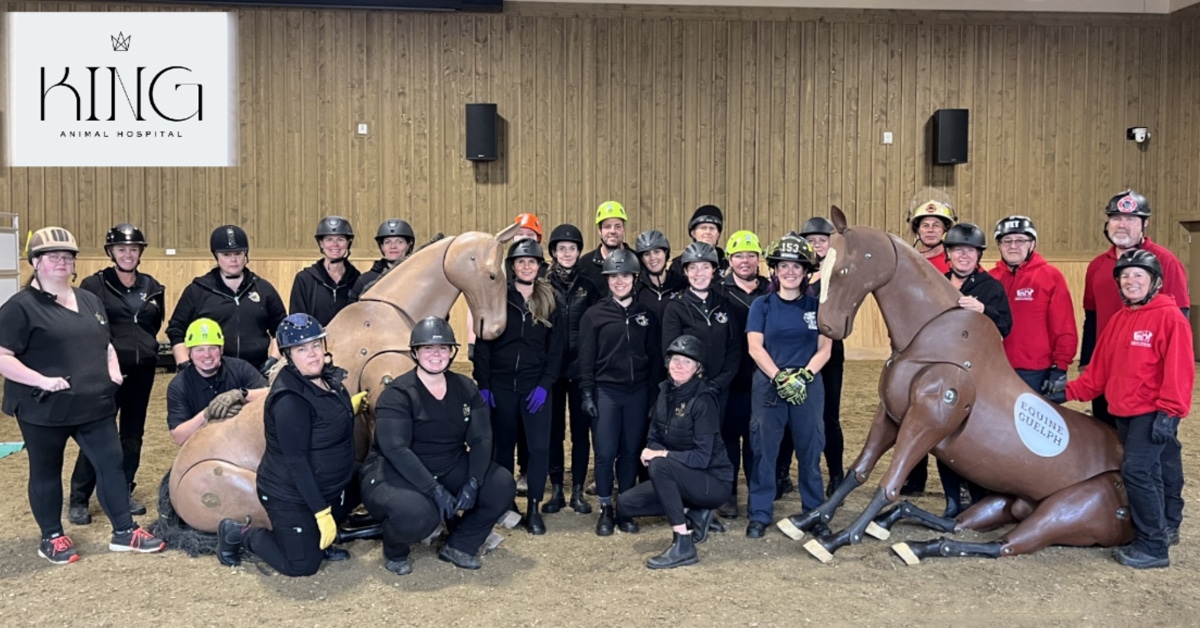
For more than a decade, Rusti, Equine Guelph’s trusty light bay horse mannequin, has helped train first responders, including firefighters, in the specialized skills required to safely rescue horses and other large animals during emergencies.
Since the Large Animal Emergency Rescue (LAER) program began in 2014, Rusti has been rolled, dragged, lifted, packaged, extricated, and rescued countless times, all in the name of education.
This September, Rusti gained a new partner in rescue training.
Equine Guelph officially welcomed a second life-size horse mannequin to the LAER team, kindly donated by an anonymous supporter. The dark bay newcomer, who is still awaiting his official name, joined Rusti for workshops held at Sunrise Therapeutic Riding and Learning Centre in Puslinch, ON and King Animal Hospital in King, ON.
The LAER community can look forward to helping choose a name in an upcoming naming contest.
While the newest recruit may not have a name yet, he certainly earned his place on the team. The addition of a second mannequin doubled hands-on learning opportunities, allowing teams of participants to work through rescue scenarios simultaneously. More practice time meant more repetitions, more problem-solving, and more confidence-building experience for first responders.
Since launching in 2014, Equine Guelph’s LAER program has focused on preparing responders to safely manage incidents involving horses and other large animals. A horse can weigh over 1,000 pounds, and when frightened, injured, or trapped, can present significant risks to both themselves and responders. Proper training, teamwork, communication, and rescue techniques can make a critical difference in achieving a successful outcome while minimizing risk to everyone involved.
Together, Rusti and the program’s newest four-legged training partner saw plenty of action in the September workshops. Participants practiced a wide range of rescue techniques including forward assists, rear assists, sideways drags, Hampshire slips, vertical lift simulations, mud rescue techniques, trailer incident response, horse entrapments beneath fences, and rescue scenarios involving horses trapped beneath vehicles or equipment. Firefighters also gained experience using specialized rescue equipment and learned how commonly available emergency response tools can be adapted for large animal rescue situations.
Fire fighters learned how much they could do with what’s already on their truck; a Personal Floatation Device for head protection, a fan and misted water to cool an overheated horse, tarps to keep a downed animal off cold ground, pike poles to help move feet, and hoses could act as webbing straps used to manoeuvre large animals.
King Workshop Brings First Responders Together
The Large Animal Emergency Rescue specialized training event held at King Animal Hospital, located at 1265 19th Sideroad, King City, Ontario, on September 19, was offered for first responders and veterinary care teams. The intensive, hands-on workshop was presented by Equine Guelph, University of Guelph, in partnership with York Regional Police and King Animal Hospital, with the support of program partner Grand River Agricultural Society.
Delighted to host the workshop at their facility, Tracy Jones, CEO of King Animal Hospital, said: “Knowledge exchange is essential to advancing veterinary care and improving outcomes for both animals and the people who care for them. By bringing together veterinary experts, first responders and community partners for practical, hands-on training, we can share knowledge, strengthen emergency preparedness and help ensure large animal incidents are managed as safely and effectively as possible.”
Throughout the day, responders worked through challenging scenarios that demonstrated the importance of clear communication and teamwork utilizing the incident command system, and safe animal handling practices. With two mannequins available, multiple training stations could operate simultaneously, maximizing participant engagement and practical learning.
“We are extremely grateful to the University of Guelph and King Animal Hospital for partnering with us to bring the Large Animal Emergency Rescue Awareness course to our region. Members of the York Regional Police Ceremonial Mounted Unit, along with a member of the South Simcoe Police Mounted Unit, thoroughly enjoyed the training.
“I have had the opportunity to attend training delivered by the University of Guelph on several occasions, and this course was particularly valuable. Having two large-animal mannequins available provided everyone with significantly more hands-on experience and the opportunity to work through practical rescue techniques in a safe, controlled environment.
“The instructors brought an exceptional level of knowledge and experience, and the combination of classroom learning and practical exercises gave our members skills that could be a valuable resource within our region should we respond to an incident involving large animals. As first responders, I believe it is important that we have the knowledge to safely assess these situations, understand the unique risks involved, and work effectively alongside veterinary and other emergency professionals.
We are very thankful to King Animal Hospital for welcoming us into their beautiful facility and supporting this initiative, and we hope this is the first of many opportunities to expand this important training to first responders throughout our region.” ~ Sgt Leanne Guthrie, York Regional Police
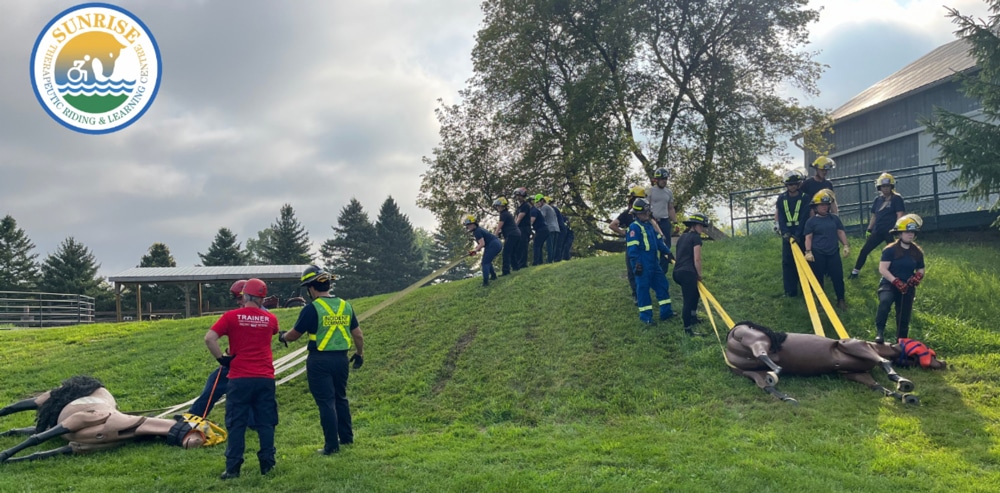
Slope rescues being practiced at Sunrise Therapeutic Riding and Learning Centre. (Susan Raymond photo)
Sunrise Offers an Exceptional Learning Opportunity
A week earlier, from September 11 to 13, Equine Guelph delivered its Operational Level Large Animal Emergency Rescue course in partnership with Puslinch Fire and Rescue, at Sunrise Therapeutic Riding and Learning Centre in Puslinch, Ontario. The workshop welcomed firefighters and pre-service firefighters from departments including Puslinch, Scugog, West Grey, West Elgin, Milton, Rosemont, and Oliver Paipoonge.
The Sunrise facility provided an added bonus that participants rarely have the opportunity to experience. In addition to extensive hands-on rescue training with Rusti and the new dark bay mannequin, participants were also able to work directly with live horses during horse handling and behaviour sessions.
While live horses are not always available during rescue training programs, the opportunity is highly valued whenever it can be incorporated. Participants practiced safe approaches, haltering, leading, emergency halter construction, reading equine body language, and understanding horse behaviour under the guidance of instructors and Sunrise staff. These sessions complemented the mannequin-based rescue exercises and provided valuable context for real emergency situations involving live animals.
“Starting the weekend working with the horses gave us a real, tangible feel for the animals we’d be dealing with, and a lot of respect for them. From there, two full days of hands-on work showed us that every situation is different, not just because of the animal, but because of the team of responders too. Rotating through the different roles helped us understand what each one involves and the perspective it brings,” says Nicola Kidd, Volunteer Firefighter, Rosemont District Fire Department. “The weekend was incredibly well organized. The scenarios felt realistic, and it was a safe, supportive place to learn. I’d recommend this course to any rural department.”
The use of two mannequins also allowed instructors to duplicate rescue scenarios, increasing the number of participants actively working through exercises at any given time. Throughout the weekend, firefighters practiced trailer rescue procedures, slope rescues, entrapment scenarios such as extraction from a trench, fence removals, vertical lifts, mud rescue simulations, and emergency horse movement techniques such as moving a horse on a rescue glide.
“One scenario that really stood out was working with a cast horse, and a horse stuck on a hill that couldn’t get up,” says Kidd. “We learned that the best rescue is often a self-rescue, so we rotated the horse into a position where he could get its feet under him and stand up on his own.”
Building Skills that Save Lives
“In today’s society, responding to incidents involving animals is both an expectation and an acknowledgement that such incidents will likely involve people putting themselves and others at risk. All large animal incidents, regardless of cause or scope, present a risk of injury to responders,” explains Dr. Susan Raymond, Program Coordinator for Large Animal Emergency Rescue at Equine Guelph. “Through proper training of best practices and the use of specialized rescue equipment we significantly mitigate these risks and improve the odds of a favourable outcome for both animals and responders.”
Booking LAER Training for 2027
Equine Guelph is currently accepting bookings for Large Animal Emergency Rescue training workshops for first responders, firefighters, veterinarians, animal professionals, and horse owners for 2027. Hands-on workshops cover key safety principles, assisted movement techniques, rescue tools, and scenario-based exercises for responding to large animal emergencies. Registrants also receive complimentary access to Equine Guelph’s online Large Animal Emergency Rescue Awareness Level program, offered with support from program partner Grand River Agricultural Society.
For information about hosting a workshop or participating in LAER training, contact:
Dr. Susan Raymond
Program Coordinator, Large Animal Emergency Rescue
Equine Guelph
slraymon@uoguelph.ca
“We’re now more than a decade into delivering this specialized training, and our commitment remains the same: enhancing large animal rescue capabilities through education, teamwork, and practical experience. Thanks to the dedication of our partners, instructors, and participants, the future of large animal emergency response continues to grow stronger.”
More News