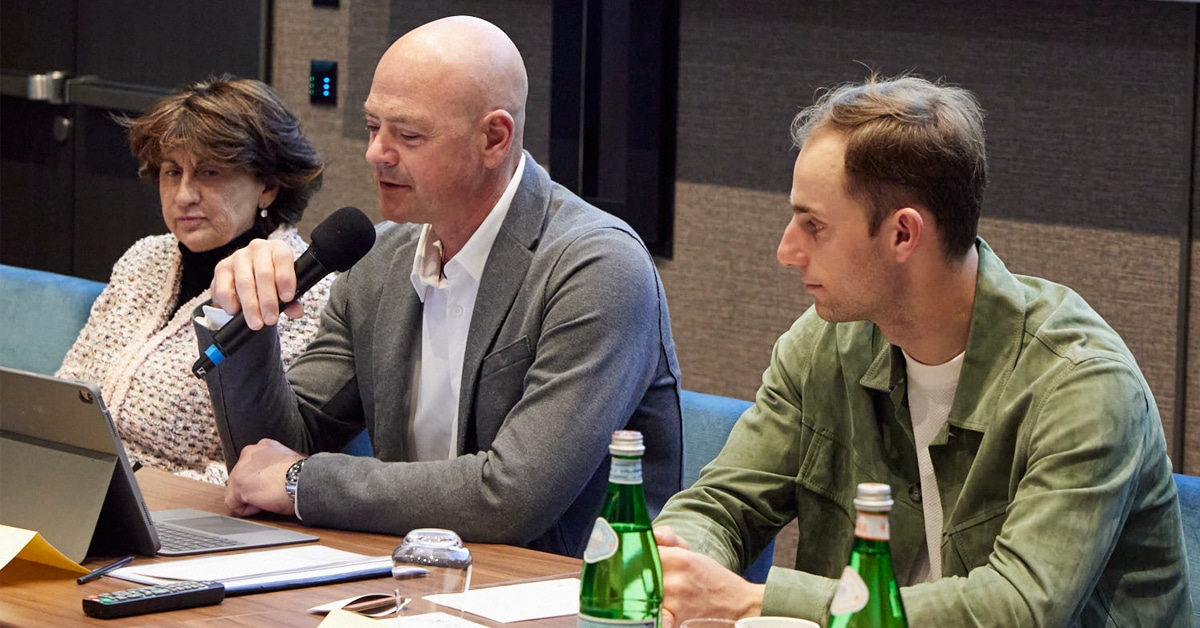
This year, the IJRC General Assembly held in Geneva on December 12 coincided with the election cycle of the Club’s senior leadership. Members present voted to confirm both the President and the Board, thereby renewing the mandate originally assigned two years ago.
As formally announced by Eleonora Ottaviani, Chair of the Assembly and long-standing Director of the Club, the presidency for the next two years will therefore remain with François Mathy Jr. He will be supported by a Board composed of Ludger Beerbaum, Emilio Bicocchi, Michael Duffy, Steve Guerdat, Rodrigo Pessoa, Kevin Staut and Richard Vogel, as well as a representative for the USA to be elected directly by IJRC American members. At present, Kent Farrington, Tiffany Foster and Lauren Hough serve in this role.
Immediately following his re-election, François Mathy Jr. addressed the Assembly to thank the riders and the entire IJRC staff, and extend a warm invitation:
“I hope that riders, even those who did not put themselves forward as candidates for the Board, will nevertheless feel encouraged to contribute in the future through the many working panels that form the core mission of the Association, with the shared goal of continuing to improve and strengthen our sport.”
Article 259
Communications over FEI Jumping Rules Article 259 formed the main debate at the International Jumping Riders Club (IJRC) General Assembly.
For more than a year, the IJRC has issued regular updates on its rationale for changes to the art. 259. It is frustrated that some national federations had not read the proposals, presented on February 2025, only “waking up” when they got to the FEI General Assembly in Hong Kong last month.
The social media pushback was attributed to many influencers and even professional journalists not reading Art. 259 in its entirety, said IJRC president François Mathy JR. Many failed to notice the separate Jumping Rule (Art 264.4.1) that mandates elimination for spur marks; that under Art. 259 all cases of blood anywhere on the horse will now be examined by the official FEI veterinarian, after which decisions are made by the Ground Jury as to whether it can jump again for the remainder of the show; that such decisions are no longer left to a Stewards’ inspection; and that a one-month suspension and CHF1,000 fine for receiving two of the new Jumping Recorded Warnings is a much more serious sanction to a jumping rider than elimination, especially if they have penalties and are already out of that class.
IJRC director Eleonora Ottaviani emphasised that in European law, consequences must be proportionate, and this had always been central to the IJRC’s discussions, especially for very micro lesions, not bleeding, that are not the rider’s fault.
The IJRC board was asked why riders had not been involved in explaining the rule change to the media. Eleonora Ottaviani explained that IJRC speaks for riders with one voice; it would have been wrong to expose individuals to personal attacks on certain platforms.
Comments were noted from Quentin Simonet, president of the European Equestrian Federation, who described some of the wording of Art. 259 as “unfortunate.” There were mistakes from all involved in drafting it [which normally includes national federations, stakeholder groups and FEI executive staff], and the spurs rule (Art 263.4.1) was not understood, leading to problems in the press.
“In September there were lots of changes to the wording compared to July. These were very critical points, and we need to do it better,” said Quentin Simonet. “I also inform everyone that this discussion is not finished. Some national federations are making a strong push for a multi-disciplinary approach.”
Aine Power, FEI Executive Director of Sport & Games, said the FEI board fully supported the rule, and had not expected the negative reaction, because statistics showed that in jumping, incidents involving blood are rare. She said: “We were surprised people could not see that this rule is better for the horse and better for the sport. There are learnings to take forward from this, that people looking in at the sport are not coming from the same place as we are.”
François Mathy Jr. reminded everyone to check equipment, their own boots, and to remember they are all public figures; problems cannot be blamed on others. In taking responsibility, riders could decide not to wear hammer spurs, while allowed under FEI Jumping Rules.
There was a short presentation on plans to increase use of IJRC social media, particularly Instagram, to explain rule changes and other key decisions.
Organiser’s ‘fantasy’ fees
The new tariff of maximum fees organisers can charge riders for services and utilities at CSIs will unfortunately not be implemented for several months, having finally been agreed for April 2026.
Eleonora Ottaviani said the “fantasy” costs that some OCs pass on to riders had been discussed for four years. Some OCs are still discussing items such as electricity, costs of which vary around the world.
“We understand the situation is different indoors and outdoors and that times are changing; the riders can give a contribute to but not pay the full bill.”
However, the list has been extensively discussed and analysed together with the organisers, and we are confident that it will not cause any problems for those shows that already operate in a professional and responsible manner.
A separate discussion was still needed in the USA where costs are notably higher.
Eleonora Ottaviani said young riders cannot be asked to spend 6,000-8,000 a month on entry fees. Riders at 2* and 3* are hardest hit, with lower prize money but increasing costs, not fair to use the maximum cost allowed and the minimum Prize money request.
Moving on from this, Jessica Kurten, FEI board member and chair of the athletes committee, raised the importance of national circuits where riders could improve their skills and save money before moving up to “international” level. The national circuit had declined in some countries. In others it is still highly regarded; in Switzerland, for example, most elite riders support it.
It was agreed it would be difficult to find organisers for new or revived national shows when there are already wait lists for the increasing number of CSI 2* and 3* tours, which are more lucrative to run. “It’s seen as ‘cool’ to be competing alongside you guys,” said Irene Verheul, secretary general of Equestrian Organisers and director of Jumping Amsterdam. “Everyone wants to compete 2* and 3* – people like to be able to say they are going to an international show.”
Longines ranking points from Nations Cups
A new scale of points related to the percentage of double clear rounds at that event had been well-intentioned, but the outcome had been difficult to predict, for instance at Nations Cups where only 50% of teams went through to the second round. From next year, the sliding scale will relate to the number of single clears, with differences between HH (5*) and H (all other) events. Where single clear rounds at HH reach 25%, a multiplying factor of 1.2 will be applied, for example.
Watch the full IJRC General Assembly video here.
More News