
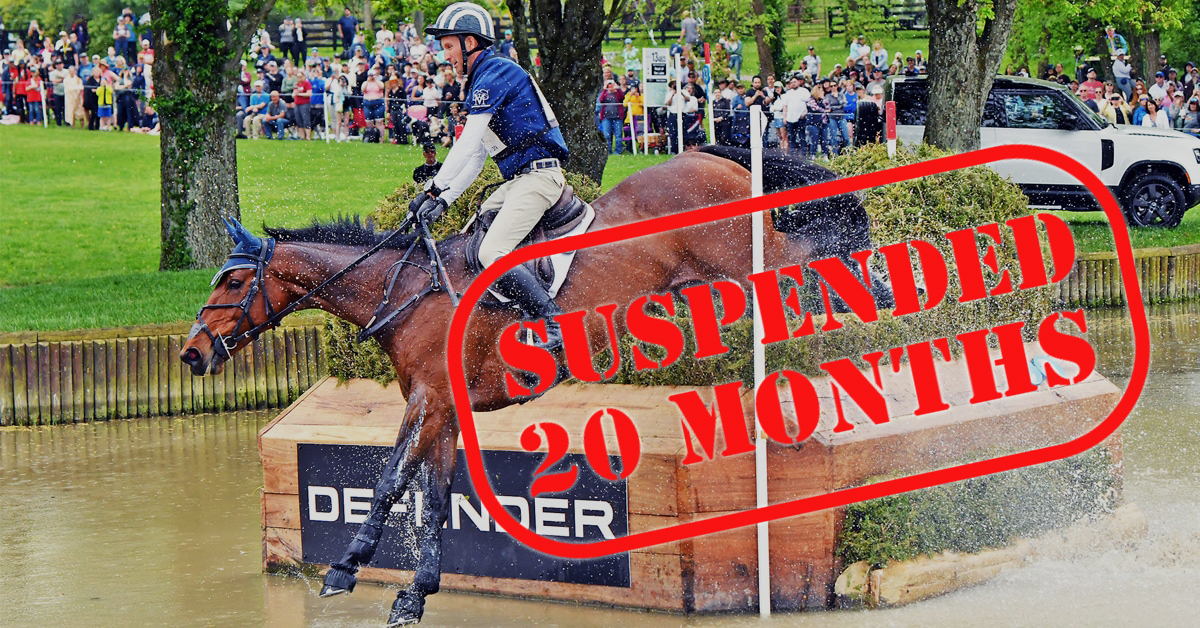
The robustness of evidence required for a successful horse abuse finding is a recurring theme in the 120-page decision notice from the FEI Tribunal regarding US eventer Andrew McConnon.
The FEI had asked for a life ban. But instead, last week its independent three-member Tribunal, consisting of Harveen Thauli (CAN), Brian Ward (CAN), and Agustin Fattal Jaef (ARG), handed down a suspension of 20 months – considerably less than given to two other US-based riders found guilty of horse abuse in recent years.
Tribunal flagged up weaknesses in photographic and video evidence in this case and found only a handful of allegations proved. Tribunal only gave any weight to the written and oral testimony of a minority of the FEI’s eight witnesses.
Tribunal cited case law that “the more serious the allegation and its consequences, the higher certainty (i.e., level of proof) the Panel requires to be comfortably satisfied.” It also referenced CAS (Court of Arbitration for Sport) decisions that sanctions must be proportionate and “must not exceed what is reasonably required in the search of a justifiable aim.”
McConnon was found to have committed abuse three times in a five-week period in February and March 2024. The proven abuse fell within the “mid-range” category of the tarriff in Article 164.13 of FEI General Regulations, providing for a suspension ranging between three months and two years. The 20 months is credited against time already served. McConnon was fined 2,500 Swiss francs; a 10,000 Swiss francs costs request by the FEI was denied due to the “insufficiency” of its evidence that took up a lot of time for both sides.
Tribunal also criticised FEI Legal for exaggerating what was shown in picture evidence. Witness 1 – who worked for McConnon for five months – had, for example, provided 10 photos mostly taken covertly in February 2024. Most of these showed alleged whip marks; there was one of a horse “tied down”, three with blood variously on a stirrup, but and around the mouth and another showing “overworking.” Tribunal said this did not prove McConnon abused horses going back several years, the central plank of the FEI case.
McConnon initially alleged the pictures had been altered digitally, but did not take the opportunity to cross-examine Witness 1 at the hearing. However, Tribunal did accept his explanation for most of them, giving full weight to McConnon and “minimal” weight to Witness 1. Video evidence was also problematic; when one was played in slow motion, McConnon had not struck the horse as alleged. Tribunal gave weight to just two pictures and two of five videos, primarily because of McConnon’s own admissions of his “unacceptable” behaviour in those images.
While admitting to using the whip on one horse, McConnon said it had recently been clipped and this made the marks look worse. This was found to be “credible.” So was his explanation for tying a horse’s head down to its forelegs for a short spell while its mane was pulled. This was done to void sedation or using a nose twitch; it was not a punishment as alleged.
Tribunal also accepted testimony from defence witnesses to the effect that professionals spend many thousands of hours in the saddle, and that the video clips were too short to really show whether a horse was reacting to something else. McConnon may have made a “bad decision” but the clip was only a couple of seconds.
In deciding the sanction, Tribunal examined other abuse cases it had heard over the past six years (involving riders in endurance, dressage and jumping) and concluded the allegations against McConnon were not comparable.
He was given credit for showing remorse. Tribunal noted: “In his statement, he apologised not only to the FEI, but also to owners, clients, sponsors, and those directly involved, taking personal accountability for the behaviour that occurred. He explained that his actions were out of character with his values as a horseman and described steps he took immediately after the incident, including reflecting on the situation, seeking guidance from fellow professionals, and making adjustments to prevent recurrence. The Respondent emphasised that his apology is sincere, stating that it is not a matter of being “sorry I got caught”, but a recognition of the impact of his actions.”
Other mitigating factors included staff shortages, his father’s recent cancer diagnosis, and one owner owing him tens of thousands of dollars.
Previous failed attempts to get governing bodies to investigate allegations against McConnon are also mentioned in the decision notice, as is the pressure people – including a vet – feel not to come forward. Social media exposure last year eventually forced action. The FEI took on the case in after it was decided USEF did not have sufficient legal power over out-of-competition allegations of abuse.
Lack of accountability was mentioned by Witness 1: “In the beginning, [McConnon] had a consistent good mood and when he was in a good mood, he was great to work with. As time went on and big competitions approached, he showed a different side of himself where he would be snappy at me and the animals. He was easily set off, and for example he would throw things at the horses for looking out their stall door with no reason.”
“[He] definitely lacks control of his temper. However, I am not sure it’s a mental condition as much as he was never held accountable for his actions by his peers.”
Witness 3, a former boarder, said that in January 2021 at the World Equestrian Center in Ocala, she saw McConnon pull a horse’s head to the side and repeatedly kick it in the head. A steward saw this, too, and told him to stop. Witness 3 tried to report it to USEF but “[…] they said they couldn’t do anything about it as we had no evidence and this was an [National Snaffle Bit Association] show.”
FEI obtained initial witness statements from eight people including three former employees, one of them of five years standing, past owners of boarded horses, neighbours and a client’s vet. Most of this relates to his time in Southern Pines. Witness 5’s statement was disregarded after she declined to testify at the hearing for undisclosed reasons.
Their combined evidence provided a long list of allegations over several years. This was listed by FEI Legal as excessive beating, whipping, use of spurs; excessive jabbing of the horses’ mouths with the bit and excessive use of hand aids; intentionally leaving horses without adequate food and drink; riding tired, lame and/or injured horses and overworking; using abusive training methods; hyperflexion; tying horses’ heads down for prolonged spells; trapping and tying horses in static positions; chasing horses by foot; preventing horses from breathing; and causing damage and inflicting injuries. However, FEI found insufficient proof for these generalised allegations occurring over a long period.
In making its case, FEI Legal condemned all training methods and practices that are contrary to horse welfare, “the core of every aspect of the FEI’s work as the international governing body. Equestrian sport is under constant scrutiny, even more so when highly publicised as was this case.”
The FEI’s witnesses
Witness 1 worked for McConnon for five months when aged 22, responsible for about 15 horses six days a week. She saw abuse at least “once a week”. She said he hit horses around the head, kicked them in the shoulder, left welts from whipping and often drew blood. But while believing it not “safe,” she left her own horse with McConnon for many months after leaving his employment.
Witness 2 reckons around 25-30 horses were abused by McConnon during her time with him, when she worked at his three separate barns. He “set up” weak horses for failure “just to beat on them. […]” he would withhold food, even for several days, after a bad ride, hit them for minor annoyances like making a sound or moving while on cross ties, and sometimes lashings would remove the skin.
“With one horse who regularly paced the fence line, [McConnon] chased until she was exhausted. She ended up being put down one morning when I was on my way to work. [He] had said she ran on her own accord to the point she crashed through multiple fences and while on the ground thrashing tore fur and skin off large parts of her body. (Having had this older mare boarded at the barn for weeks at that point, I do not believe she did that to herself…[he] chased her so badly she crashed and fell and the stress caused her to colic, leading to her being put down.)”
Witness 3, the former horse boarder who had tried to report the Ocala incident, was extensively cross-examined by McConnon’s defence attorneys over vagueness over dates, and suggestions of collusion with the FEI and other witnesses over their respective statements.
McConnon’s defence also queried Witness 3’s friendly and supportive texts to McConnon. However she said her daughter’s experience with McConnon was “extremely negative” and they were secretly planning to leave. “Would I lie to protect my children and my horses? Absolutely.
“I think protecting my child and my horses when someone obviously had power over them and had caused damage in the past would make me try to keep everything happy at the moment, even though we were very much unhappy and we’d made plans to leave.”
Witness 4 had been a neighbour from 2018 and sometime horse boarder with McConnon. “From my apartment, I could see the parking / driveway area where the mounting block is. [He] had just gotten on and had barely proceeded down the driveway perhaps 50 yards when he unleashed on him with his dressage whip – over and over and over, and for no apparent reason. He was whipping [the] right side rapidly and with a lot of force – such that I could sense the anger – raising his whole arm from the shoulder, not just flicking his wrist.
“He then continued up the driveway towards the dressage ring.
“[…] [McConnon] was yanking the horse’s head and neck to the side to an unnatural degree, and at the same time kicking it on, as much at the fence line as along it, so the horse was practically stepping on itself, spinning, moving sideways, wherever it could, like a panicked drunken waltz. This went on and on. A few times during this episode, [he] hit it on the side of the poll with fist still clenched on the reins.”
While only testifying to two incidents of abuse in seven years, Witness 4 said his riding “often involved what I would describe as a steady, low-level torment” although at other times his riding was “nice” and “kind.”
She did not mention it to McConnon at the time as she regarded him as a friend, but after reading allegations in Eventing Nation last year she reported McConnon to the FEI in September 2024. She probably contacted the FEI after reading that USEF was “feeling sort of powerless” and “passing it off to the FEI”.
Witness 4 later admitted that she had stopped watching the incident described from her apartment and gone off to do something else. Another witness said Witness 4 would only have been able to see the mounting block from her window, and would have had to go outside to see the rest of what she’d described.
Witness 6 is a well-known welfare advocate, actively involved in rehabilitating horses off the track. She had involved McConnon in that work. She said: “Horses purchased by people that came through [McConnon] started having severe problems. I didn’t recognize the pattern at the time but it was clear with hindsight that they all had experienced the same type of trauma we began witnessing years later. While none of the owners needed to return the horses they had been misrepresented as “safe” and “easy” when they in fact carried extremely dangerous baggage from their past. […]”
Prior to this she had challenged one person to justify their negative remarks against McConnon and saying this would be difficult as horses were “happy and chipper” and that “pathological lying” would get them into a “world of trouble.”
She later came to believe other peoples’ experiences. In 2024, she re-posted videos online the weekend McConnon was at Burghley CCI5* – a “divine coincidence”. She then became concerned that it “would be in his head enough” and could cause an injury to him while he was competing. Nonetheless, the videos remained online. She reported McConnon to the FEI, but because she had never seen any of the alleged abuse herself “it really didn’t go anywhere.”
Under cross-examination she said it was an “assumption” the horses sent to him had been abused because of their behaviour when returned.
Concerns were also raised by the Tribunal about Witness 6’s involvement with other witnesses as the case progressed, including asking Witness 7 how she testified. She said she hadn’t been told not to do that.
Witness 7 worked for McConnon from July to October 2014 when she was 17, in return for lessons.
“I started seeing things with some of the horses that I did not like. Especially the horse Kona, owned by FEI Witness 6. [McConnon] would be riding Kona who would start being difficult and then it would kick off.”
“[…] For the young horses, if they didn’t get it the first or second time, he would go at them. At that point in time, I witnessed him beat and abuse several horses. His’ go to’ would be to gallop them violently after missing a distance or other mistakes, beating them with a crop or whip. After he left one of the horses bleeding and welted from his excessive spur and whip use he instructed me and another person working under him at the time to give the horse some dexamethasone and anti-inflammatory drugs so the swelling would be down for the owner’s visit in a few days. […]” This a reference to Witness 6, owner of Kona.
Under cross-examination, Witness 7 became unclear whether she had witnessed abuse “weekly” or “two or three” times a week. There was also ambiguity over the anti-inflammatories in her statement and who prescribed them or who else was present. She had drawn up the statement with FEI Legal and did not read it before signing it.
Back in 2014, she never spoke to the owners of the other horses, aside from Witness 6 who initially called her a “fear mongering liar.”
Witness 7 believed there was a two-year statute of limitation to report horse abuse. She feared repercussions from McConnon. She did not know that she could have filed a complaint anonymously.
Witness 8 has been a practising veterinarian for 17 years. She attended Witness 3’s horse at McConnon’s barn for chiropractic work and general veterinary care. On one occasion, she arrived to find “numerous long thin welts from a whip on her flank and haunches” and that the “welts were bleeding” after a session with McConnon. She could not complete the chiropractic treatment due to “the physical trauma on the mare’s hind end.”
She did not report it. “I didn’t see anything, so that’s a fine line of blaming somebody for something you did not witness yourself. The owner had repeated the information to me. […]” She believed it was the owner’s obligation to report McConnon.
Witness 8’s witness statement was submitted just a week before the Tribunal hearing and there was ambiguity over dates and location and no reference to her veterinary notes at the time.


