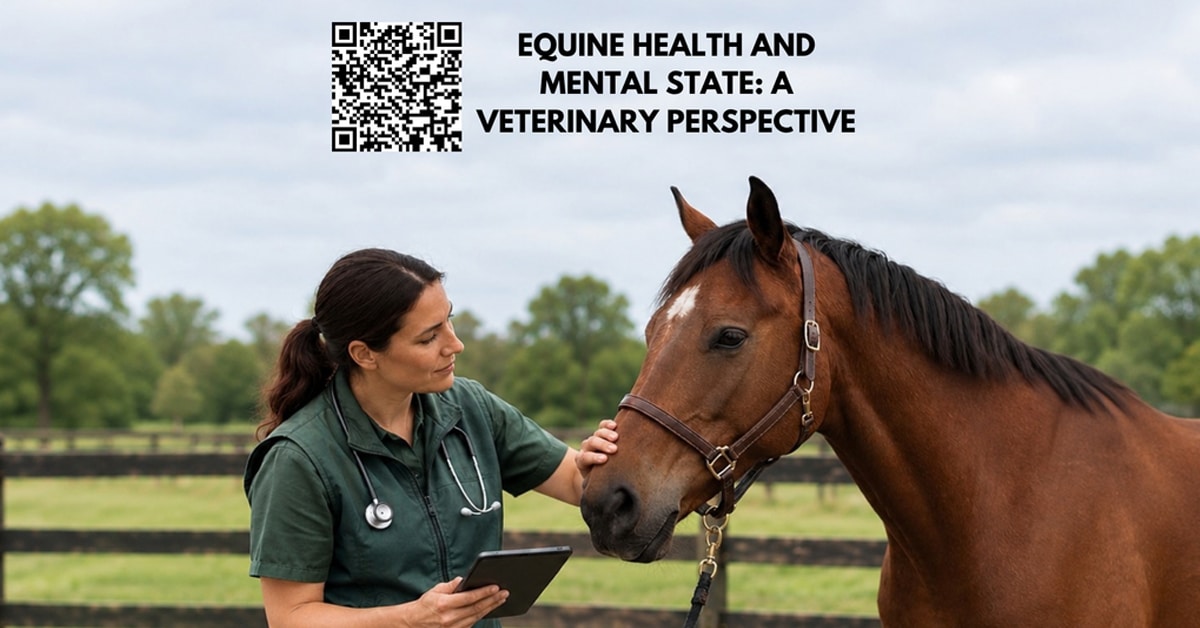
When a horse is injured, recovering from surgery, struggling with arthritis, or facing a lengthy hospital stay, most veterinary assessments focus on what can be measured physically: pain, lameness, wound healing, body condition, or other clinical signs. But what about the horse’s mental state?
MSc. candidate at the Ontario Veterinary College, Alessia Masini, under the supervision of Dr. Christopher Riley, aims to better understand how equine veterinarians perceive the effects of illness and injury on a horse’s mental state.
Through an international survey launched in August 2026, the research team hopes to capture the expertise of equine veterinary professionals and further evolve conversations in equine welfare science. The anonymous online survey asks veterinarians, among other questions, to assign behavioural descriptors to a range of clinical scenarios. By starting this conversation, the project creates an opportunity for meaningful collaboration between animal welfare scientists and veterinarians, who play a critical role in advocating for horse welfare and supporting the equine industry’s social licence to operate.
Dr Riley explains, “Vets can articulate that a horse is depressed, unhappy, or in pain, but the survey invites deeper contemplation of other descriptors more commonly cited in animal welfare research. One goal is to better understand veterinary perceptions of how illness and injury may affect a horse’s mental state and have vets further deliberate that connection.”
For many horse owners, conversations about welfare begin with the three F’s (Friends, Forage, and Freedom) or the Five Freedoms, focused on protecting animals from hunger, discomfort, pain, fear, and restrictions on normal behaviour.
Just over two decades ago, the Five Domains Model was developed, building on the Five Freedoms by recognizing that welfare is ultimately reflected in an animal’s mental state and the balance of positive and negative mental experiences. The model considers four physical and environmental domains (nutrition, environment, health, and behavioural interactions), and how they collectively influence the fifth domain: mental state.
While the Five Domains Model has gained acceptance in animal welfare science, translating it into ‘practical tools’ for equine clinical practice remains a challenge. Welfare assessments in veterinary settings often focus on physical health, leaving questions about the horse’s mental experience less clearly defined. As the chair of Clinical Studies at the Ontario Veterinary College and past Deputy Chair of the National Animal Welfare Emergency Management Committee of the New Zealand Government, Dr. Riley explains, “there’s not really a systematic way in which we consider the welfare of the horse, that is aligned with the five domains in everyday practice. A long-term goal would be development of a way for veterinarians to frame other aspects of welfare during their consults that extend beyond physical assessment.”
With their study firmly based on the five domains model, Masini emphasizes the need for a strong link between physical and mental states and is interested in the preliminary information from veterinary professionals, on how they perceive illness or injury to affect mental state. “Veterinarians see how horses behave between regular visits and how their behaviour progress and changes,” explains Masini illustrating the value this feedback will provide.
One of the survey questions will establish if the veterinarian is familiar with the 5 domains model. There is anticipation of a variety of answers depending on whether the practitioner has graduated recently or has been practicing veterinary medicine for a number of years. Geography may be another factor with greater familiarity expected in New Zealand (where the 5 domains model was developed), Australia and the U.K.
Riley and Masini underscore that understanding how veterinarians’ assess a horse’s mental state will become increasingly important as the Five Domains Model is progressively being adopted within animal welfare codes of practice, and emerging legislative frameworks around the world.
Masini continues, “The challenge is that veterinarians need assessment tools that are practical, scientifically validated, and feasible to use in busy clinical settings. This research survey is a first step toward understanding how that might be achieved.”
Riley brings up the Equine Facial Grimace scale as an example of a practical, scientifically-validated, welfare assessment tool currently in use. He says pictures are posted in many equine hospitals for easy reference and understanding micro-expressions can prove very useful in identifying anxiety and pain in a horse.
Also lead author and senior editor of Fraser’s The Behaviour and Welfare of the Horse | CABI Books, Riley describes opportunities for intervention to lower anxiety in horses in stressful situations like hospital stays. “Interventions that take as little as three to five minutes can make a huge difference, increasing comfort level and cooperation,” says Riley. Examples like introducing a cardboard cut-out of a foal if a mare becomes stressed when separated from her foal, the use of mirrors or a simple behaviour modification exercise before administering a needle like equine behaviourist, Dr. Gemma Pearson demonstrates in the “Don’t Break Your Vet” video series on YouTube. Of course, anything that helps reduce anxiety before it escalates contributes to a safer environment for the horse, the handler, and the practitioner.
The findings from this survey may help identify common behavioural descriptors associated with different health conditions and levels of stress, providing a foundation for future research and the possible development of practical welfare assessment tools for veterinarians.
Beyond veterinary practice, Masini believes the work may also help horse owners better understand what their horses may be experiencing when dealing with illness or injury.
“Behavioural changes are often one of the first signs that something is wrong,” says Masini. “We hope this research also encourages owners to pay close attention to changes in their horse’s behaviour and seek early intervention when needed. It may also help people interpret behaviours differently. For example, aggression may be recognized as a potential indicator of pain rather than dismissed as a horse being ‘naughty.’ The flip side would be noticing discomfort in a horse appearing unusually quiet or unresponsive rather than believing them to be well-behaved and very cooperative.”
Should the survey reveal consistent patterns in how veterinarians describe and assess horses across a range of clinical conditions, the researchers see opportunities for further study, including the development of standardized behavioural descriptors and more comprehensive welfare assessment frameworks for hospitalized horses.
Raising awareness of the Five Domains Model will be another benefit of the survey, concludes Riley. “Anything that encourages discussion about welfare is a positive outcome. This project creates an opportunity for veterinarians and animal welfare scientists to come together, share perspectives, and advance our understanding of the horse’s experience during illness and injury.”
The survey is being distributed through the Canadian Veterinary Medical Association, American Association of Equine Practitioners (AAEP), British Equine Veterinary Association (BEVA), and other veterinary networks globally. The survey will remain open until December 2026.
Horse owners can also support the project by helping spread the word and encouraging their veterinarian or other veterinary professional to participate in the 10 – 15 minute anonymous survey, Veterinary perceptions of the effects of illness and injury on the mental state of the horse. The survey will remain open until the end of Dec 2026. Every response will contribute to a better understanding of how illness and injury may affect a horse’s mental state and help inform future approaches to equine welfare assessment.
***
Veterinarians: To participate or for more information, please scan the QR code above or contact the researchers: Alessia Masini (MSc Student), amasini@uoguelph.ca, Dr. Christopher Riley, criley03@uoguelph.ca
More News