Lesson horses are the heart of equestrian education in Canada. They teach beginners how to ride, help build confidence, and often serve as the first connection between people and horses. For many riders, these horses are the gateway to a lifelong passion—and for researcher Caleigh Copelin, they were the reason she entered the field of equine welfare.
Now, with part one of Canadian Riding Lesson Industry Survey study published, there are some in-depth responses to share from 154 lesson barns, representing over 1,500 lesson horses. With support from OMAFA Agri-Food Innovation Alliance and Equine Guelph, researchers Caleigh Copelin and Katrina Merkies, from the University of Guelph’s Campbell Centre for the Study of Animal Welfare, explored everything from feeding and housing to health care and daily routines, as well as the opinions of barn owners, managers, and coaches. (You can read the entire research paper here.)
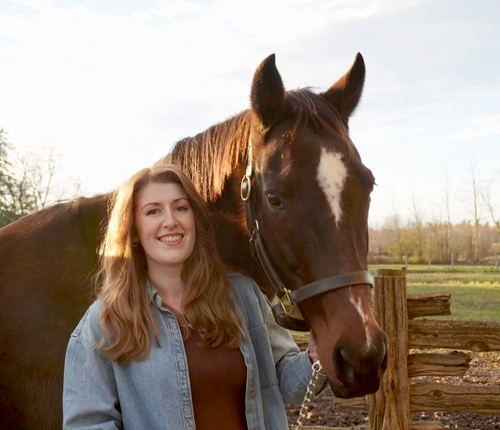
University of Guelph researcher Caleigh Copelin with Polly.
Canadian riding lesson facilities aren’t required to register with any official body, and there’s very little oversight, so there is very little information.
“Lesson horses live a very different life than show or pleasure horses, and past research shows they face unique welfare challenges — everything from equipment-related wounds and stereotypic behaviours to higher levels of injury-related insurance claims and even more aggression toward humans,” explains Copelin. “We know they’re struggling, but we don’t fully understand why. This study helps us see how Canadian lesson horses are managed, where support is needed, and where the industry is already doing well. It’s a critical first step toward understanding areas for future research of this understudied demographic.”
The Good News
The survey revealed encouraging trends: most lesson horses in Canada appear to receive solid, species-appropriate care. They’re turned out in groups, see veterinarians and farriers regularly, and often benefit from complementary and alternative veterinary medicine treatments like massage and chiropractic care. But the study also uncovered concerns around long-term use of pain medications and growing financial pressures that make it difficult for barns to prioritize horse welfare over making ends meet.
Copelin explains that while challenges exist, the overall picture of daily management had primarily positive reports.
Basic Needs and Beyond
“Most respondents reported housing their lesson horses in ways that align with Canada’s Equine Code of Practice,” said Copelin. “They are living outside in groups or getting long turnout hours, seeing farriers and having teeth checked on recommended schedules. Beyond that, many barns are going above and beyond with dietary supplements and complementary therapies like massage, laser treatments, and even things like Reiki. Whether or not the science supports every practice, the fact that owners are actively seeking ways to improve comfort shows a high level of concern for horse welfare.”
- Just over 90% of respondents said they use therapies such as massage, chiropractic, acupuncture, or osteopathy to help horses feel their best;
- Over 97% of facilities used professional farriers, with more than 70% reporting a regular trimming or shoeing schedule every 4–6 weeks;
- Over 77% of barns had a herd health plan developed with veterinarian input;
- 65% had horses’ teeth checked or floated at least once a year.
Turnout was also prioritized:
- 76% of barns reported group turnout for all horses, and just over 40% kept horses outdoors full-time;
- Long turnout hours were common, averaging 12.6 hours per day in the summer and 9.2 hours per day in the winter;
- Nearly 96% of facilities scheduled at least one day off per week for lesson horses;
- 75% reduced lesson loads during riding camps.
Feed and supplements:
- Most participants felt confident assessing body condition, with 92% familiar with body condition scoring.
- 75% of facilities provided constant access to hay for stabled horses.
- Supplement use was widespread (73%), but only about half performed forage tests — highlighting a potential knowledge gap in nutrition.
Despite these efforts, the study also points to persistent challenges that require attention.
Only 12% of respondents felt the Canadian lesson industry was financially sustainable, while 41% believed the industry was not sustainable at all.
Challenges Behind the Scenes
While the study highlights many examples of good care, it also reveals some areas where lesson horse welfare may be at risk—often due to pressures that go beyond daily routines.
“The open-ended responses had an eye-opening pattern,” says Copelin. “Most participants recognized that there are serious challenges in the lesson horse industry — horses can face physical and mental mistreatment — but almost every respondent insisted their own horses were exceptionally well-managed and that the problems were at other barns. We saw comments like, ‘I take great care of my horses, but I’d never send them to another facility because they wouldn’t be treated like I treat them.’ When a lot of people share that same opinion, you start to wonder if the issue is more industry-wide. There’s awareness, but perhaps accountability may need examining.”
Increasing Financial Pressures
Only 12% of respondents felt the Canadian lesson industry was financially sustainable. Nearly half described the situation as “somewhat sustainable,” while 41% believed the industry was not sustainable at all. Many reported sacrificing their own income or quality of life to maintain horse care. Others said they couldn’t raise lesson prices without losing clients, even as costs for feed, fuel, and veterinary care continued to rise. These financial constraints often forced difficult decisions — like delaying horse retirement or increasing workloads.
Some respondents reported taking second jobs to offset income loss from running more welfare-friendly programs, rather than compromising horse care to keep every client.
“I would argue this is the biggest issue facing the lesson industry today,” says Copelin. “When we asked respondents what the biggest barrier was to maintaining horse welfare, one person just wrote ‘FUNDS!!’ in all caps with exclamation points. That really sums it up. The cost of horse keeping in Canada has gone up 466% since 2010, while average Canadian income has only risen 15%. Those numbers aren’t sustainable. Facility owners are stuck—they can’t raise prices without risking losing clients, but everything from hay and vet care to saddles and supplements costs more. So horses end up working longer, retiring later, and breaking down faster. It’s a vicious cycle.”
While most facilities did not report extensive daily workloads, the fact that some facilities in this study reported up to eight hours of work in a day raises concerns.
Client Expectations vs. Horse Welfare
Balancing horse welfare with client demands emerged as a persistent challenge in the survey. Many barns reported implementing protective measures — such as limiting jump heights, restricting the number of jumping sessions per month, or scheduling “flat-only” weeks — to reduce wear and tear on lesson horses. But these efforts often clash with client expectations.
“This came up a lot in our open-ended responses,” says Copelin. “It’s much easier said than done. Owners told us they constantly have to stand up to clients who don’t understand why these limits exist. If a horse is lame and a client expects another horse to do a second lesson, the facility owner has to be prepared to say no — even if it means losing that client. There’s a lot of demand for instant gratification without understanding the horsemanship behind it.”
Some respondents reported taking second jobs to offset income loss from running more welfare-friendly programs, rather than compromising horse care to keep every client.
Most barns reported giving horses at least one day off per week but nearly 25% didn’t keep written records of how much each horse worked which would make it difficult to monitor workload during busy seasons.
The Beginner Lesson Debate
One surprising theme in the responses was the belief that assigning older horses to beginner riders is a way to give them a break. A lot of people said they use beginner lessons to protect their horses’ welfare and maintain their mental health.
“They reported thinking that’s an easier workload — that perspective sparked future research questions for us to examine the effects of beginner versus advanced riders on lesson horse welfare.” Copelin expounds. “The challenges of a beginner lesson are very different from those of an advanced lesson. Advanced riders might ask more from the horse physically, but they tend to be better balanced with more co-ordinated cues. Beginners often lack body control, apply conflicting signals, and may be tense. That could be mentally exhausting for horses. So, while beginner lessons might look easier, one would expect they can be stressful in other ways.”
Pain and Ulcer Medication Use
More than 55% of barns reported using long-term pain medications—most commonly drugs like Previcox, Bute, or Banamine—for at least one horse. Among those barns, the proportion of horses receiving pain meds ranged from 4% to 100%, with an average of about 30% of the herd living on daily medication. In addition, 12.5% of facilities reported using ulcer medications long-term, and nearly half had utilized joint injections.
“I wish I could say these numbers were surprising, but they weren’t,” says Copelin. “Over half of respondents use long-term pain meds, and in some barns, every single horse is on them. That tells us a lot about the physical demands of the job and the risks lesson horses face. Many are older or stepping down from show careers, so they may already have issues—but it also raises ethical questions. If a horse needs daily Previcox to function, is it fair to keep asking them to work? Especially when the conditions causing pain might be degenerative and exacerbated by more work.”
Copelin notes that while medication use reflects concern for horse comfort, it also highlights the financial strain barns face. Retiring a horse often isn’t an option when replacing them could cost $10,000 or more, and losing one horse means others have to pick up extra lessons — creating a cycle of overwork and breakdown.
“It’s a tough reality,” she adds. “Owners are trying to do right by their horses, but the economics make it hard to step back. And long-term pain meds carry their own risks, like ulcers and digestive issues. It’s a welfare challenge that really speaks to the bigger financial picture.”
Nutrition Knowledge Gaps
While supplement use was widespread — reported by 74% of facilities — the study revealed gaps in how lesson barns approach nutrition. 44% of barns had never tested their hay, and among those that did, only half used the results to adjust feeding. This suggests that while barns are investing in supplements, they may not be building diets based on forage quality.
“It was encouraging to see that 35% of facilities had consulted an equine nutritionist, and another 51% said they would if needed,” notes Copelin. “That’s a big improvement compared to past research, but nutritionists are still seen as optional compared to vets or farriers. Hay testing was another interesting finding — 56% of barns received tests, but only 28% used them to formulate diets. And the most experienced respondents were the least likely to test hay, which may reflect a tradition over science approach.”
Only 25% of respondents had heard of the term ‘social license to operate.’
Copelin adds that the high use of supplements — especially for joint health, digestive support, and vitamins — shows owners are trying to support their horses, but without forage analysis, those efforts may not be as effective as they could be.
Limited Awareness of Public Perception
Only 25% of respondents had heard of the term social license to operate — the concept that public trust is essential for industries working with animals. While those familiar with the term generally agreed it should be a concern for the lesson industry, overall awareness was low.
“Social license is a hot topic in equine research because if we lose public acceptance, we risk losing access to horses, the sport, even the entire industry,” explains Copelin. “We’ve seen this happen — modern pentathlon lost its social license after the Tokyo Olympics scandal and had to remove riding from the sport. The fact that only 25% of lesson facilities recognized the term was surprising. They may feel less visible than top-level competition barns, but lesson programs interact with the public more than anyone — parents and beginners are on these properties every day. That visibility means social license matters here too.”
As public attitudes evolve, lesson barns may benefit from sharing more about the steps they take to care for their horses — and explaining why those practices matter for horse health and well-being
Conclusion
This national study paints a complex picture of the Canadian riding lesson industry. On one hand, many lesson horses appear to receive thoughtful, species-appropriate care. Barns are prioritizing turnout, regular veterinary and farrier visits, and even complementary therapies that go beyond the basics. These efforts reflect a deep commitment to horse welfare from the people who work with lesson horses every day.
On the other hand, the study highlights challenges — especially around workload, pain management, nutrition knowledge, and financial sustainability. Many facility operators are doing their best under tough conditions, often sacrificing their own income or well-being to keep horses healthy and lessons running.
“From what we’ve seen, management probably isn’t the biggest concern,” says Copelin. “Most barns are meeting or exceeding the requirements of Canada’s Equine Code of Practice. Our next paper coming out of this study will dive into horse behaviour patterns — everything from bonding behaviours, like seeking contact with riders, to conflict behaviours such as bucking, tail swishing, kicking, or ear pinning. We are researching how these behaviours may relate to factors like equipment use and workload. Understanding those connections will help us identify what might be causing stress and discomfort for lesson horses during their working hours.”
Copelin also looks forward to yet another scheduled future study to understand how workload and rider level affect horses physically and mentally. “If we can identify what’s truly stressful, we can help lesson facility owners, perhaps create a more balanced schedule for these horses that identifies where the risks might be and what’s really an easier, lighter load for the lesson horses for when they need them.”
As public expectations around animal welfare continue to evolve, lesson barns will need support—not just in education and resources, but also recognition for the essential role they play in shaping responsible, compassionate equestrians.
Continued research, open dialogue, and industry-wide collaboration will be key to ensuring that lesson horses not only work well but live well.
“These horses are the grassroots of our industry,” Copelin adds. “I wouldn’t be here without them. It’s been incredibly rewarding to work with the facilities that participated in this survey and those welcoming us for on-farm research. Together, we can make a real difference for lesson horses.”
Watch the interview with researcher Caleigh Copelin here:
The Latest